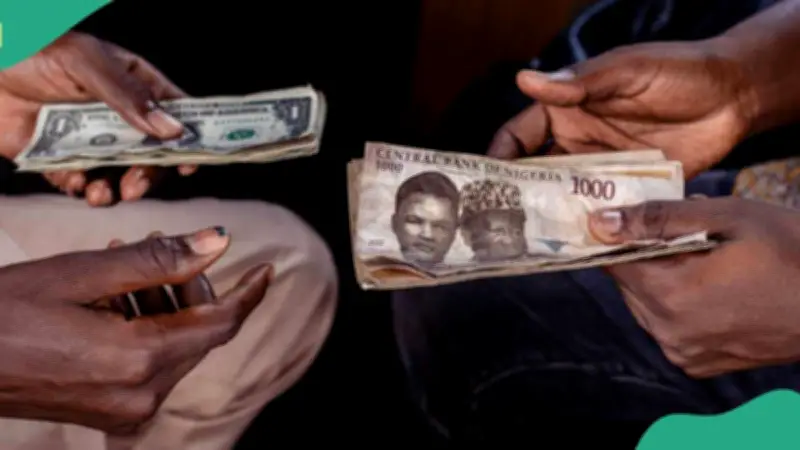
The naira appreciated to its strongest level in two years, trading at N1,331.77 per dollar in the official foreign exchange market on Wednesday, October 8, 2026, up from the previous rate of N1,340. Central Bank of Nigeria (CBN) data showed the local currency gained 24.68%, equivalent to N328.72, against the dollar from N1,660.49 recorded on October 18, 2024.
Parallel Market and Day-on-Day Movements
In the parallel market, the currency has recovered approximately N350 from its 2024 levels, representing a 25.55% gain. On a day-on-day basis, however, the naira traded at around N1,370 to the dollar on Wednesday, October 8.
The appreciation comes amid stronger dollar supply and improved market conditions, according to market analysts.
What Is Driving the Naira's Recovery
A report by FSDH Merchant Bank indicated that the naira strengthened from around N1,650 per dollar in December 2024 to N1,329 per dollar on September 24, 2026. FSDH analysts stated: "The appreciation reflects stronger autonomous FX supply, rising external reserves and improved confidence in the market-based FX framework." They added that exchange-rate volatility had moderated significantly compared with the turbulence seen in 2025 and early 2026.
CBN Deputy Governor Muhammad Sani Abdullahi, speaking at the 38th Seminar for Finance Correspondents and Business Editors, said the structure of inflows had shifted significantly. Of the $10.82 billion in total FX inflows recorded in July 2026, $7.33 billion, or nearly 68%, came from autonomous sources. Remittances through International Money Transfer Operators reached $950 million during the month, while net foreign portfolio inflows totalled $6.31 billion between January and August 2026.
Nigeria's gross external reserves stood at $55.60 billion as of September 11, 2026, with the end-August reserve position providing 11.3 months of import cover. Abdullahi also pointed to broader economic progress, with headline inflation falling to 15.43% in July 2026 from a peak of 34.8% in December 2024. Real GDP grew by 4.43% in the second quarter of 2026, driven mainly by non-oil activity.
Analysts Urge Caution Despite Gains
The naira's rally comes even as the Monetary Policy Committee cut the Monetary Policy Rate to 23% from 26.5%, recalibrating its asymmetric corridor while leaving the Cash Reserve Ratio and liquidity ratio unchanged. Coronation Merchant Bank cautioned that the rate cut should not be read as the start of a prolonged easing cycle, describing it instead as "a reset designed to restore the effectiveness of the monetary policy framework."
United Capital analysts warned that portfolio inflows, while beneficial, remain reversible. They said: "While stronger reserves and external balances provide policy flexibility, they do not eliminate Nigeria's vulnerability to shifts in global risk and investor sentiment."
CBN Announces Biggest Interest Rate Cut
Earlier, Legit.ng reported that the CBN reduced its benchmark interest rate by 350 basis points to 23%, the largest cut to the Monetary Policy Rate in the bank's history, in a move that could lower borrowing costs across the Nigerian economy. CBN Governor Olayemi Cardoso announced the decision on Tuesday, September 22, 2026, following a two-day sitting of the Monetary Policy Committee in Abuja. At its 307th meeting, the committee voted to bring the MPR down from 26.50% to 23%. Alongside the rate cut, the MPC agreed to recalibrate the Standing Facilities Corridor to +50/-300 basis points around the MPR.