
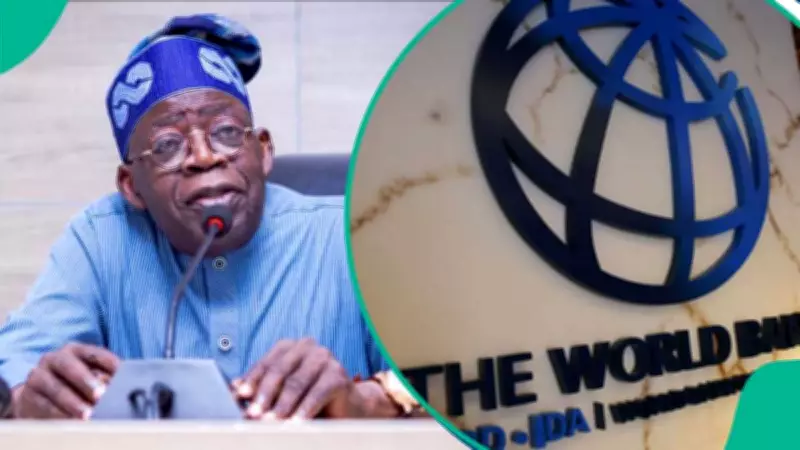
The Nigerian Economic Summit Group (NESG) has warned that Nigeria remains in a high-risk fiscal environment despite a slight decline in its debt burden index (DBI) in 2024. This caution comes as the federal government seeks a new $1.2 billion loan from the World Bank, sparking widespread criticism from economists and citizens alike.
NESG Report Highlights Persistent Fiscal Strain
In its latest Debt Burden Monitor report, titled 'Debt pressure persists beneath surface stability: DBI signals elevated fiscal strain in 2025', the NESG noted that Nigeria's fiscal position remains unstable due to rising debt service costs, declining revenue mobilization, and sustained debt financing. The report indicated that the DBI fell from 83.6 in 2023 to 70.9 in 2024, suggesting a slight reprieve in debt stress. However, the group emphasized that these gains reflect neither strong fiscal capacity nor broad-based reforms.
According to the NESG: 'Although, on face value, this indicates a decline in debt stress, these gains reflect partly the slight moderation in debt service stress and not in fundamental fiscal capacity of the Nigerian economy.' The group pointed out that Nigeria's public debt-to-GDP ratio rose from 37.4% in 2023 to 40.6% in 2024, driven by sustained government borrowing to bridge revenue gaps and close deficits.
The NESG projects persistently elevated debt pressure for 2025, with the DBI fluctuating within a high-stress band. The report stated: 'This pattern indicates that debt pressure has not structurally eased but instead fluctuates within a high-stress band.'
Expert Insight on Nigeria's Debt Level
The Debt Management Office reported that Nigeria's total public debt soared to N159.28 trillion by December 31, 2024, while government debt service obligations grew to approximately N16 trillion in the same period. Economist Bismarck Rewane described the debt burden as a major concern given the weak revenue base and increasing repayment obligations. He explained that borrowing is acceptable only if funds are invested in productive sectors that stimulate growth and enhance government revenue.
Rewane stated: 'The problem is not just borrowing, but what the loans are used for. If the money is invested properly in infrastructure, production, and economic expansion, it can support growth. But when revenues remain weak, debt pressure will continue to increase.'
Nigerians Appeal to World Bank
Meanwhile, Nigerians on social media have voiced strong objections to the proposed borrowing plan, calling on the World Bank to deny the loan request. They lamented increasing economic hardship, surging inflation, and lack of transparency regarding past loans. A user identified as @desirecrib stated: 'Stop borrowing the president of Nigeria money, he is looting the country into oblivion.' Another user, @benkill20018, said: 'Don't give them that money, Nigerians are suffering already.' @captbobby101 commented: 'Please do not approve any loan again. Nigerians are already struggling.' @realkinggdavid said: 'Please don't give Tinubu loan again please, people are suffering too much in the country.' @precious2291 pleaded: 'Please stop borrowing our president.'
10 States with Highest Foreign Debts
Earlier, Legit.ng reported that the National Bureau of Statistics revealed Nigeria's total external debt stock climbed to $51 billion (N74.43 trillion) in the fourth quarter of 2025. According to its latest public data report, Lagos State emerged as Nigeria's most indebted subnational government in terms of external borrowing, recording the highest external debt profile at $1.17 billion, far ahead of other states.




