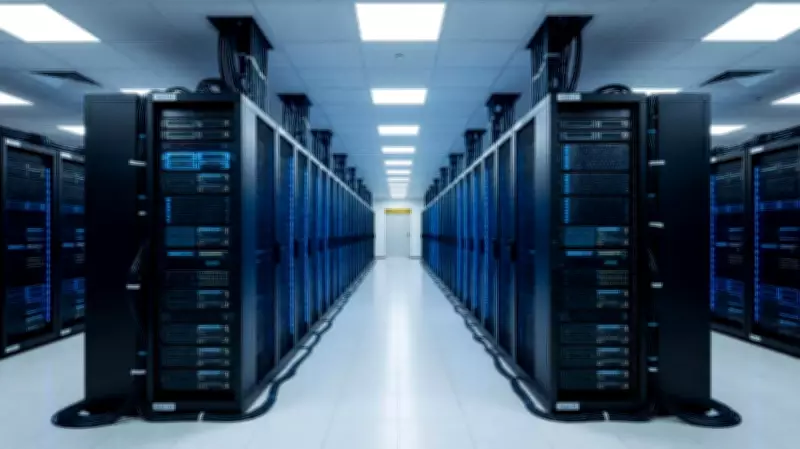
Establishing in-country data centres is the cornerstone of digital sovereignty. By keeping data within national borders, countries secure local legal jurisdiction, shield critical infrastructure from foreign interference, and accelerate domestic innovation, reports ADEYEMI ADEPETUN.
Nigeria's digital future is being written not in distant data hubs, but within its own borders. As the world accelerates toward an AI-driven economy, the question of digital sovereignty has become urgent: who owns the data, where is it stored, and under what laws is it governed? For Nigeria, the answer lies in building robust in-country data centres that anchor its digital ecosystem firmly on home soil, ensuring that its technological destiny is not outsourced but secured.
The implications stretch far beyond infrastructure. In-country data centres are the backbone of trust, resilience, and independence in the digital age. They safeguard sensitive information, reduce reliance on foreign servers, and create the conditions for Nigeria to harness artificial intelligence at scale. By localising data, Nigeria strengthens its ability to regulate, innovate, and protect its citizens' digital rights while laying the groundwork for industries to thrive in an AI-ready environment. This is more than a technical milestone; it is a strategic leap.
Analysts noted that deepening digital sovereignty through local data centres positions Nigeria as a continental leader in shaping Africa's digital economy. It signals a commitment to inclusive growth, national security, and technological competitiveness. In this move, Nigeria is not just catching up with global trends; it is defining its own path toward an AI-powered future that reflects its values, priorities, and ambitions.
For decades, Nigeria has faced a paradoxical digital reality: despite being a leading economy and a tech powerhouse in Africa, over 90 per cent of its data has been hosted on foreign servers. This reliance resulted in an estimated yearly capital flight of $850 million for cloud services alone, alongside significant latency issues and jurisdictional vulnerabilities. However, the commissioning of the Kasi AI data centre, among others, appeared to be a turning point.
Imperative for Digital Sovereignty in Nigeria
Digital sovereignty extends beyond data residency; it encompasses the nation's ability to govern its digital assets, protect citizen privacy, and retain economic value from data generation. The Nigerian government has recognised that without local infrastructure, the country cannot fully enforce the Nigeria Data Protection Act (NDPA) 2023 or the new General Application and Implementation Directive (GAID) 2025. Hosting data externally exposes national secrets, financial transactions, and personal data of citizens to foreign legal jurisdictions. Under the current legislative review by the National Assembly, there is a growing push for mandatory local storage of all public and financial sector data, treating data as a strategic national asset similar to oil or gas.
Current Data Centre Landscape
Before analysing the Kasi impact, it is essential to understand the existing baseline. As of early 2026, Nigeria operates approximately 21 to 22 major data centre facilities. They include Rack Centre, Equinix (formerly MainOne/MDXi), Open Access Data Centres (OADC), Africa Data Centres, Dabengwa Data Centre (owned by MTN), Digital Reality, Airtel's Nxtra, Galaxy Backbone, among others. The market is projected to grow from $322 million in 2025 to nearly $782 million by 2031, driven by cloud adoption and 5G rollouts. However, the sector suffers from two critical bottlenecks: geographic concentration and legacy limitations.
Today, more than 80 per cent of these facilities (approximately 19) are clustered in Lagos. In contrast, the Federal Capital Territory (Abuja) has only three, while the other 35 states have virtually zero colocation infrastructure. This creates latency for users outside the commercial capital. Before the Kasi launch, experts noted that while Tier III facilities in Nigeria excelled at cloud and enterprise IT, they were years away from supporting the high-density racks required for AI and real-time inferencing.
The Kasi Edge
Indeed, the unveiling of the Kasi Lekki Campus, backed by the Nigerian Sovereign Investment Authority, represents the most significant shift toward indigenous control of digital assets in West Africa. Unlike standard cloud data centres, this facility was engineered specifically to anchor AI workloads within Nigerian borders. The Kasi facility is designed to reach 100MW of critical IT capacity at full build-out, with the initial phase (LOS1) immediately operational. This is a massive expansion of the current 30MW national installed capacity. It is officially designated as West Africa's first AI-ready hyperscale data centre. This allows Nigerian startups and banks to train and run AI models locally instead of using foreign GPUs. The facility guarantees sub-50 milliseconds latency for local workloads, enabling real-time applications like autonomous fintech fraud detection that were previously impossible due to the round-trip to Europe or the U.S.
Located on four hectares in Lekki, the campus sits adjacent to six subsea cable landing systems (including Equiano and 2Africa). This carrier-neutral positioning allows it to act as a true internet exchange point, reducing the cost of bandwidth. Founder and CEO of Kasi Cloud Datacenters, Johnson Agogbua, said: For too long, Africa's data has powered someone else's economy. Today, that changes. This flag-off marks the transition from development into commissioning and operational readiness — as we deliver world-class sovereign cloud and AI infrastructure, built in Lagos, for Africa's digital future.
Economic Impact on Sovereignty
The flagship benefit of the Kasi centre is its ability to stop capital flight. By providing an institutional-grade, locally owned alternative, it allows companies to pay in Naira (avoiding FX volatility) while keeping revenue within the Nigerian economy. The government estimates this will recapture a significant portion of the $850 million lost yearly to foreign cloud providers. The Minister of Finance and Coordinating Minister of the Economy, Taiwo Oyedele, at the unveiling, emphasised the need to strengthen national data sovereignty. He described the project as sovereign infrastructure, adding that it marked a strategic choice for the country. We cannot remain consumers of artificial intelligence, paying foreign exchange to access AI capability hosted abroad. We can become producers, hosts, and builders of the infrastructure powering the next-generation economy. Today, with Kasi Cloud, Nigeria has made that choice, he said. When the story of Nigerian digital transformation is written, history will remember today as the moment we stopped exporting raw potential and started building the infrastructure to process that potential at home, the minister added.
The launch of Kasi is not occurring in a vacuum but as part of a broader Sovereign Cloud Initiative. The Nigerian Sovereign Cloud project, backed by NITDA, encourages government agencies and banks to migrate to local infrastructure. The recent partnership between Galaxy Backbone and the iHatch programme offers subsidised cloud credits to startups, specifically shielding them from the dollar-denominated costs of AWS or Azure. In collaboration with the International Data Centre Authority (IDCA), Nigeria has initiated a three-year master plan to move beyond Lagos. The NDT aimed to build interconnected hyperscale clusters across the geopolitical zones, ensuring that the $1.9 billion market opportunity serves the entire nation, not just the coast.
Challenge of Power and Decentralisation
Despite the optimism, two structural challenges threaten to bottleneck this progress. First, there is a power supply crisis. Data centres are essentially factories for electricity consumption. However, Nigeria's national grid struggles with availability (historically supplying only 41 per cent of required uptime) and frequently collapses. Second, there is the cost of autonomy. Operators like Kasi must over-invest in captive power. To guarantee uptime, facilities rely on redundant gas generators and solar hybrids. Industry reports indicate operators are spending approximately $1 million per MW on backup generation just to bridge the grid gap. While there is a push for solar, the sheer density of AI servers requires base-load power that gas turbines currently provide. Without grid reform, a significant portion of the revenue generated by the sector will be eaten by diesel/gas costs, raising prices for end-users.
Though Lagos is now AI-ready, the rest of the country is not. To realistically support a $1 trillion economy, industry leaders estimate Nigeria requires at least 72 edge data centres (two per state). Currently, state capitals outside Lagos lack the fibre ring infrastructure or reliable power to support even Tier II facilities.
Future Beckons
The inauguration of the new data centres has effectively retired the excuse that Nigeria lacks the hardware for digital sovereignty. For the first time, a major African economy has the onshore capability to host AI, high-frequency finance, and government records under its own jurisdiction and legal protection. The Governor of Lagos State, Babajide Sanwo-Olu, at the unveiling, said the project demonstrated what could happen when ambition, technical excellence, and institutional backing come together. What we are commissioning today is proof that ambition coupled with technical excellence and institutional backing truly delivers, he said. Sanwo-Olu said Lagos had become the heartbeat of Africa's digital economy, producing many of the continent's most successful startups, but noted that much of that growth had depended on foreign infrastructure. For too long, African innovation has depended on infrastructure built elsewhere. Our startups are built here, but they are hosted abroad. Our businesses generate data here, but process it elsewhere. That model may have survived in the early Internet era, but it will not sustain the AI economy we see today, he said. He also highlighted the project's employment potential. Beyond technology, this project is also about jobs and skills, he said.
However, industry analysts posited that sovereignty is not just about storage; it is about access. To fully realise this opportunity, they said Nigeria must aggressively pursue two parallel paths: first, decentralising infrastructure to the 72 required nodes to avoid a digital Lagos-only reality, and secondly, solving the energy trilemma by designating data centres as critical national infrastructure eligible for dedicated power plant support. If these challenges are met, Nigeria will not only host its own data but will become the data hub for the entire West African region, they stated.