
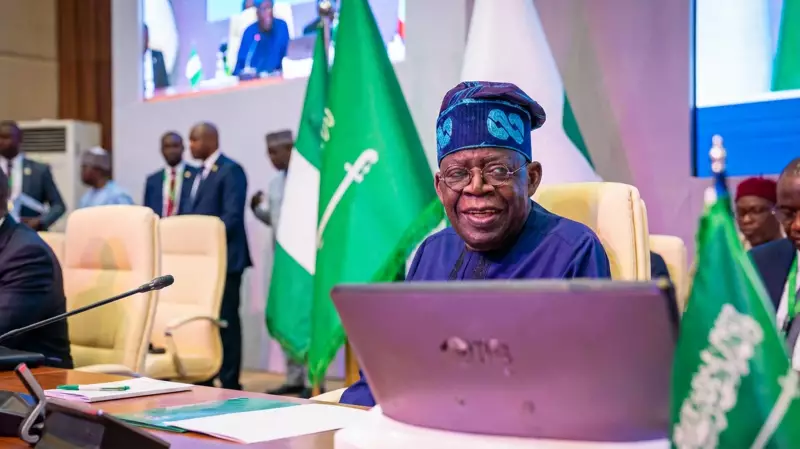
President Bola Ahmed Tinubu has projected that Nigeria's newly activated carbon market holds the potential to generate a substantial $2.5 billion to $3 billion in revenue every year for the next decade. This ambitious forecast was presented as a core strategy to mobilise critical climate finance and accelerate the nation's energy transition.
Unlocking Billions in Climate Finance
President Tinubu made this revelation on Tuesday, January 13, 2026, while speaking at the Abu Dhabi Sustainability Week. The event, themed “The Nexus of Next: All Systems Go,” gathered world leaders and investors. Tinubu positioned Nigeria at the heart of a major development opportunity, linking climate action with economic growth.
He detailed that the federal government has launched a comprehensive climate and green industrialisation investment plan designed to unlock between $20 billion and $30 billion in annual climate finance. To achieve this, a series of regulatory and governance steps have been taken to strengthen the framework for low-carbon investments.
Policy Foundations and Institutional Backing
The push to establish a credible carbon market is anchored on two key pillars: the National Carbon Market Activation Policy and the operational National Carbon Registry. According to the President, these instruments are crucial for improving the reporting, verification, and transparency of emissions reductions, thereby making Nigerian carbon credits attractive to international buyers.
He outlined the sequential steps already taken by his administration:
- October 2025: Approval of the National Carbon Market Framework, which sets clear rules for carbon credit registration, issuance, and verification.
- November 2025: Operationalisation of the Climate Change Fund and the restoration of the National Council on Climate Change to the federal budget.
Tinubu explained that the carbon market will financially incentivise projects that cut emissions across vital sectors. These include:
- Forestry and agriculture
- Renewable energy development
- Clean cooking initiatives
This approach is expected to create new revenue streams for local communities and businesses while tackling environmental challenges.
Energy Access and Broader Financing Initiatives
On energy sector reforms, President Tinubu pointed to the Electricity Act of 2023 as a transformative law. It permits decentralised electricity generation and distribution, paving the way for inclusive energy access. This is particularly impactful for rural communities, off-grid health facilities, schools, and markets that have been historically underserved.
“Nigeria recognises the urgent need to deploy and advance technologies to improve green efficiency, modernise infrastructure, and accelerate the delivery of sustainable energy to underserved areas,” he stated.
The President also highlighted several major financing initiatives tied to Nigeria's climate agenda:
- A climate investment platform targeting $500 million for climate-resilient infrastructure.
- A national climate platform aimed at mobilising $2 billion in capital investment.
- A $50 billion sub-regional green bond, which he noted was oversubscribed by an impressive 97.7%.
He acknowledged the role of multilateral partners, citing a $750 million World Bank programme to expand clean electricity access to over 17.5 million Nigerians.
The Path to Net-Zero by 2060
Tinubu framed Nigeria's energy transition plan as an integrated framework that combines climate mitigation, industrial growth, and social development. The overarching goal is to achieve net-zero emissions by 2060 while simultaneously ensuring universal access to energy for all citizens.
The President called on developed nations to deepen partnerships with Nigeria through technology transfer, knowledge exchange, and innovation. He emphasised that “the adoption of artificial intelligence to optimise efficiency is no longer a matter of the future.”
This announcement aligns with Nigeria's updated climate commitments submitted to the United Nations in September 2025, which reinforced the nation's intention to use market-based mechanisms like carbon trading to meet its emissions targets without stifling economic growth.




