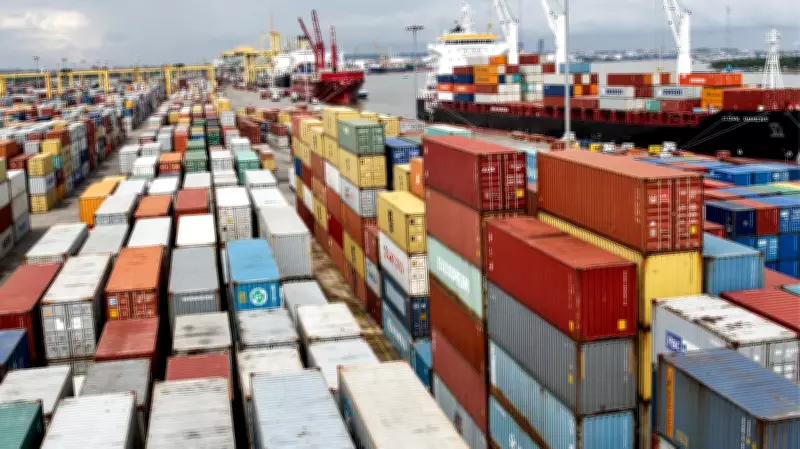
Freight forwarders have strongly criticized the sale of empty containers in United States dollars at Nigerian ports, especially as the Federal Government ramps up efforts to stabilize the economy and bolster the Naira. The condemnation follows an advertisement by Grimaldi Group, a shipping company operating in Nigeria, offering empty containers for sale in USD, with 40-foot units priced at $2,000 and 20-foot units at $1,600.
APFFLON's stance on dollarisation
The Africa Association of Professional Freight Forwarders and Logistics of Nigeria (APFFLON) described the foreign currency sale as a direct affront to Nigeria’s economic stability and a contradiction to the Federal Government’s Renewed Hope Agenda. The dollarisation of logistics services in the maritime sector has faced ongoing resistance from port users, who argue it violates the Coastal and Inland Shipping (Cabotage) Act and undermines economic stability.
CBN de-dollarisation policy
The Central Bank of Nigeria (CBN) de-dollarisation policy, effective May 1, 2026, mandates all local transactions for goods and services to be settled in Naira to stabilize the foreign exchange market. Although the CBN granted exceptions for the oil and gas and maritime sectors to transact in dollars under strict documentation requirements, APFFLON contends that the sale of empty containers does not justify such pricing.
In a statement signed by its National President, Frank Ogunojemite, APFFLON expressed concern that a company operating within Nigeria would denominate local transactions in foreign currency during a critical period. The group stated: “The sale of empty containers—assets physically located within Nigeria—has no justification whatsoever to be priced in U.S. Dollars. This form of dollarisation of domestic transactions is economically disruptive, anti-local content, and clearly out of tune with the realities faced by Nigerian businesses, importers and freight forwarders who earn revenues in Naira.”
Call for government intervention
APFFLON viewed this development as an act capable of sabotaging the Federal Government’s Renewed Hope Agenda, particularly its focus on economic recovery, currency stabilisation, and reduction of dependence on foreign exchange. The group warned that if unchecked, such practices will continue to erode the value of the Naira and weaken the resilience of Nigeria’s maritime and logistics sector.
They called on the Federal Government, the Central Bank of Nigeria, and the Nigerian Shippers’ Council to immediately intervene by enforcing strict compliance with policies that mandate the use of Naira for all local transactions. According to them, regulatory clarity and enforcement are urgently required to prevent further economic distortions.
APFFLON urged all industry stakeholders to act responsibly and align their business practices with national economic priorities, noting that Nigeria’s economic recovery is a collective responsibility. The association reaffirmed its commitment to protecting Nigeria’s interests and ensuring the maritime industry contributes positively to national development.