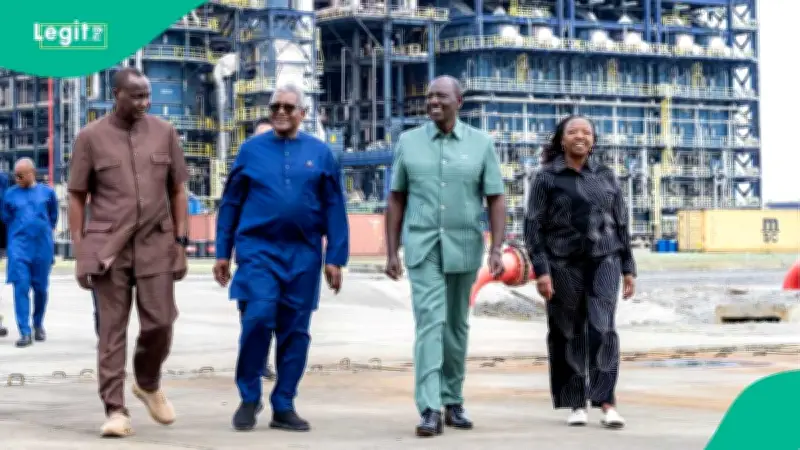
Kenyan President William Ruto has toured the Dangote Petroleum Refinery in Lekki, Lagos State, ahead of the groundbreaking ceremony for a new Dangote refinery in Lamu, Kenya, with the project expected to create about 60,000 jobs when completed.
Ruto visited the Nigerian refinery on Friday, September 25, 2026, at the invitation of Dangote Group President and Chief Executive Officer, Aliko Dangote. The visit came just days before Kenya is expected to break ground on the proposed Dangote East African Refinery in Lamu on September 30.
Ruto Praises Lagos Refinery as Model of Collaboration
Sharing details of the visit on his official X account, Ruto described the Lagos refinery as an example of what African governments, private investors and financial institutions can achieve through collaboration. The Kenyan president said the Nigerian facility has a crude refining capacity of 700,000 barrels per day and produces more than 100 million litres of petrol, diesel and aviation fuel daily.
The Dangote refinery is located within the Lekki Free Zone and is currently Africa's largest single-train crude oil refinery. Its processing capacity stands at 700,000 barrels per day, with Dangote planning an eventual expansion to 1.4 million barrels per day. The complex is more than a conventional refinery, as it combines crude processing, storage, marine infrastructure, pipelines, petrochemicals and logistics facilities.
Kenya's Refinery Targets 60,000 Jobs
For Kenya, the Lamu project is being positioned as a similar industrial development with implications extending beyond fuel refining. The planned Dangote refinery in Lamu is expected to have a refining capacity of 700,000 barrels of crude oil per day, making it one of the largest refinery projects in Africa and the biggest planned refinery in East Africa. The project is expected to be developed within the Lamu Port-South Sudan-Ethiopia Transport (LAPSSET) corridor.
Ruto said the refinery would transform Kenya's petroleum industry by improving fuel reliability and security, supporting industrialisation and creating about 60,000 jobs. The refinery is also expected to trigger new businesses around petroleum processing. Ruto said industries linked to fertiliser production, chemicals and packaging could emerge as spin-off businesses once the facility is completed.
Regional Supply and Construction Challenges
The Kenyan government expects the refinery to strengthen domestic energy security while supplying petroleum products to markets across East and Central Africa. Construction is expected to take several years after the September 30 groundbreaking.
The project also faces the challenge of securing sufficient crude supplies. Analysts have raised questions about whether regional oil production from Kenya, Uganda and South Sudan will be enough to keep a 700,000-barrel-per-day refinery operating at full capacity.
Ruto's tour of the Lagos facility therefore comes at a significant moment as Kenya prepares to begin work on its own large-scale refinery, with the project expected to combine fuel production, industrial development and tens of thousands of jobs.