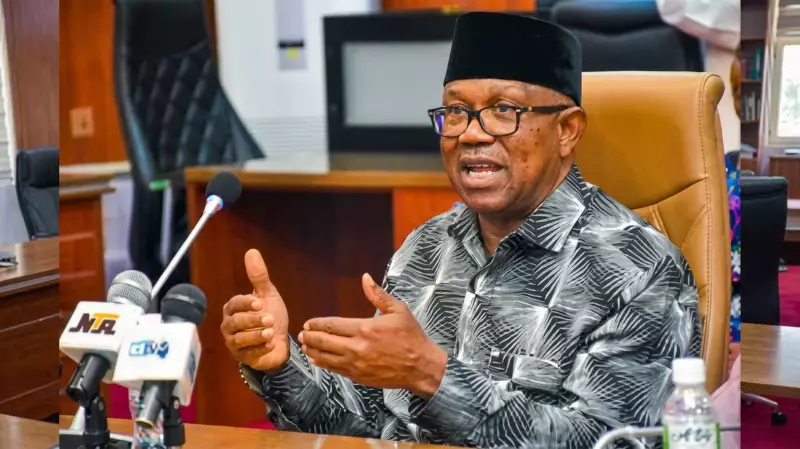
Former presidential candidate and Labour Party leader, Peter Obi, has issued a strong call for the Nigerian government to immediately suspend the implementation of a controversial new tax law. He warns that the legislation contains numerous critical errors that could undermine citizens' trust and destabilize the nation's economy.
KPMG Report Reveals 31 Critical Problem Areas
In a statement made on his official X (formerly Twitter) handle on Tuesday, 13 January 2026, Obi drew public attention to a damning review conducted by the professional services firm, KPMG. The report allegedly identified 31 major problem areas within the newly passed tax legislation.
According to Obi, these flaws are not minor. They encompass a range of serious issues including:
- Drafting errors and ambiguous language.
- Contradictions in policy objectives.
- Significant gaps in administrative procedure.
Obi raised a red flag regarding the transparency of the process, noting that these critical findings were only discussed in private consultations between KPMG and the National Revenue Service. This lack of public disclosure, he argued, leaves ordinary Nigerians in the dark about laws that directly impact their finances.
Taxation as a Broken Social Contract
Peter Obi framed his argument around the core principle of taxation as a social contract. "Taxation is more than fiscal policy; it is a social contract between the government and its citizens," he stated. "You cannot enforce a social contract that isn't understood, trusted, or justified by tangible public benefits."
He contrasted Nigeria's approach with effective global systems, where tax revenue is visibly linked to improvements in public services. "In Nigeria, the focus has shifted toward extracting more from citizens, without clearly explaining what they will gain in return," Obi contended. He pointed out that standard practice worldwide involves extensive consultation with businesses, workers, and civil society before finalizing tax laws, a step he claims was missing in this instance.
The former Anambra State governor warned that rolling out this flawed tax regime amidst a severe cost-of-living crisis marked by soaring prices for food, transport, and essentials is a recipe for disaster. It risks deepening public confusion and eroding trust in government institutions. "Without clarity, trust, or evident public value, taxation feels like punishment—and for ordinary Nigerians, it may feel like robbery," Obi said bluntly.
A Call for Consensus and a Path Forward
In his conclusion, Peter Obi urged the federal government to pause implementation, listen to the concerns of citizens, and engage in effective communication to build a national consensus. He emphasized that responsible governance requires justifying how public funds will be used for the collective good before demanding more from already strained pockets.
"A new Nigeria is not just possible—it is imperative," he asserted, linking the resolution of this issue to the broader project of national renewal.
In related news, Peter Obi also emphasized the transformative role of education during the foundation-laying ceremony for the Sacred Heart Primary and Secondary School in Ozubulu. Alongside Papal Nuncio Archbishop Jude Thaddeus Okolo, Obi described education as a powerful tool for shaping society and pledged a monthly subvention to support the project's completion, aiming to provide quality learning for children with limited opportunities.