
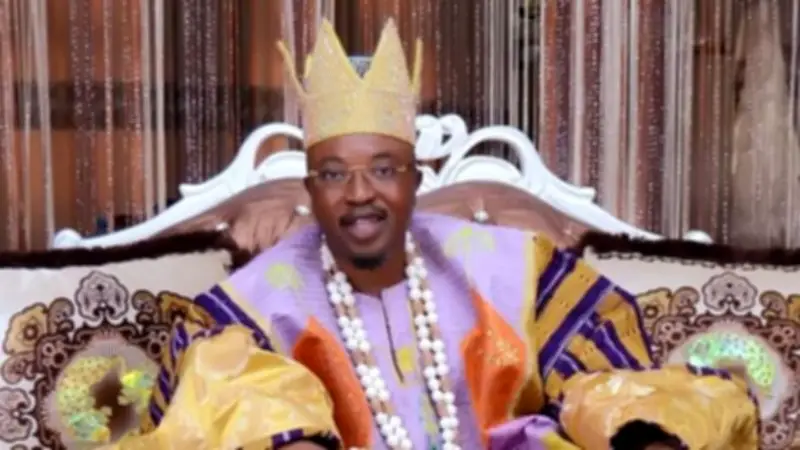
The Oluwo of Iwo, Oba Abdulrasheed Akanbi, has issued a sweeping ban on alcoholic beverages, including Hennessy, within his palace, asserting that such drinks pose severe health risks and should never be presented to him or other elders. The monarch's declaration, made in a video shared on his official Facebook page on Tuesday, carries a stark warning: anyone who brings alcohol to the palace is effectively seeking to "eliminate the king."
Health Concerns Behind the Ban
Oba Akanbi elaborated on the health rationale, stating that the gin, schnapps, and imported spirits traditionally reserved for elders are detrimental to their well-being. He described these beverages as lethal weapons disguised as hospitality.
"The so-called alcohol usually presented or reserved for the elders is detrimental to their health – it leads to death," he said. "Anyone who brings hot drinks to the king's palace wants to eliminate the king. Gin, schnapps reserved for the elderly should not be brought to my palace because what they call alcohol for the elderly is made by the Western people to kill and destroy internal organs. It will render the kidneys useless."
The traditional ruler revealed that he had recently learned of an attempt to bring Hennessy into the palace, a move he interpreted as a direct threat. "I heard you brought Hennessy; don't bring it here o; you want to kill me. Anyone who brings Hennessy or other dangerous alcoholic drinks has the intention to kill me. So, I should drink an entire bottle; what will I use to pray?" he asked.
Alcohol Not Part of Yoruba Tradition
Oba Akanbi argued that alcohol is not an authentic component of Yoruba ancestral practices, challenging a long-held cultural norm. His stance aligns with global health guidance; the World Health Organisation (WHO) has stated that "no level of alcohol consumption is completely safe for health," a point that bolsters his position.
Health experts have consistently warned about the dangers of excessive alcohol consumption, linking it to liver disease, kidney damage, and a host of other chronic conditions. The Oluwo's ban underscores a growing awareness of these risks even within traditional institutions.
Criticism of Other Traditional Practices
Beyond alcohol, the monarch used the opportunity to condemn violent aspects of Yoruba cultural practices, particularly the use of canes by masquerades to beat people on the streets. He described such actions as outright violence and questioned their place in a modern society.
"Are Yoruba cows? How can I be a king and people are being macheted in the streets? Are we butchers?" he asked, calling for adherents of traditional religion to eliminate violent practices to gain wider acceptance.
Oro Festival Restrictions Under Fire
Oba Akanbi also criticized the restriction of movement during the Oro festival, labeling it unconstitutional and illegal. He questioned why women should be barred from moving freely during certain traditional festivals, a practice he deemed discriminatory.
"We restrict people's movement; even the president cannot do that. It is unconstitutional. It is illegal," he asserted.
Since ascending the throne in 2016, the Oluwo of Iwo has been a vocal critic of various traditional and cultural practices in Yorubaland, often sparking controversy. He has frequently clashed with religious and traditional leaders, leading to his suspension by the Osun State Council of Traditional Rulers for alleged improper behavior toward fellow monarchs. In response, Mr Akanbi dismissed the suspension as "a mere audio pronouncement," signaling his continued defiance.