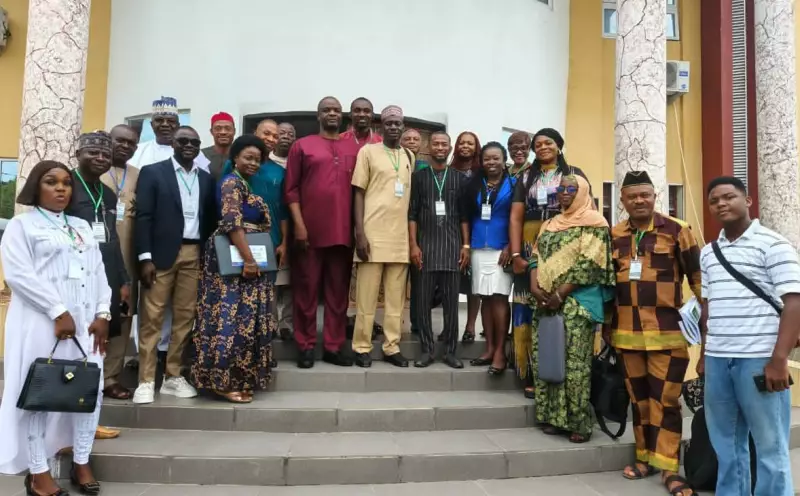
Communication scholars across Nigeria have issued a powerful call to action for the revival and strengthening of Africa's Indigenous Knowledge Systems (IKS). This urgent appeal was the central resolution at the 26th international conference of the African Council for Communication Education (ACCE) Nigeria chapter.
Conference Highlights Asymmetry in Global Knowledge
The conference, themed 'Communication and Indigenous Knowledge Systems in the era of AI, big data and cultural transformation,' was held at the University of Calabar, Cross River State. In his address, the National President of ACCE-Nigeria, Prof. Abdullahi Bashir, presented a critical analysis of the current academic landscape.
He observed that communication scholarship and practice are largely filtered through a Western lens. This includes Western ideas, theories, behaviours, and languages, which create an asymmetrical relationship with African indigenous knowledge rather than a balanced, symmetrical one.
Prof. Bashir pointed to the rich ideas, theories, and practices within Nigeria's indigenous cultures. He noted that many Asian societies have successfully integrated their own indigenous knowledge into sciences, humanities, and technologies, a model Africa should emulate.
IKS at a Crossroads: Marginalization and Renaissance
The scholars acknowledged that despite the valuable contributions of African ethno-communicologists and journalists using indigenous languages, IKS in Africa remains in a marginal state. However, they identified a potential turning point driven by global developments.
Prof. Bashir stated that phenomena like the rise of social media, Artificial Intelligence (AI), Big Data, climate change, and global health challenges are ironically fostering a renaissance for IKS. These global forces create both a need and an opportunity to re-examine and strengthen indigenous knowledge frameworks.
Key Resolutions and the Path Forward with AI
In a formal communique, the conference participants outlined concrete steps for scholars and practitioners. Their primary resolution is that communication experts must actively revive and strengthen Africa's IKS to preserve and sustain African culture for future generations.
The scholars addressed the role of modern technology directly. They resolved that while AI has transformed the knowledge industry, it has not erased indigenous practices. Therefore, AI should be harnessed to preserve and promote Indigenous Knowledge Systems.
To achieve this, the conference made several critical recommendations:
- African scholars must intensify research in IKS, document their findings, and publish them to expand the AI database in traditional communication and culture.
- Editorial control must be applied to AI-generated content through rigorous fact-checking traditions.
- Academics must vigilantly identify and counter bias, sentiment, and misleading tendencies in AI, especially when portraying cultures and ethnic groups.
- Universities should develop interdisciplinary curricula that embed indigenous philosophies and languages into AI and media studies.
- Collaborative partnerships between local communities, universities, and tech firms must be institutionalized to translate indigenous knowledge into applied AI design.
The conference concluded with a clear mandate: as global technological tides rise, Africa must anchor itself in the rich, sustaining wisdom of its own heritage, using new tools not to erase the past, but to secure its future.