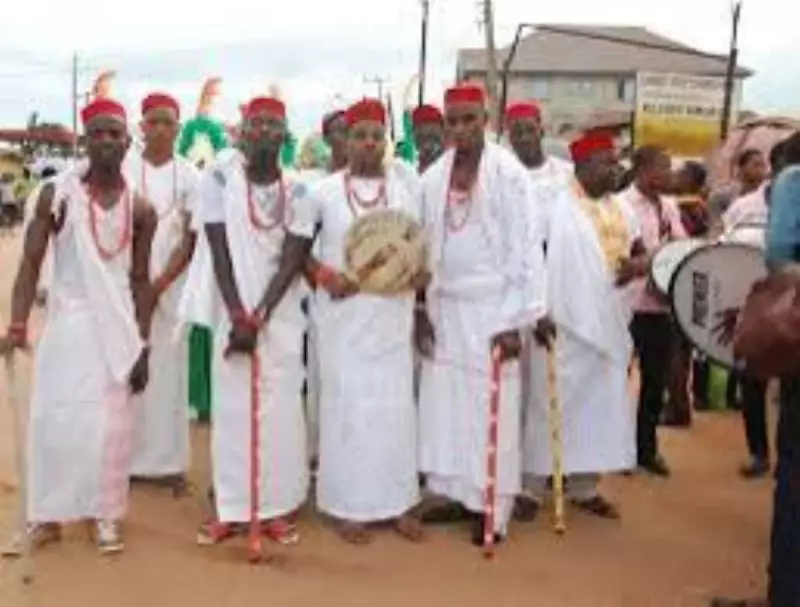
A prominent traditional ruler in Delta State has made a definitive statement on the long-debated origins of the Anioma people, firmly placing their ancestry within the Igbo nation of Nigeria's South East.
Setting the Record Straight on Anioma Identity
The Obuzor of Ibusa, Prof. Louis Nwaobishi, has publicly affirmed that the Anioma people of Delta North are unequivocally Igbo. He presented evidence drawn from shared history, language, and cultural practices to support this claim. His declaration comes as a direct response to recent contrasting views, notably from the Asagba of Asaba, Prof. Epiphany Azinge, who had disputed the Igbo lineage of the Anioma and specifically denied Asaba's migration from Nteje in Anambra State.
Prof. Nwaobishi described the Igbo identity of the Anioma people as "unbreakable." He traced the root of the present-day identity confusion to a deliberate act of colonial punishment following the fierce Ekumeku resistance against British rule. He argued that the current crisis in parts of Delta North is a direct continuation of the consequences of the 1939 boundary demarcation.
The 1939 Boundary: A Colonial Punishment
Linking past events to the present, the monarch explained that the British administration never forgave the people for the Ekumeku War, which lasted from 1898 to 1914. "The British never forgave us for the Ekumeku resistance because we fought them harder and longer than any other group west of the Niger," Nwaobishi stated.
He detailed that when regional boundaries were drawn in 1939, it was a retaliatory act. The colonial authorities deliberately carved out all Igbo-speaking communities located west of the Niger River from the Eastern Region and placed them into the Western Region. This move, he insisted, was designed to punish the people and fracture Igbo unity.
"The true East–West boundary was supposed to be far beyond Abudu in present-day Edo. The boundary between North and West is not the River Niger, just as the boundary between North and East is not the River Benue. Yet they used the Niger as a knife to split our people," the Obuzor lamented.
A Historical Struggle and Unifying Culture
The traditional ruler revealed that the agitation for the Anioma to be reconnected with their Igbo kin began long before Nigeria's independence, between 1938 and 1939. "Our fathers started protesting immediately. Traditional rulers from Aboh, Ibusa, Isele-Uku, and even Agbor were already writing petitions demanding that we be returned to our Igbo brothers in the Eastern Region," he recounted.
He clarified that he is not a pioneer but a continuator of this legacy. Following the civil war, as other Igbo areas solidified their identities, the people of the region coined the name 'Anioma' from the amalgamation of Aniocha, Ndokwa, Ika, and Oshimili to foster unity. In 1980, Nwaobishi personally founded a cultural organisation to protect and project this shared identity.
He commended Senator Ned Nwoko, who represents Delta North, for resuming the struggle, noting that the lawmaker's father was among the early agitators in 1939. "The struggle is in his blood," Nwaobishi said.
Addressing the recent controversy on Asaba's origin, the Obuzor expressed shock at claims denying the Nteje connection. "Asaba is a direct child of Nteje," he asserted firmly. He cited previous Asagbas, including the late Prof. Chike Edozien, who had publicly acknowledged this origin during visits to Anambra monarchs.
He provided compelling cultural evidence to substantiate the common ancestry:
- Identical eight-quarter (ezi) system
- The Olieze title
- Coronation rites
- The Ijele masquerade
"Nnebisi was the third son of Eze Nteje through Diaba, granddaughter of Eri. This is not a matter for debate; it is settled history among serious custodians of Anioma and Igbo tradition," he stated.
In his concluding remarks, Prof. Nwaobishi warned against what he termed "political revisionism," urging people not to rewrite history due to contemporary politics or fear of regional labelling. "Whether in Delta, Anambra, Ebonyi, Imo, or Rivers, the language, names, culture, and ancestors are the same," he emphasized.
He called for unity: "It is time to awaken and embrace your brothers. We are one people. Nteje remains the mother, Asaba remains the child. Ibusa, Ogwashi-Uku, Ubulu-Uku, Aboh, Illah, Ebu; we all are traced to the same Igbo east, 100 per cent. Let us stand together and correct the injustice of 1939."