Malian Griots and Hip-Hop: The Unbroken Thread of African Oral Storytelling
For centuries, the rich tradition of oral storytelling in Africa has served as a vital conduit for preserving history, critiquing authority, and shaping community identity. In Mali, griots, known as jeliw, have long been the custodians of this legacy, using song and performance to weave dynastic histories and moral values into the fabric of society. Their role extends far beyond mere entertainment; they are living archives, binding memory to rhythm and transforming words into heritage that spans generations. Similarly, hip-hop, emerging from the streets of the Bronx and thriving in places like Ajegunle, Lagos, continues this tradition in new forms, narrating struggles, resistance, and aspirations with a similar urgency. Together, these traditions reveal the persistence of oral storytelling as an archive, a critique, and an anthem, demonstrating that form is never neutral but always charged with meaning.
The Griot's Legacy: Living Archives and Mediators
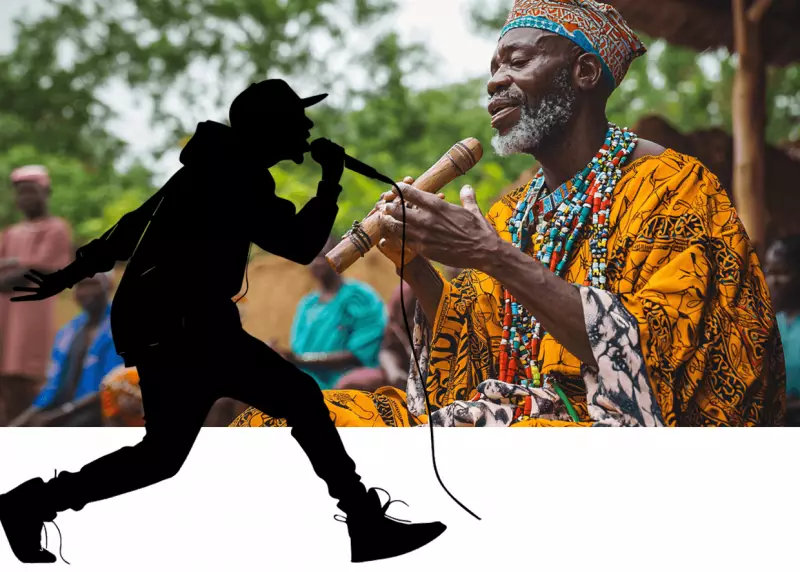
Imagine a griot in Mali, seated with a kora, his voice resonating with the genealogies of kings and the ethical lessons of centuries. These performers are not historians in the written sense but dynamic repositories of community memory. They preserve royal lineages, historical events, and cultural values through orature—spoken word, chant, melody, and rhythm. The griot's authority stems from this deep-rooted memory, making every performance a renewal of continuity that links present generations to their ancestors. Moreover, griots serve as mediators in courts, praising rulers while also offering critiques, reminding them of their duties to justice. This dual role underscores the principle that memory itself is power, and their words carry weight because they are anchored in tradition and truth.
Hip-Hop's Emergence: A Modern Echo of Ancient Traditions
Now shift to the Bronx in the 1970s, where amid poverty and neglect, young people carved out new forms of expression through hip-hop. At block parties, DJs looped breakbeats, MCs rhymed over them, and dancers spun on cardboard, transforming oppression into rhythm. Hip-hop became a tool for survival and creativity, with rappers acting as chroniclers of daily life. Their verses, much like griot chants, narrate street genealogies—who lived, who died, and who thrived—preserving realities often ignored by mainstream society. This tradition of resistance and memory found fertile ground in Nigeria, particularly in Ajegunle, Lagos, where artists fused global rhythms with local realities, telling stories of hardship and aspiration. Ajegunle stands as proof that African oral traditions did not vanish with colonization or urbanization; instead, they adapted and reemerged, echoing griot legacies in new, vibrant forms.
Parallels and Adaptations: From Kora to Beat Machine
The parallels between griots and hip-hop artists are striking and profound. The griot's kora evolves into the rapper's beat machine, while praise songs for kings transform into protest anthems for the marginalized. Oral genealogies give way to oral innovations, threading memory into rhyme. Both traditions understand that rhythm carries weight, identity, and philosophy, turning performance into preservation. Hip-hop did not emerge in a vacuum; it drew from African diasporic performance traditions, with influences from funk, soul, and jazz. Figures like James Brown, with his call-and-response rhythms, and Michael Jackson, with his assertions of identity, extended griot traditions into modern forms. Even Muhammad Ali, through his poetic boasts, embodied griot-like qualities, showing how verse can be a source of power.
Global Spread and Technological Evolution
Today, hip-hop is a global phenomenon, from Dakar to Johannesburg and Ajegunle to Atlanta, serving as a platform for voices otherwise unheard. Artists like Senegalese rapper Didier Awadi invoke Pan-African heroes, while Nigerian musicians blend hip-hop with Afrobeats, exporting rhythms worldwide. This adaptability mirrors that of griots, who could adjust their stories to different contexts, from royal courts to village gatherings. Both traditions rely on technology to amplify their voices: for griots, it was instruments like the kora or drum; for hip-hop, it is turntables, samplers, and now smartphones and streaming platforms. Yet, the principle remains that technology is never neutral—it shapes meaning and frames narratives, reminding us that form carries philosophy.
Resistance and Continuity: The Power of Voiced Memory
In both griot and hip-hop traditions, memory resists erasure. Griots preserved lineages against the forgetting of time, while hip-hop artists preserve stories against the erasure of poverty, racism, or neglect. The act of speaking, rhyming, or chanting is itself an act of resistance, which is why governments have often feared both griots and rappers. They speak truths that unsettle power and hold rulers accountable, whether kings or presidents. From the strings of the kora to the loops of the sampler, from dynastic praise songs to protest anthems, the unbroken thread of oral storytelling endures. It reminds us that history is alive in every beat, verse, and chant, and that when memory is voiced, it carries immense power.