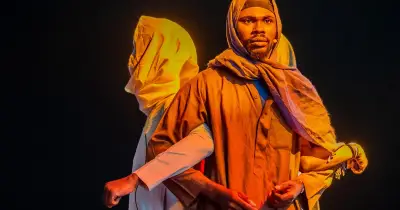
Salmah Salam Oiza's poetry chapbook, Foreign in a Long Familiar Leap Year, delves into the journey of self-discovery and the unfamiliar. Sometimes, not even the prophet or oracle can predict what lies ahead. One must navigate the bend to see for themselves. What they find—familiar or strange—depends on how they shape it. Oiza's work meditates on an outward journey into the unknown, a quest many yearn for but few attain. When she arrives at her destination, the question remains: what next? No one is sure what the other side of the great quest holds until they get there.
The Japa Phenomenon and Personal Growth
In an era where 'japa'—the Nigerian term for emigration—is synonymous with survival, Oiza crafts poetic pieces that stir the soul. Her journey is not for survival but for growth, a yearning for something sublime. From January to December, she takes special notes of her being, observing how time stretches infinitely outward. She becomes a spectator watching herself perform in her growth journey.
January: A One-Way Ticket
In January, the poet persona sets out on her trip abroad. Mid-air, unease invades her being about the correctness of her decision. Gradually, she settles in, and 'Heathrow appears. A slick cathedral of runaway and ice, her God is motion, security check and silent tears. I have become a woman fluent in departures.' She has left a lifetime behind, and uncertainty about the future gnaws at her, inducing tears. 'January is a one-way ticket, in disguise,' as she watches 'home vanish before me.'
February: The Indecisive Month
February finds her trying to get used to her new environment, but settling down is hard. 'February just can't make up its mind.' The fickle weather and all it stands for unsettle the newcomer. Coming from sunny Abuja, Nigeria's warm weather, the discomfort is palpable: 'The sun forgets it owes us more than one cheap kiss of warmth.' In frustration, she calls February 'you indecisive bastard! Just like Basquiat, you never make up your mind.'
Mother Calls on the 29th
February 29 makes a particular year a leap year. Precisely then, her mother calls, longing to have her daughter back to fulfill feminine obligations like marriage and family. But the poet persona is lost in her journey to the center of the world. The mother screams, 'This is not the plan. One year. A degree. Then home.' The daughter deflects, 'Plans change. Even the moon changes shape sometimes.' The mother's concerns about raising a family and what neighbors say fall on deaf ears. New ways of living abroad have seeped into the traveler's consciousness. 'What do I tell everyone?' the mother wails. The daughter replies, 'Tell them I'm well. Tell them I'm thriving. Tell them I'll be home. Soon.' She decodes her mother's undertone of shame and pushes back: 'What you call shame, mother—I call the soil loosening. I call the seeds waking. It is a garden—beginning again.'
March to June: Weighing Ambition and Rebirth
In 'Last March,' the poet persona weighs herself on a scale, assessing her ambition: 'Measuring the girl who was made for more, against the woman who calls enough by name, and lets it rest.' 'April Baby' is for rebirth, a month 'of second chances,' asking 'what is the price of beginning again?' 'May, as in Maybe' invokes questions of being and indecision: 'May, as in maybe I wanted to go, but clung to what felt most secure. Where nothing bloomed, but the ache to bloom...' It morphs into 'June is for Leaving' with its 'swelter—yet London once groaned beneath sun's amber lash,' yet 'June whispers with a voice so soft and sweet persuading me to postpone the reckoning—to sip, to kiss, to wander, to burn.'
The Turning: Split Personality
'The Turning' (a split account of September) reads like a condition of split personality, divided between 'Clarity'—'I wake up knowing, finally'—and 'Collapse'—'I wake up shaking, sweating.' It ends with 'I name this healing. I name it mine' for Clarity and 'I name this haunting. It calls me back' for Collapse.
Ember Months: Reality Check
As the year runs deep into the 'ember' months, 'October: A Portfolio of Lies' emerges as a reality check: 'Make October empty her bag of tricks—let her lay out her jars and serums, swallow her promises whole.' Then 'November splits its tongue into doorways, each doorway widening into rooms, each room multiplying like lies told too many times to count.'
Oiza makes her manifesto clear from the start: 'This was my own scattered year—a year of growth and discovery, of feelings both familiar and foreign in the same breath.' These themes run through this important work, speaking to readers as the poet believes we might each 'recognize fragments of us, or of just yourself' in the poems. This hope speaks to the universality of her work, echoing what most people go through in her peculiar circumstance. These poems are evocative in their exploration of the familiar and the strange—a triumph of poetic voyage indeed.