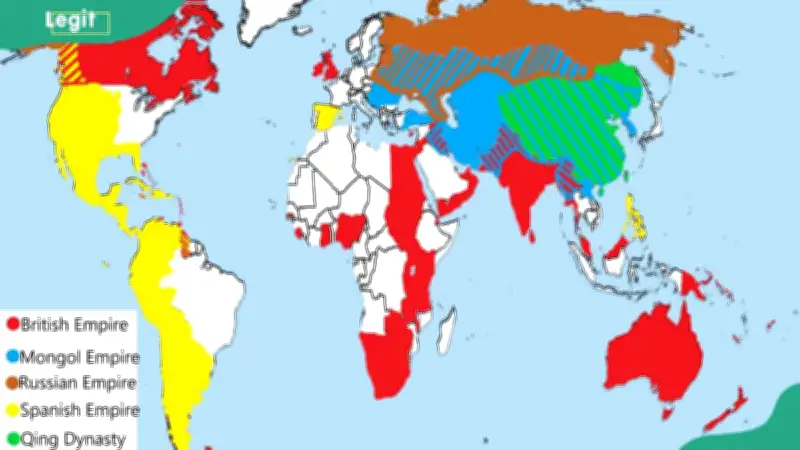
The British Empire stands as the largest empire in recorded history, reaching its greatest territorial extent in 1920 with approximately 35.5 million square kilometres—roughly 26.35% of the Earth's total dry land area. This made it nearly half again as large as the next-largest empire, the Mongol Empire, which covered about 24.0 million km² at its peak.
How the Ranking Was Determined
According to a report by Legit.ng, the rankings are based on peak land area data from Wikipedia's List of Largest Empires, cross-referenced with figures from Britannica, History.com, and World Atlas. Each empire is ranked by its maximum controlled dry land area (in km²) at any point in its history, with empire size defined as the dry land area controlled at the time, which may differ from the area claimed. Where estimates vary across sources, figures reflect the most widely cited historical consensus.
The Top 10 Largest Empires
The ten largest empires range from the British Empire's 35.5 million km² down to the Portuguese Empire's roughly 10.4 million km². The list includes the Qing Dynasty, the only entry that also governed the most populous state on Earth at its peak, with over 426 million subjects. Three empires—the Abbasid Caliphate, the Umayyad Caliphate, and the Yuan Dynasty—each controlled more than 11 million km², yet are largely overshadowed in popular history.
10. Portuguese Empire (~10.4 million km²)
Founded around 1415 with the capture of Ceuta, the Portuguese Empire reached about 10.4 million km² at its peak in 1815. It is the longest-lasting colonial empire, enduring from 1415 until the handover of Macau in 1999. Portugal pioneered global navigation and trade, with explorers like Vasco da Gama extending its reach across continents, including Brazil, coastal Africa, India, Southeast Asia, and Macau.
9. Yuan Dynasty (11.0 million km²)
Founded by Kublai Khan in 1271, the Yuan Dynasty peaked in 1310 at 11.0 million km² (8.16% of world land). Kublai Khan is most famous for conquering Song China, creating the Yuan Dynasty, and assuming the title of Emperor of China. The dynasty ruled present-day China, Mongolia, and Korea. At the end of the 13th century, Kublai attempted invasions of Japan, Vietnam, and Java, but these failed; his successors could not hold the empire against the Ming dynasty, which overthrew it in 1368.
8. Umayyad Caliphate (11.1 million km²)
The Umayyad Caliphate, founded in 661 CE and lasting until 750 CE, peaked in 720 CE at 11.1 million km² (8.24% of world land). It was the second of four Islamic caliphates, ruling for roughly a century. Historians estimate that at its peak, up to 62 million people lived under Umayyad rule. In the west, the empire controlled all of Africa's northern coast as well as Spain and Portugal; it reached as far east as the eastern banks of the Indus River in India.
7. Abbasid Caliphate (11.1 million km²)
Founded in 750 CE, the Abbasid Caliphate reached its maximum territorial extent in the early 9th century under Harun al-Rashid, stretching from the western border of India in the east to the coast of North Africa in the west, totalling 11.1 million km² (8.24% of world land). The Abbasids shifted the capital from Damascus to Baghdad, which became a renowned centre for science, culture, philosophy, and trade. The caliphate lasted until 1258 CE, and during its rule, Islam's Golden Age began.
6. Second French Colonial Empire (11.5 million km²)
Established in 1830, the Second French Colonial Empire peaked around 1920 at 11.5 million km² (8.53% of world land). At its territorial peak during the 1920s, the French colonial empire covered 4.44 million square miles, with holdings concentrated mainly in Africa and Indochina, including North and West Africa, Indochina, and Madagascar. The peak followed post-WWI territorial mandates.
5. Spanish Empire (13.7 million km²)
Rising in the late 15th century, the Spanish Empire became one of the first global empires, covering 13.7 million km² (10.17% of world land) at its peak in 1810. It ruled vast territories in Latin America, the Philippines, and parts of Europe and Africa, spreading Spanish culture and Catholicism worldwide before declining in the 19th century. The late 18th century marked the Spanish Empire's territorial peak, but it soon followed a steep decline as independence movements swept through the Americas.
4. Qing Dynasty (14.7 million km²)
Founded in 1636 (entering China proper in 1644), the Qing Dynasty reached its territorial height in 1790 at 14.7 million km² (10.91% of world land), making it the fourth-largest empire in world history. Although its land mass peaked in 1790, its population continued to expand significantly into the late 19th and early 20th centuries, reaching over 426 million citizens by 1907. The Qing Dynasty annexed Mongolia, Northeast China, Xinjiang, Tibet, and Taiwan, creating a territory larger than today's China—the largest China has ever been.
Unlike many dynasties of Imperial China, the Qing Dynasty was not an ethnically Han kingdom—the final rulers of Imperial China were Manchus from the north. Under the Qing, the empire's territory tripled from the preceding Ming dynasty, and its population grew from roughly 150 million to 450 million over its rule, which lasted until 1912.
3. Russian Empire (22.8 million km²)
Founded in 1721, the Russian Empire reached its peak in 1895 with a total land area of 22.8 million km² (16.92% of world land), or roughly a sixth of the world's total landmass. Unlike the colonial empires, Russia's land empire was contiguous—meaning you could walk from one end of its territory to the other without crossing an ocean or border. The empire stretched from Poland to the Pacific, even including Alaska, which was sold to the United States in 1867. It lasted until 1917.
2. Mongol Empire (24.0 million km²)
The Mongol Empire began in 1206 with Genghis Khan's election as leader of a federation of nomadic tribes along the Onon River. By the late 13th century, it stretched from the Pacific Ocean to the Danube River and the Persian Gulf. At its peak (1270–1309), it covered about 24.0 million km² (17.81% of world land), making it the largest contiguous land empire in world history.
Many people lost their lives during Genghis Khan's invasions, but he also granted religious freedom to his subjects, abolished torture, encouraged trade, and created the first international postal system. Despite its reputation for brutal warfare, the Mongol Empire briefly enabled peace, stability, trade, and safe travel during a period of "Pax Mongolica," beginning around 1279 and lasting until the empire's division and decline around 1368.
1. British Empire (35.5 million km²)
Starting in the 16th century, the British followed Spain and Portugal into the Age of Exploration, establishing colonies across the Americas, Africa, and Asia. By the 1920s, maps of the British Empire showed 13.7 million square miles (35.5 million km²) of controlled territory—over a quarter of the Earth's land area. The British Empire was also the only one in history to claim political control over an entire standalone continent—Australia.
After World War I and the League of Nations mandates in 1920, the British Empire reached its territorial peak, surpassing all previous empires in human history. The long-term significance of this era is still visible in the widespread use of the English language, common legal and government frameworks in former colonies, and global trade networks that Britain helped establish. The empire lasted from the 16th century to the mid-20th century.
Comparative Analysis and FAQs
The Ottoman Empire, at its zenith in 1683, controlled 5.2 million km², dominating Southeast Europe, Western Asia, and North Africa; its capital, Constantinople, was a hub of culture and trade, and under leaders like Suleiman the Magnificent, the empire was renowned for its architectural wonders. At 5.2 million km², it ranked outside the top 10 by land area.
Post World War II, British imperialism began to wane, and the United Kingdom was forced to give up most of its colonial possessions. The remnants of this vast empire are now scattered throughout islands in the Atlantic, Pacific, Indian, and Southern Oceans, as well as a mainland territory in South America, totalling about 47,548 square miles combined.