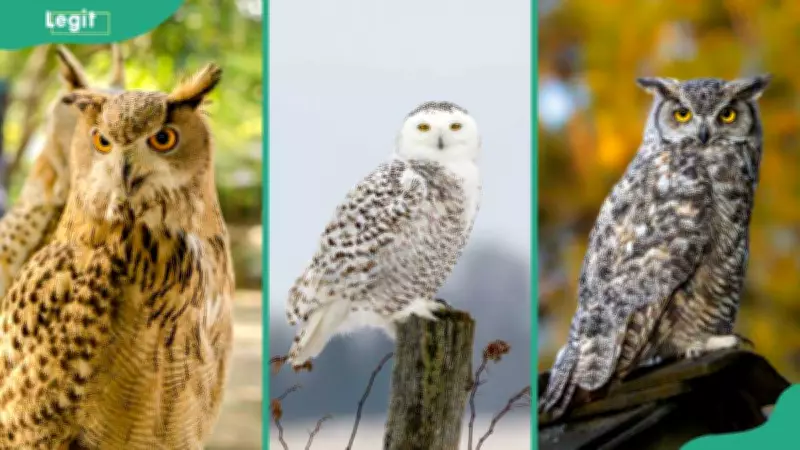
Top 10 Largest Owl Species in the World: Majestic Apex Predators
Owls, renowned for their silent flight and exceptional hunting abilities, include some of the most formidable birds of prey on the planet. Among them, species like the Eurasian eagle-owl and Great horned owl stand out as powerful apex predators, dominating their ecosystems with size and strength. According to Dr. Yilma Abebe, an ornithologist and conservation biologist, determining the "biggest" owl depends on various factors such as weight, wingspan, and length, making it essential to understand how these measurements are applied to distinguish these giants from smaller relatives.
Key Takeaways on the World's Largest Owls
- Blakiston's fish owl holds the title as the largest owl globally, with a weight of up to 4.5 kg (9.9 lbs) and a wingspan reaching 2 meters (7 ft).
- Great grey owl is the largest species in the northern hemisphere, boasting a wingspan between 1.5 and 1.8 meters (5–6 ft).
- Great horned owl is considered the most powerful, weighing between 1.6 and 3.5 kg (3.5–7.7 lbs) and capable of taking down prey larger than itself.
- These large owls are apex predators, often hunting animals that other predators avoid, such as skunks and porcupines.
- In most species, females are up to 30% larger and more powerful than males, a phenomenon known as reverse sexual dimorphism.
10 Biggest Owl Species and Their Unique Characteristics
Owls are nocturnal birds found on every continent except Antarctica, celebrated for their camouflage and nearly silent flight. The following list highlights the top 10 largest owl species, based on data from sources like largest.org and facts.net, detailing what makes each one unique.
- Eurasian Eagle-Owl (Bubo bubo): With a weight of 2.3–4.5 kg (5–10 lbs) and a length up to 75 cm (30 inches), this species has a wingspan of 1.5–2.0 meters (5–6.6 ft). Native to Europe, Asia, and North Africa, it features prominent ear tufts and bright orange eyes, primarily feeding on small mammals like voles and rabbits.
- Blakiston's Fish Owl (Bubo blakistoni): The world's largest owl, weighing 4–4.5 kg (8.8–9.9 lbs) with a wingspan of 1.7–2 meters (5–7 ft) and length up to 95 cm (37 inches). Found in Eastern Russia, northern China, and Korea, it specializes in hunting fish in freezing rivers.
- Great Grey Owl (Strix nebulosa): Weighing 1.3–1.8 kg (2.9–4 lbs) and reaching up to 80 cm (31 inches) in length, this species has a wingspan of 1.5–1.8 meters (5–6 ft). It inhabits boreal forests across North America, Europe, and Asia, known for its mottled grey coloration.
- Great Horned Owl (Bubo virginianus): A powerful predator weighing 1.6–3.5 kg (3.5–7.7 lbs), with a wingspan of 1.5–1.8 meters (5–6 ft) and length up to 64 cm (25 inches). Found throughout the Americas, it can take down birds and mammals larger than itself, using ultra-soft feathers for silent flight.
- Snowy Owl (Bubo scandiacus): Weighing 1.6–3.5 kg (3.5–7.7 lbs) with a wingspan of 1.5–1.8 meters (5–6 ft) and length up to 71 cm (28 inches), this species lives in Arctic tundra regions. It hunts small mammals like lemmings and hares, using its white plumage for camouflage.
- Pharaoh Eagle-Owl (Bubo ascalaphus): Weighing 1.6–3.2 kg (3.5–7 lbs) with a wingspan of 1.6–1.8 meters (5.2–6 ft) and length up to 60 cm (24 inches), found in Sub-Saharan Africa. It has cat-like faces and forms lifelong monogamous pairs.
- Indian Eagle-Owl (Bubo bubo indica): Weighing 2.7–3.2 kg (6–7 lbs) with a wingspan of 1.8–2.5 meters (6–8.2 ft) and length up to 74 cm (29 inches), native to the Indian subcontinent. It resembles the Eurasian eagle-owl but is smaller and lives up to 20 years.
- Cape Eagle-Owl (Bubo capensis): Weighing 2–4 kg (4.4–8.8 lbs) with a wingspan of 1.5–2 meters (5–6.6 ft) and length up to 60 cm (24 inches), found in Sub-Saharan Africa. It inhabits rugged terrain and feeds on mammals from rodents to hares.
- Verreaux's Eagle-Owl (Bubo lacteus): Also known as the Giant eagle-owl, weighing 2–4 kg (4.4–8.8 lbs) with a wingspan of 1.8–2.1 meters (6–7 ft) and length up to 61 cm (24 inches). Native to Sub-Saharan Africa, it preys on medium-sized mammals like monkeys and hyraxes.
- Magellanic Horned Owl (Bubo magellanicus): Weighing 1.5–2.5 kg (3.3–5.5 lbs) with a wingspan of 1.1–1.3 meters (3.6–4.3 ft) and length up to 55 cm (21.7 inches), found in South America. It features ear-like feathers and a rounded body with white neck patches.
Why the "Biggest" Owl Depends on Measurement Methods
Dr. Yilma Abebe explains that identifying the largest owl varies because different sources use distinct metrics. Total length, which includes feathers, can be misleading—for instance, the Great grey owl appears large due to its fluffy plumage but has a relatively small body. Wingspan measures the distance between wingtips, while body mass (weight) is often considered the truest indicator of size, with Blakiston's fish owl leading in this category. Additionally, female owls are typically larger than males, by up to 30%, meaning record-breaking sizes usually refer to females.
How Large Owls Hunt and Survive in the Wild
Large owls, such as the Great horned and Eurasian eagle-owl, employ unique survival tactics that set them apart as apex predators. They rely on brute force, with talons exerting up to 500 PSI—over 15 times human grip strength—to sever prey spines instantly. These owls target dangerous animals like skunks and porcupines, avoiding competition by hunting other birds of prey. Some species, like the Snowy owl, hunt on the ground using camouflage, while Blakiston's fish owl wades into rivers to catch fish with specialized foot pads.
Frequently Asked Questions About Giant Owls
What is the world's largest owl? The Blakiston's fish owl is the largest, weighing 4–4.5 kg (8.8–9.9 lbs) with a wingspan of 1.7–2 meters (5–7 ft).
What is the most powerful owl? The Great horned owl is the most powerful, capable of exerting significant force with its talons to subdue large prey.
How big are giant owls? Species like Verreaux's eagle-owl weigh 2–4 kg (4.4–8.8 lbs) with wingspans of 1.8–2.1 meters (6–7 ft), showcasing their impressive size.
With over 200 species worldwide, these large owls play a crucial role in ecosystems by controlling small mammal and insect populations. Their presence is vital for maintaining ecological balance, underscoring the importance of conservation efforts for these majestic birds of prey.