Seaking's Scathing Critique of VDM's Ratels Over Protest Absence
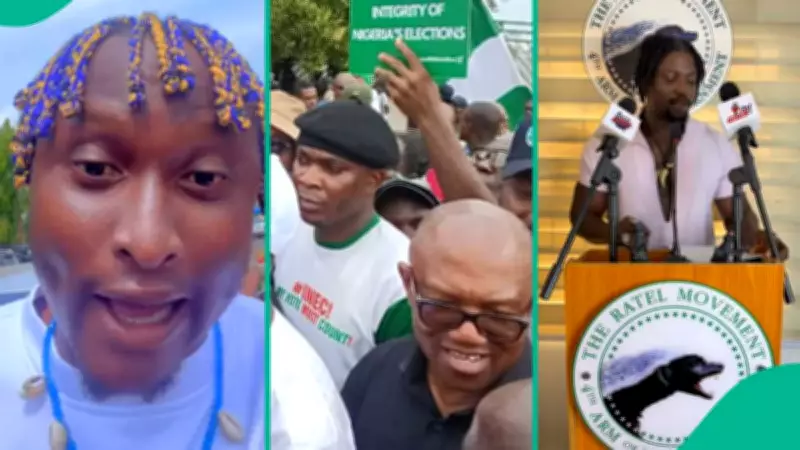
Social media activist Seaking has launched a blistering attack on members of VeryDarkMan's dedicated fanbase, known as the Ratels, for their conspicuous absence at a significant protest held at the National Assembly in Abuja. The demonstration, which took place on Monday, February 9, 2026, was spearheaded by Labour Party presidential candidate Peter Obi, who led a substantial march advocating for the mandatory electronic transmission of election results ahead of the crucial 2027 general elections.
'Gutter Cleaners' Jibe Sparks Heated Debate
In a video recorded directly from the protest venue, Seaking expressed profound disappointment at the lack of representation from VDM's followers. He mockingly questioned why members of the Ratels were completely missing from what he described as a vital civic action addressing fundamental electoral reforms. His pointed remarks have ignited a fierce controversy regarding the actual impact and commitment of social media pressure groups in influencing critical government policies and national discourse.
"Ratels only know how to clean gutters," Seaking declared emphatically. "We're at the National Assembly and I can't see any ratels to come join the protest about the most important thing in life." His statement appeared to suggest that the group frequently participates in symbolic or comparatively less significant community activities but fails to mobilize when confronted with major national issues that demand public engagement and collective action.
Social Media Reactions and Counterarguments
The activist's criticism has generated diverse reactions across various social media platforms, reflecting polarized opinions about the appropriate roles of different civic groups in Nigeria's political landscape. Some users supported Seaking's position, arguing that electoral reform represents a paramount concern that should unite all activists, while others defended the Ratels' community-focused approach as equally valuable to national development.
One social media user, @MindOfNaijaLife, commented: "Seaking is not holding back at the National Assembly today. He's calling out VeryDarkMan's 'Ratels,' claiming they only know how to 'clean gutters' but are nowhere to be found when it comes to protesting the 'most important thing in life'—the INEC Electoral Reform Bill. Is this a fair critique?"
Another user, @realmrshina, offered a contrasting perspective: "Everybody has their own role to play in the development of a nation. Continue with your own passion for our nation as long as it is productive and not tarnishing the image of the country."
VDM's Stance on Electoral Reform Discussions
Meanwhile, VeryDarkMan himself has publicly addressed the protest led by Peter Obi, clearly stating that he sees no purpose in engaging with electoral reform conversations. In a separate video shared online, VDM characterized the entire electoral process as fundamentally flawed and already doomed. According to his viewpoint, the responsibility for advocating reforms should primarily rest with politicians who actually contest elections, rather than social media activists or ordinary Nigerian youths who lack direct political power.
This position further complicates the ongoing debate about whether digital activism and online pressure groups can genuinely effect meaningful change in Nigeria's political system, or whether their influence remains largely symbolic and limited to social media platforms without translating into tangible policy outcomes.
Broader Implications for Civic Engagement
The controversy surrounding Seaking's comments and the Ratels' absence highlights deeper questions about the nature of civic participation in contemporary Nigeria. It raises important considerations about:
- The evolving roles of social media influencers and their followers in political activism
- The perceived hierarchy of civic activities, from community service to direct political protest
- The effectiveness of different approaches to demanding governmental accountability and electoral integrity
- The growing tension between online activism and physical presence in political demonstrations
As Nigeria approaches another critical election cycle in 2027, this incident underscores the complex dynamics between various activist groups, their chosen methods of engagement, and their ultimate impact on the country's democratic processes and political future.