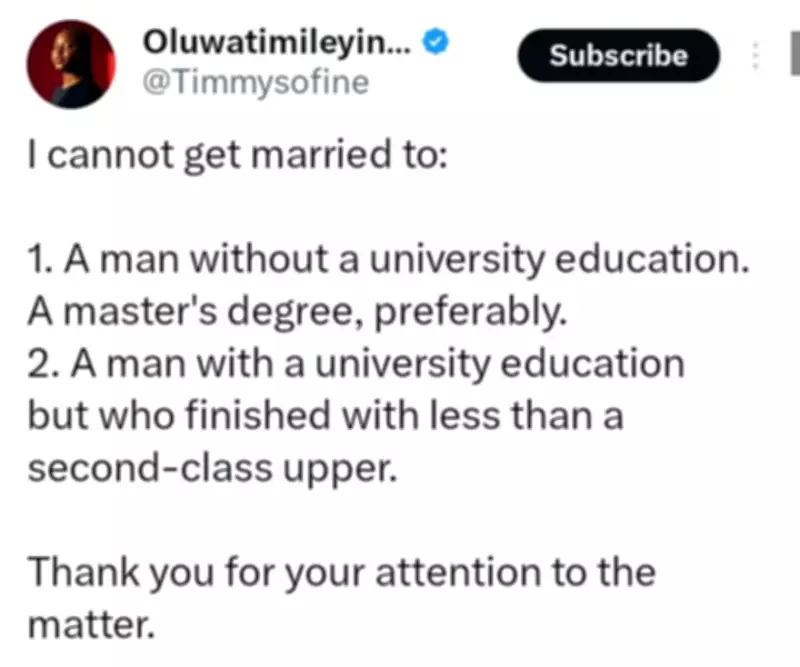
Nigerian Lady Announces Stringent Educational Requirements for Prospective Husband
A Nigerian woman, identified as Oluwatimileyin, has ignited a significant conversation on social media by publicly declaring her non-negotiable educational standards for any potential marriage partner. In a detailed post made on Sunday, she explicitly outlined that she will not entertain the idea of marrying a man who lacks a university degree.
Specific Academic Benchmarks Outlined
Oluwatimileyin elaborated further, stating that even possessing a bachelor's degree is insufficient if the candidate did not achieve a minimum of a second-class upper division classification. She emphasized that any man who graduated with less than this academic standing is categorically "out of the question" for her marital considerations.
In her own words, she wrote: "I cannot get married to: A man without a university education. A master's degree, preferably. A man with a university education but who finished with less than a second-class upper." This clear and firm stance has drawn widespread attention and sparked varied reactions across online platforms.
Broader Implications and Social Commentary
The declaration raises pertinent questions about the evolving criteria for marriage in contemporary Nigerian society, where educational attainment is increasingly being prioritized alongside traditional factors. It highlights a growing trend where individuals are setting specific, measurable standards for their life partners, moving beyond more subjective qualities.
This incident underscores the intersection of personal choice and societal expectations, as discussions around such public statements often reflect deeper cultural values and economic considerations. The emphasis on a second-class upper degree, in particular, points to the competitive nature of the job market and the perceived correlation between academic performance and future success.
As the story circulates, it continues to generate debate on whether such stringent educational prerequisites are practical, fair, or indicative of broader shifts in marital preferences among young Nigerians. The conversation extends to the balance between academic qualifications and other vital attributes in a successful partnership.