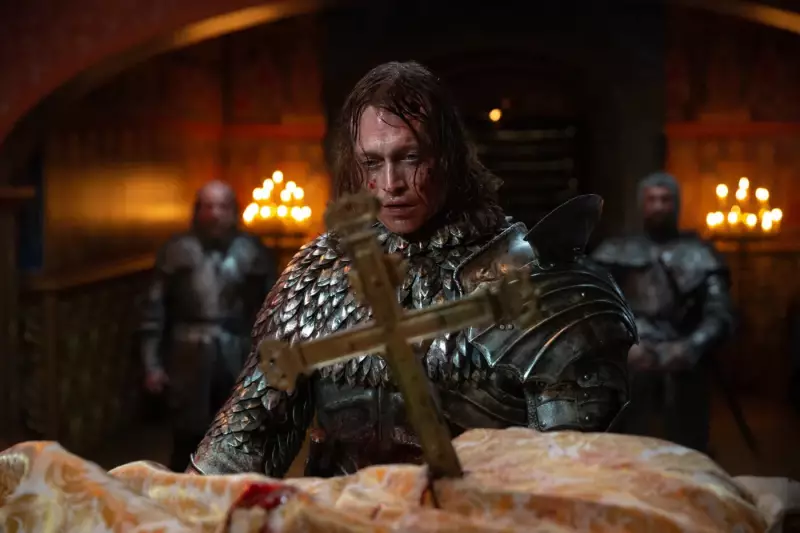
When you hear the name Dracula, your mind immediately conjures images of blood-thirsty vampires and Transylvanian castles. However, the latest cinematic interpretation, Dracula: A Love Tale, directed by visionary filmmaker Luc Besson, completely transforms this centuries-old character into something profoundly different.
A Tragic Love Story Spanning Centuries
The film begins in 1480 Romania, where we meet Prince Vladimir, portrayed with raw emotion by Caleb Landry Jones, and his beloved wife Elisabeta, played by Zoë Bleu. Their passionate romance unfolds through intimate scenes of laughter and tender moments, establishing a connection that feels both genuine and deeply moving.
Tragedy strikes when Vlad is called to war, torn away from Elisabeta's embrace by his soldiers. Despite emerging victorious from battle, he returns to find his wife attacked and dying in his arms, hunted down by rogue Turkish forces. The film never fully explains why she was targeted, leaving viewers to assume it was an act of vengeance against the powerful prince.
The Curse of Immortality and Eternal Searching
Consumed by grief and rage, Vlad storms into a church, cursing both God and fate for taking his beloved. This act of defiance earns him a terrible punishment: immortality as a vampire with an unquenchable thirst for blood. What might seem like a supernatural gift becomes his eternal curse.
For the next four centuries, Vlad dedicates his existence to finding Elisabeta's reincarnation. We witness his descent from noble prince to tormented creature, experimenting with scents to attract women who might contain his lost love's soul. His frustration becomes so profound that he attempts suicide multiple times, jumping from balconies only to find death forever beyond his reach.
Visual Splendor and Emotional Depth
By the 19th century, Vlad has retreated into solitude, his vampire brides scouring the world for Elisabeta's reincarnated spirit. One of these brides, Maria, played by Matilda De Angelis, eventually discovers Mina, who bears Elisabeta's soul and is portrayed again by Zoë Bleu.
The film's visual elements deserve special recognition. The Gothic atmosphere, elaborate costumes, and breathtaking cinematography create a world that feels both haunting and beautiful. Caleb Landry Jones delivers a transformative performance as the older Vlad, appearing weary and vengeful yet retaining traces of his humanity beneath centuries of darkness.
Supporting characters add depth to the narrative, with Christoph Waltz appearing as a priest reminiscent of Van Helsing, and Guillaume de Tonquédec as Doctor Dumont. Together they hunt Vlad to Paris, where he resides in a decaying castle surrounded by monstrous creatures and enslaved souls.
Missed Opportunities and Compelling Themes
Despite its title as a love story, the film surprisingly dedicates limited screen time to developing Vlad and Elisabeta's romance. Apart from the opening scenes, their relationship primarily unfolds through flashbacks. An intriguing revelation from Caleb Landry Jones during press interviews indicated that Elisabeta was pregnant in the story, a detail that could have significantly deepened the tragedy but remains largely unexplored in the final cut.
The film taps into contemporary audience preferences for emotionally vulnerable male characters. Vlad embodies this archetype perfectly—a man consumed by love, guilt, and loss rather than merely a brooding vampire. Even through his monstrous acts, his humanity shines through, making viewers question whether even a blood-drinking creature deserves love and redemption.
Dracula: A Love Tale stands as a visually stunning and emotionally resonant addition to vampire cinema. While imperfect in its narrative execution, it succeeds in making audiences empathize with one of literature's most infamous monsters. Beneath the fangs and centuries of pain, Vlad remains fundamentally a man eternally searching for his lost love, making this one of the most tragically beautiful vampire films in recent memory.