
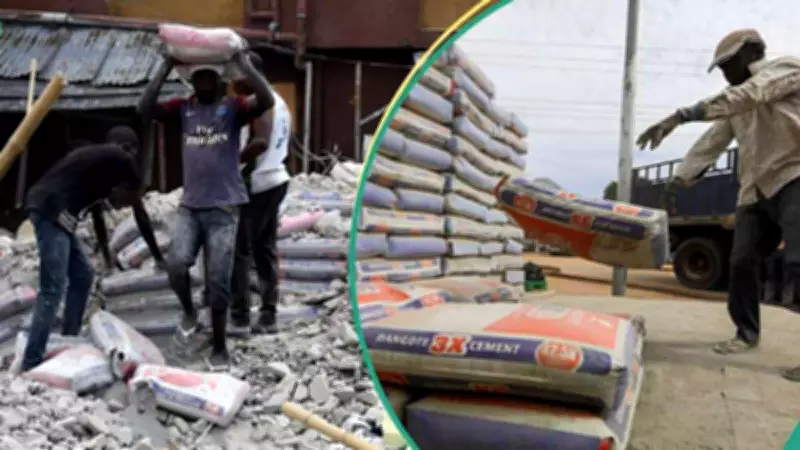
Agora Policy Explains Persistent High Cement Prices in Nigeria
Agora Policy, a Nigerian policy think tank, has provided a detailed analysis explaining why cement prices remain elevated in Nigeria despite the country having more than enough local production capacity. The organisation attributes this phenomenon primarily to weak competition and high market concentration rather than production costs.
Market Structure Over Production Costs
In a policy insight titled 'Market Power and Failure of Competition Policy in Nigeria's Cement Industry', Agora Policy stated that persistently high cement prices are driven more by market structure than by production expenses. The think tank noted that Nigeria achieved self-sufficiency in cement production back in 2012 and currently maintains installed capacity far exceeding local demand.
Despite this surplus capacity, prices have remained stubbornly high across the country. Agora Policy linked this development directly to the dominance of three major producers: Dangote Cement, Lafarge Africa, and BUA Cement. This concentrated market structure has translated into unusually high profit margins for these firms.
Unusually High Profit Margins
According to the report, average operating profit margins for cement producers stood at approximately 49% as of September 2025, a significant increase from roughly 30% in 2024. Agora Policy emphasized that this level of profitability is substantially higher than what is observed in North America, Europe, Asia, and most of sub-Saharan Africa.
The organisation argued that the coexistence of excess capacity, high prices, and strong profitability suggests that pricing outcomes are shaped mainly by market power rather than cost pressures. "Nigeria has built the capacity it set out to build, but the benefits of that achievement have yet to show up fully in prices paid by households, builders, and government," the report stated.
Questioning Traditional Explanations
While cement producers frequently cite taxes, energy costs, transport challenges, and financing constraints as reasons for high domestic prices, Agora Policy said these arguments raise further questions. The think tank pointed out that Nigerian cement is often sold profitably at lower prices in export markets, where many domestic levies do not apply.
The organisation traced the current structure of the industry to import-substitution policies introduced in the late 1990s and early 2000s. These policies, which included tariff protection, tax incentives, foreign exchange support, and exclusive limestone concessions, succeeded in boosting local capacity and ending imports but also resulted in a highly concentrated market.
Strategic Use of Excess Capacity
Agora Policy explained that in capital-intensive industries like cement, excess capacity can be used strategically to deter new entrants and preserve dominance. Despite surplus production, the report said major producers continue to exercise pricing power through several mechanisms:
- Control of limestone deposits
- Scale advantages
- Regional market segmentation
- High transport costs that limit consumer choice
The organisation warned that high cement prices act as a "hidden tax" on housing and infrastructure, raising the cost of homes, roads, schools, and hospitals while reducing what governments can achieve with limited resources.
Call for Competition-Focused Reforms
Agora Policy argued that reopening cement imports would not offer a sustainable solution, given high transport costs and logistical challenges, particularly for inland markets. Instead, the think tank called for competition-focused reforms including:
- Opening access to limestone deposits
- Treating logistics as a competition issue
- Addressing regional dominance
- Strengthening oversight by the Federal Competition and Consumer Protection Commission (FCCPC)
The organisation concluded that Nigeria's cement challenge is not about capacity building but about restoring competition. It stated that without stronger safeguards, industrial policies risk entrenching dominance at the expense of affordable housing, infrastructure delivery, and inclusive growth.
This analysis comes as cement producers, including Dangote Group, have previously argued that multiple taxes and levies collected by the Nigerian government contribute to higher domestic prices compared to export markets. However, Agora Policy's research suggests market concentration plays a more significant role in maintaining elevated prices for Nigerian consumers.




