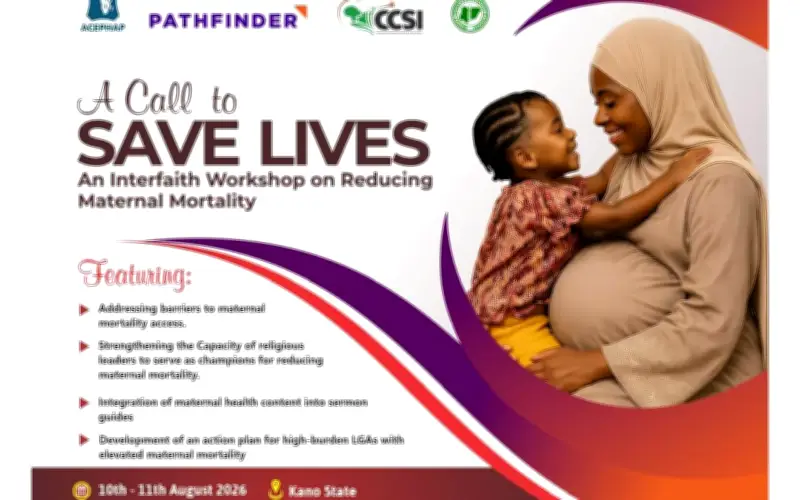
Religious leaders, health professionals, and development partners gathered in Kano State for a two-day interfaith workshop to address the cultural, financial, and logistical barriers that contribute to maternal deaths. The workshop, titled “Save Lives: An Interfaith Workshop on Reducing Maternal Mortality,” was organized under the Advocacy and Implementation of Maternal, Newborn, Child Nutrition and Health (AIM-MNCNH) project and held on Monday.
Examining the 'Three Delays' and Community Findings
Participants examined the “three delays” associated with maternal deaths and reviewed findings from community dialogues in Gaya Local Government Area of Kano State. The discussions revealed that access to care is often determined by more than just the availability of health facilities. Decisions by husbands and older family members, transport difficulties, and beliefs about childbirth can all determine whether a woman receives timely care.
Religious Leaders' Role in Changing Beliefs
Adeniyi Ogunbanwo, Secretary of the Christian Association of Nigeria (CAN) in Kano State, said religious leaders could play a significant role because of the trust communities place in them. He said churches could use sermons, weddings, naming ceremonies, and other gatherings to educate families about maternal health. “Religious leaders, in terms of being realistic, people listen to us. So, we have a lot to play, and mostly by speaking,” he said. Ogunbanwo noted that some churches have maternity wards and could support women who struggle to pay medical bills. However, he warned that religious beliefs should not be used to discourage women from seeking professional medical care, as some interpret biblical references to childbirth as meaning they should deliver without assistance. CAN has been engaging the Kano State Primary Healthcare Board and other government structures and would develop a sermon guide for churches across the state.
Family Decisions and Community Influence
Maryam Danjuma, Community Engagement Officer with Pathfinder International, said many pregnant women were not the final decision-makers when it came to seeking antenatal or delivery care. Women often depended on their husbands, who could be influenced by mothers-in-law and older women. Some older women who had delivered at home in the past sometimes considered women who preferred health facilities to be lazy. Danjuma recalled a case from a town-hall meeting where a woman died after relatives opposed her husband's decision to take her to a health facility, and a contrasting case where a husband insisted on antenatal care despite his wife's refusal.
Transport, Harmful Practices, and Misconceptions
Danjuma said distance and transportation costs compounded the problem, particularly for women in remote communities. She also raised concerns about “ruwan naƙuda,” a substance some women take during labour, sometimes mixed with herbs or pills, which can cause complications. She said the challenges require community actors to work together, not just religious leaders. Pathfinder is engaging men, health workers, traditional birth attendants, and other influential community members. Traditional birth attendants can help by referring women to health facilities, especially when complications arise. Some community meetings were held inside health facilities to familiarise women with the environment and address privacy concerns.
Muhammad Gwagwarwa, Chairman of Jama’atu Nasril Islam (JNI) in Kano State, said religious leaders have a responsibility to challenge beliefs that discourage women from seeking medical care. He noted that Nigeria accounts for 27 per cent of global maternal deaths, a figure presented at the workshop. Some families believe hospital care is unnecessary because childbirth is determined by God, but Islam encourages seeking treatment from experts. “Islam has established that people should seek healthcare and go to those who are experts in the field of health. Therefore, staying at home, refusing to go to the hospital and relying on fate has also contributed to these deaths,” he added. Gwagwarwa also attributed some challenges to the decline in experienced traditional birth attendants. JNI will take maternal health messages to schools, marriage ceremonies, Qur’anic learning centres, Maulud gatherings, and Islamiyyah schools.
Shared Responsibility and Measurable Action
Habiba Mijin-Yawa, Ameera of the Federation of Muslim Women of Nigeria, Kano State chapter, said responsibility for reducing maternal deaths extends beyond families to include communities, government, and health facilities. She identified beliefs, irresponsible husbands, and women's attitudes as challenges, but said the government and hospitals must also address gaps that discourage women from seeking care. “This is not only on the husband, but also the government and even the hospitals,” she said.
Olufemi Ibitoye, Technical Adviser, MNCH at Pathfinder International, said the workshop was designed to move religious leaders beyond advocacy towards measurable action. Kano was selected because of its high burden of maternal mortality, with religious leaders drawn from high-burden local government areas. Participants developed action plans for taking maternal health messages into their communities. “What we are doing here is actually to save lives, an interfaith workshop to reduce maternal mortality in Kano State,” he said. The project is funded by the Gates Foundation through a consortium led by ACEPHAP, with Pathfinder International, CCSI, and American Women’s Association of Nigeria as supporting partners. A sermon guide was developed to help religious leaders address antenatal care, danger signs, and skilled birth attendance. The initiative will use existing structures to track results, with health promotion and advocacy officers at the LGA level working with religious and community leaders to monitor antenatal attendance, facility deliveries, complications, and maternal deaths.