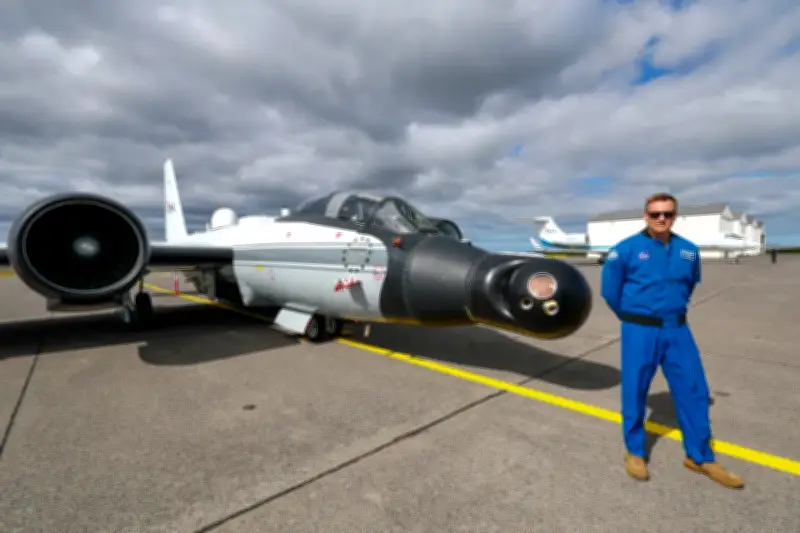
NASA is sending a specialized high-altitude research aircraft to chase Wednesday's total solar eclipse, aiming to capture unprecedented observations of the Sun's corona and address a long-standing mystery in solar science.
Mission Details and Aircraft
The WB-57 Canberra aircraft will fly at approximately 50,000 feet above the clouds during the eclipse, roughly twice the cruising altitude of a commercial passenger airliner. The mission will focus on observing the Sun's corona, the thin halo of light surrounding the Moon during a total solar eclipse. The corona is normally difficult to observe because the Sun's surface is overwhelmingly bright, but the Moon's position during an eclipse blocks much of the glare, providing a rare opportunity to study the Sun's outer atmosphere.
The WB-57 will operate from Iceland, which will experience a total solar eclipse, and fly along the path of the eclipse to capture detailed observations. Four cameras mounted on the aircraft's nose cone will take high-resolution images of the corona. NASA said the aircraft would provide researchers with a unique perspective from above much of the water vapour, haze, and turbulence found in the lower atmosphere, allowing its instruments to capture clearer images and record wavelengths of light that are difficult to observe from the ground.
Scientific Goals
Scientists hope the observations will provide further insight into the superheated plasma loops emitted by the Sun and help address one of solar science's major mysteries: why the Sun's outer atmosphere is significantly hotter than its surface. Kelly Korreck, the eclipse programme manager at NASA headquarters, emphasized the mission's importance. "From our unique perspective on Earth during a total solar eclipse, scientists can study the Sun's corona in a way we can't from anywhere else in the solar system," Korreck said. "The Sun impacts our daily life, satellites and astronauts in space, and we can take advantage of this moment to advance our understanding of that influence."
The WB-57 is a specialized high-altitude research aircraft originally developed in the 1950s and has been used for a range of scientific and atmospheric research missions.
Global Coverage and UK Visibility
NASA is also working with scientists and technicians in Spain, where the total eclipse will be broadcast to a global audience. The agency has selected the village of Villalibado in the province of Burgos as one of the locations for its eclipse coverage, with a team of almost 30 NASA and Exploratorium scientists and technicians preparing the international broadcast.
In the United Kingdom, the eclipse will be visible as a partial solar eclipse, with the first signs expected from around 6:15pm on Wednesday. The exact timing will vary depending on location, with the eclipse expected to begin at about 6:18pm in Cornwall and reach maximum coverage at around 7:16pm. The peak is expected at around 7:13pm in London, Bristol and Cardiff, 7:11pm in the Midlands and 7:10pm in Manchester. The UK lies outside the path of totality, meaning the Sun will not be completely obscured. Instead, viewers will see a bright crescent-shaped portion of the Sun as daylight fades.
The eclipse will be the first solar eclipse visible from the UK since 1999, while the next one visible from the country is not expected until 2090. A solar eclipse occurs when the Moon passes between the Earth and the Sun, temporarily blocking some or all of the Sun's light from reaching parts of the Earth.