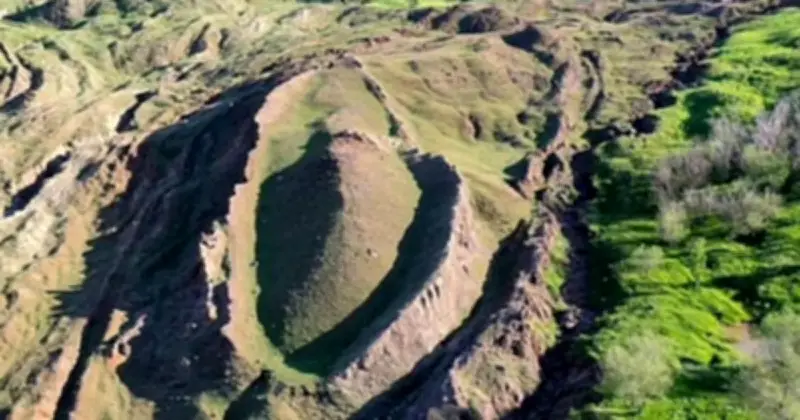
Researchers investigating the Durupınar Formation in Turkey have detected underground structures they believe could be man-made, reigniting claims that the site may be the resting place of Noah’s Ark. The findings, announced by the research group Noah’s Ark Scans, have brought fresh attention to a mystery that has persisted since the formation’s discovery in 1959.
Underground Scans Reveal Anomalies at Durupınar Formation
The Durupınar Formation is a 157-metre-long boat-shaped geological feature near Doğubayazıt in Turkey’s Ağrı Province, close to Mount Ararat. It was identified in 1959 by Turkish Army Captain İlhan Durupınar, whose aerial photographs revealed its unusual shape. Since then, some researchers and religious groups have suggested it could be linked to the biblical story of Noah’s Ark.
According to Noah’s Ark Scans, recent underground surveys using advanced radar technology detected features beneath the formation, including straight lines, angular intersections and cavity-like spaces. The team says these resemble organised internal structures rather than natural rock formations. The scans also revealed possible corridors and multiple layers beneath the surface, which they claim are consistent with descriptions of Noah’s Ark in religious texts.
Soil Composition Differences and Organic Material Found
The researchers also reported differences in soil composition inside the formation, with higher levels of organic material compared with surrounding areas. They believe this could warrant further investigation. Andrew Jones, founder of Noah’s Ark Scans, said the findings strengthen the team’s belief that the formation may not simply be a natural structure.
“We believe the Durupınar Formation is the remains of Noah’s Ark, and that is exactly why we want to put it through the strongest scientific testing we can,” Jones said.
Scientific Community Remains Divided Over Claims
Despite the new findings, the claim remains disputed among scientists. While some researchers involved in the project believe the underground features could indicate a man-made structure, there is currently no confirmed archaeological evidence proving that the site contains Noah’s Ark. Previous geological studies have argued that the formation is a natural structure created by geological processes.
The team has moved to a new phase of investigation, including drilling and collecting samples from beneath the formation. Researchers say further analysis will be needed to determine the nature of the underground features and whether they contain any evidence of human construction.
Religious Significance and Historical Context
For thousands of years, the story of Noah’s Ark has appeared in Jewish, Christian and Islamic traditions, with the biblical account stating that the Ark came to rest “on the mountains of Ararat.” The Durupınar site has remained one of several locations claimed by some researchers to be linked to that story, but no discovery has been universally accepted by the scientific community.
The ongoing drilling and testing aim to provide more clarity on the formation’s origins, but until conclusive evidence emerges, the mystery of Noah’s Ark remains unresolved.