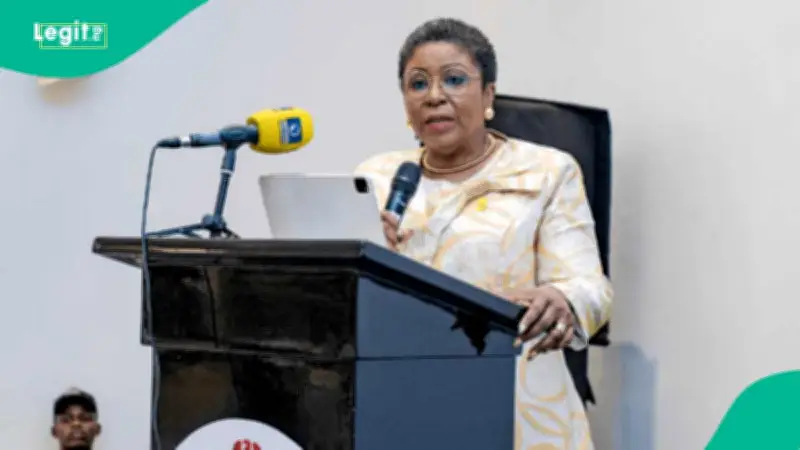
Nigeria's Head of the Civil Service, Didi Walson-Jack, has conceded that her office approved requests from the Presidential Foreign Investment Promotion Council (PFIPC) based on fabricated documents, acknowledging that proper due diligence was not performed before issuing key authorizations. She made this admission on Wednesday, July 29, during a session of the House Ad-Hoc Committee chaired by Yusuf Gagdi, the lawmaker representing Kanke/Kanam/Pankshin Federal Constituency in Plateau State.
Forged Documents Used to Obtain Official Recognition
The committee is investigating how the PFIPC and the Presidential Economic Advisory Council allegedly secured official government status without any enabling legislation. At the center of the investigation is Prince Adeyemi Adeniyi, who reportedly posed as the PFIPC's Director-General and used forged appointment letters, fabricated legislative documents, and fictitious government offices to obtain approvals from multiple federal institutions.
Walson-Jack told lawmakers that officials of the purported agency attended the 2025 Annual Manpower Budget Defence, presenting what appeared to be a legitimate Establishment Act and a letter appointing a Director-General. Based on those documents, her office processed a recruitment waiver and authorised the establishment of the agency.
Under questioning, she admitted that the Establishment Act was not genuine. "I requested to see the documents myself, and I saw that the Establishment Act was not really an authentic Act. I have almost 30 years of legal practice experience, and immediately I saw it, I knew it was not real," she stated. She further noted that the signature on the appointment letter, purportedly from the Office of the Chief of Staff to the President, differed visibly from other documents bearing the same signatory's name.
Forensic Analysis Confirms Signature Discrepancies
Chairman Yusuf Gagdi disclosed that Nigeria Police Force forensic experts had already analyzed the signatures and found no match, adding that there was no attempt to imitate the original signature. The committee also observed that the document presented as a National Assembly Act lacked citation numbers, Supreme Court numbers, Gazette numbers, and Gazette titles—all standard features of valid Nigerian legislation.
Gagdi also revealed that the Directorate of Administration and Support Services, which appeared on the correspondence, does not exist within the State House. The committee noted that the letter meant for the State House Permanent Secretary was never delivered; instead, it was collected by Adeyemi.
Accountant-General's Office Points to Individual Staff Member
Joshua Luka, Director of the Federal Project Financial Department in the Office of the Accountant-General of the Federation, told the committee that his office had deliberately addressed an administrative code letter to the State House Permanent Secretary as a precaution. However, the letter was intercepted. Luka attributed the failure to a single staff member, identified as Bello Abdullahi, who was present in the hearing room. Bello admitted giving the letter to Adeyemi, though the committee chairman interrupted his explanation before he could elaborate.
Adeyemi could not be produced before the committee as directed because he remains in custody under a court order. The committee said it would seek a reproduction warrant from a court of competent jurisdiction to compel his appearance.
Committee Nears Conclusion, Plans Public Report
The committee announced that it has completed most of its fact-finding work and intends to present preliminary findings to the public the following week. A final report will be submitted to the House after lawmakers return from recess.
Senate Declines Probe Amid Budget Allocation Scandal
Meanwhile, the Nigerian Senate voted against a motion to investigate how ₦1.3 billion was allocated to the allegedly non-existent PFIPC in the 2026 budget. Deputy Senate President Barau Jibrin stated that the Senate would await the findings of the Independent Corrupt Practices and Other Related Offences Commission (ICPC) before taking further legislative action. This decision contrasts with the House of Representatives, which adopted a motion to investigate the same controversial allocation.
Former Vice President Atiku Abubakar criticized President Bola Tinubu's directive to the ICPC to probe the PFIPC affair, calling it a reluctant response to his seven-day ultimatum. Atiku argued that referring the matter to a government agency contradicts the standard of independence Nigerians expect and demanded the establishment of a 10-member Special Independent Commission of Inquiry to conclude work within one month.
The unfolding scandal continues to draw attention to systemic weaknesses in Nigeria's civil service vetting processes, highlighting how forged documents can secure official status and budget allocations without proper verification.