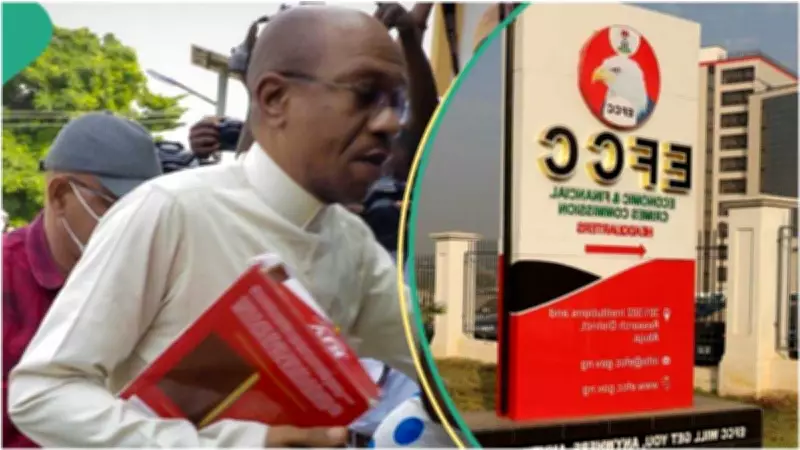
Shocking Testimony Reveals $6.23 Million CBN Withdrawal Through Forged Documents
In a dramatic courtroom revelation during the ongoing trial of former Central Bank of Nigeria Governor Godwin Emefiele, a witness has provided detailed testimony about how $6.23 million was illegally withdrawn from the apex bank using forged documentation. The witness, Bashirudden Muhammed Maishanu, who served as an assistant director at the CBN, gave his account before Justice Hamza Muazu at the Federal Capital Territory High Court in Abuja.
Forged Documents for Election Logistics
According to Maishanu's testimony, the substantial sum of $6,230,000.00 was withdrawn from the Garki Branch of the Central Bank of Nigeria on February 8, 2023. The witness explained that the forged documents presented for this transaction were purportedly created to support election observers and logistics operations. This revelation has sent shockwaves through Nigeria's financial and judicial circles, highlighting significant vulnerabilities in the banking system's security protocols.
Witness Connection to Emefiele's Office
Maishanu informed the court that he became acquainted with the defendant, Godwin Emefiele, through an individual named Eric, who served as the former CBN governor's personal assistant. The witness detailed how in early January 2023, a man identified as Alhaji Ahmed approached him, claiming that Emefiele's personal assistant had directed him to seek Maishanu's assistance regarding certain transactions being processed at the apex bank.
The witness recounted his initial interaction with Ahmed: "He said he was working in a Special Committee in the SGF office. I asked him for I.D. and he showed me. I asked him to call Mr Eric so that I could confirm he indeed asked him to see me. He called Mr Eric, and we spoke, and he said he knew Alhaji Ahmed, and he said indeed he did ask him to see me."
Elaborate Scheme Unfolds
According to the testimony, Ahmed explained that they were processing a payment from the CBN under presidential authority and would proceed to the bank once they obtained written presidential approval. Maishanu expressed confusion about his role, stating: "I asked Ahmed what role I was to play because I was not working in the branch where the payment was made. He said it was too early at that time, and that once they obtained the approval of the government, he would let me know."
The witness further testified that Ahmed returned approximately one week later, claiming they had secured presidential approval. "He showed me the copy and told me that they will now go to the CBN to obtain Mr Emefiele's approval. At that point, he told me that they wanted cash payment and if I could either go with them or recommend someone to go with them. I told him I couldn't go, and I suggested that I should call someone I knew," Maishanu stated.
Prosecution's Case Strengthens
The Economic and Financial Crimes Commission (EFCC) prosecutor led the witness through these testimonies during the hearing on Thursday, January 29, 2026. These revelations significantly bolster the prosecution's case against the former CBN governor, highlighting potential systemic failures and procedural breaches within Nigeria's central banking institution.
Related Judicial Developments
This testimony comes amid other significant developments in Emefiele's legal battles. Recently, Justice Rahman Oshodi of the Lagos State Special Offences Court in Ikeja rejected Emefiele's request for the judge to recuse himself from the case. Justice Oshodi maintained that the defense counsel's allegations were unsustainable due to lack of substantial evidence, asserting that proceedings had been conducted with utmost fairness.
The ongoing trial continues to attract national attention as it unfolds, with financial experts and anti-corruption advocates closely monitoring proceedings that could have far-reaching implications for Nigeria's banking sector governance and anti-corruption efforts.