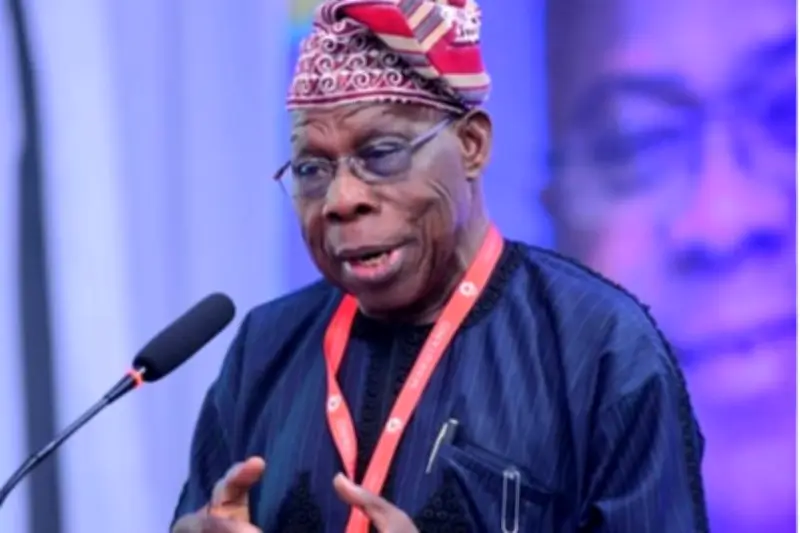
Former President Olusegun Obasanjo has warned that Nigeria must never experience another civil war, saying many of the conditions that led to the 1967–1970 conflict still persist and should be addressed to prevent a repeat of history.
Obasanjo made the remarks on Wednesday at the Olusegun Obasanjo Presidential Library (OOPL) in Abeokuta, Ogun State, while receiving a historical documentation on the Asaba Massacre from the Isama Ajie of Asaba, Chief Chuck Nduka-Eze.
Historical Documentation on Asaba Massacre
The publication, titled Asaba Massacre, comprises a book and an audiovisual documentary based on eyewitness accounts, recorded interviews, archival materials and historical research documenting the events that occurred during the Nigerian Civil War.
Speaking at the presentation, Obasanjo, who served as a military commander during the war, said he had deliberately refrained from commenting extensively on the Asaba Massacre because the area was under the command of the late General Murtala Muhammed.
He commended Nduka-Eze for documenting the events, describing the work as an important contribution to preserving Nigeria's history and ensuring that similar tragedies do not recur.
"We pride ourselves that we preserve the past, we capture the present and we inspire the future. We capture the past, and this is the past; we want to capture it, we want to know about it," Obasanjo said. "I must confess, and you know that I was involved in the civil war. When people talk about the Asaba Massacre, I always confess that I cannot give details of it."
Obasanjo Recalls Preventing Rape During War
The former president also recalled preventing a soldier from raping a woman in Asaba during the conflict, noting that such misconduct would have carried consequences under the principle of command responsibility.
Expressing concern over the country's present circumstances, Obasanjo said several of the issues that contributed to the civil war remain unresolved. "Some of the things that led to the civil war are still on. Now, how long will this be with us?" he asked.
He also recalled a remark by former Head of State, General Yakubu Gowon, that Nigeria would not survive another civil war, saying he shared the same view. "I was with a colleague when General Yakubu Gowon said, 'We will not survive a second civil war as a country.' I believe we have fought one civil war too many already."
"So, to say that we will have a second civil war, God forbid. Getting ourselves to know some of what happened, and to say, yes, we condemn what happened that should not have happened, and then make sure that we do everything humanly possible to prevent its recurrence."
"For us to be able to say, 'Never again,' what are we going to do? Thank you very much for making people know about it, for people to learn about it, and for people to take a vow that it should never happen again. I say to you, never. I will do everything possible to ensure it never happens again."
Evidence of Civilian Killings in Asaba
Earlier, Nduka-Eze said the publication was the result of extensive research supported by eyewitness testimonies, recorded interviews, archival materials, audiovisual documentation and established historical scholarship.
According to him, the evidence indicated that after federal troops entered Asaba, then a civilian population centre in the Mid-West Region during the civil war, residents were gathered in public places and instructed to demonstrate their loyalty to Nigeria by declaring "One Nigeria." He said the research showed that men were subsequently separated from women and children before unarmed male civilians were killed despite complying with the instructions.
"The evidence establishes a recurring pattern. Civilians were assembled in public places under conditions of fear and uncertainty. During these assemblies, residents were required to proclaim allegiance to the Nigerian State, including being instructed to declare 'One Nigeria' and otherwise demonstrate loyalty," Nduka-Eze said.