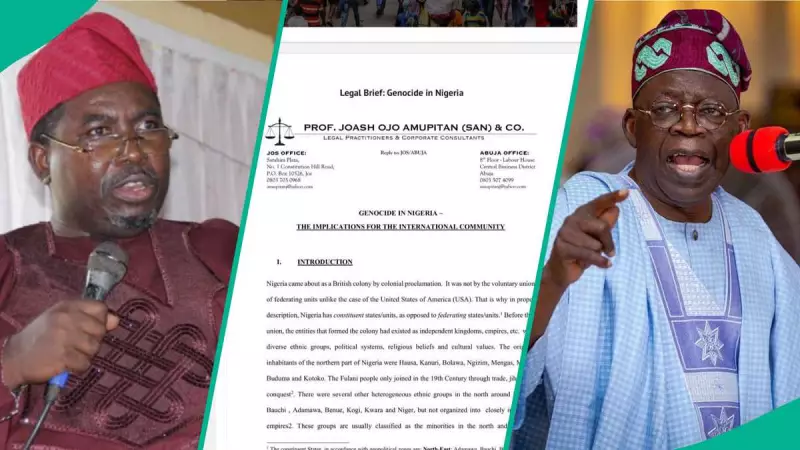
Nigerian political circles are engulfed in controversy as demands intensify for the removal of the newly appointed Chairman of the Independent National Electoral Commission (INEC), Professor Joash Amupitan. The uproar follows the resurfacing of a 2020 legal brief he authored, which described violence by Boko Haram and Fulani herdsmen as a coordinated campaign of genocide against Christians in Nigeria.
Legal Brief Details and Allegations
According to a review by Daily Trust, Professor Amupitan contributed an 80-page chapter titled "Legal Brief: Genocide in Nigeria" to a 2020 publication. In this document, he argued that the killings and mass displacement in certain regions met the legal definition of genocide under international law. He further alleged that the Nigerian government was complicit due to its failure to protect the affected Christian communities.
The brief went a step further, accusing Fulani ethnic militants and state institutions of collaborating towards the Islamisation of Nigeria. It recommended that the United Nations and major world powers consider referring Nigeria to the International Court of Justice (ICJ) and even contemplate military intervention as a final recourse.
Mixed Reactions from Legal Experts and Groups
The revelation has sparked a fierce debate among legal professionals regarding his suitability to lead the nation's electoral body. Senior Advocate of Nigeria, Nwoko Uwemedimo, opined that the government's dispute is with the term 'genocide,' not the existence of killings, and that Amupitan's past legal opinion should not impact his current role.
However, this view was strongly countered by another SAN, Mumini Jimoh, who stated that authoring such a report questions his credibility and integrity. Similarly, former Kwara Attorney General, Salman Jawondo (SAN), suggested it would be honourable for the INEC boss to resign if the document is confirmed to be his work.
Adding to the pressure, the Supreme Council for Sharia in Nigeria (SCSN) has demanded Amupitan's removal. The council labeled his 2020 brief as "toxic, divisive, and dangerous," arguing that its content reveals a prejudice incompatible with the neutrality required of an INEC chairman.
Government Silence and Political Fallout
Despite the growing public outcry, the Federal Government has maintained a conspicuous silence. Attempts to get a reaction from the Minister of Information and National Orientation, Mohammed Idris, were unsuccessful. Meanwhile, sources close to the INEC chairman indicate he is focused on preparations for the upcoming Anambra governorship election.
In a related development, the Senate has denied any prior knowledge of the controversial publication. The Senate spokesperson, Yemi Adaramodu, stated that lawmakers were not privy to the 2020 brief during Professor Amupitan's confirmation process. Professor Amupitan, a law professor from the University of Jos, was sworn in by President Bola Tinubu on October 23, 2025.