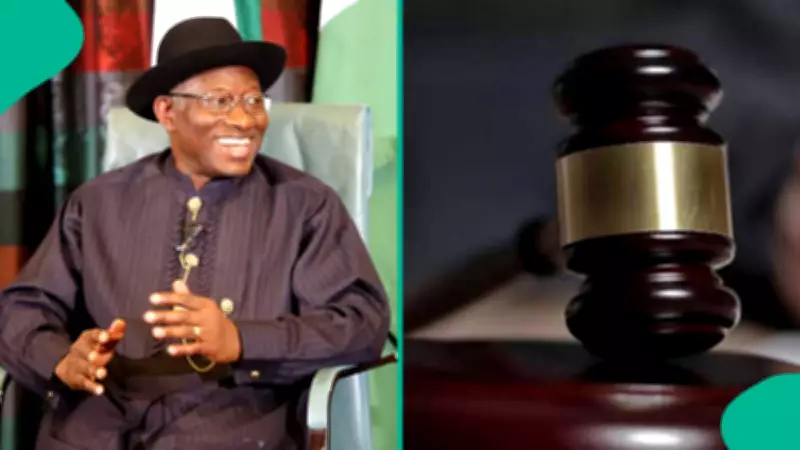
A Federal High Court in Abuja has scheduled May 26, 2026, to deliver its judgment in a lawsuit questioning former President Goodluck Jonathan's eligibility to run in the 2027 presidential election. Justice Peter Lifu set the date after hearing arguments from both sides. The case has garnered significant attention due to its potential to reshape the political landscape ahead of the next general election.
Plaintiff Seeks to Bar Jonathan from Contesting
The suit, filed by Jideobi, seeks to prevent Jonathan from presenting himself as a presidential aspirant under any political party for the 2027 race. Additionally, the plaintiff requests a court order restraining the Independent National Electoral Commission (INEC) from accepting, processing, or publishing Jonathan's name as a presidential candidate. The case hinges on constitutional interpretation, particularly Sections 1(1), (2), (3) and 137(3) of the 1999 Constitution, to determine whether Jonathan's previous tenure disqualifies him from seeking the office again.
Constitutional Grounds and Implications
The plaintiff argues that Jonathan's prior service as president may render him ineligible under the constitution. The upcoming ruling will clarify this issue and could influence the political atmosphere as parties gear up for the 2027 elections. This case underscores the importance of constitutional interpretation in Nigeria's democracy and the judiciary's role in resolving disputes over political participation.
Goodluck Jonathan's Political Background
Goodluck Ebele Azikiwe Jonathan, born on November 20, 1957, in Otuoke, Bayelsa State, began his political career in the late 1990s with the People's Democratic Party (PDP). He served as Deputy Governor of Bayelsa State from 1999, becoming governor in 2005 after his predecessor's impeachment. In 2007, he was selected as running mate to Umaru Musa Yar'Adua and became Vice President. Following Yar'Adua's death in 2010, Jonathan assumed the presidency, serving until 2015. His tenure focused on economic reforms, education, and infrastructure, but faced challenges like corruption and insecurity. In 2015, he lost to Muhammadu Buhari, notably becoming the first sitting Nigerian president to concede defeat peacefully, a move that strengthened the nation's democracy.
Legal Expert Advises Jonathan to Reconsider
Legit.ng earlier reported that Chief Ben Izuegbunam, a Senior Advocate of Nigeria, urged Jonathan to rethink his presidential ambition. The Onitsha-based lawyer suggested that various factors could lead to Jonathan's defeat if he enters the race. Meanwhile, a coalition of northern political groups, youth organizations, and PDP leaders is pressuring Jonathan to contest the 2027 election.