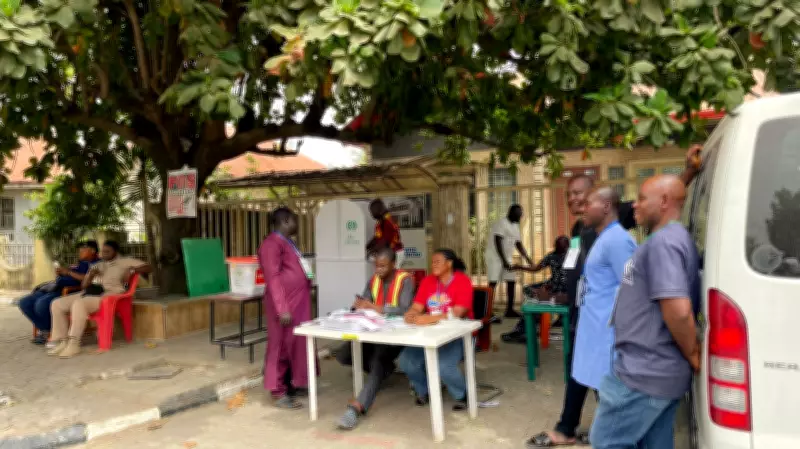
FCT Election Exposes Deep Democratic Crisis with 15% Voter Turnout
The recent area council election in the Federal Capital Territory has starkly revealed a profound democratic defect, serving as a troubling metaphor for electoral failures in Nigeria, a nation often hailed as Africa's largest democracy. Held in the nation's capital and occurring just a year before the pivotal 2027 general elections, this event underscores an urgent need for reform, as voter participation plummeted to alarmingly low levels.
Shocking Voter Apathy and Declining Turnout Trends
Despite the deployment of 4,345 BVAS machines across 2,822 polling units, only 239,210 out of 1,587,025 registered voters with Permanent Voter Cards exercised their civic duty, resulting in a mere 15% turnout. In the Abuja Municipal Area Council, where 837,338 voters are registered, a paltry 65,676 were accredited, representing less than eight percent. Reports from some polling units indicated as few as 10 individuals voted throughout the entire day, painting a grim picture of citizen disengagement.
This low turnout is not an isolated incident but part of a disturbing national trend. Data from the Catholic Bishops Conference of Nigeria shows a steady decline in voter participation over the years: from 69% in 2003 to 57% in 2007, 54% in 2011, 43.65% in 2015, 35.66% in 2019, and a mere 23% in 2023. With the FCT, often considered a barometer of the country's democratic health, recording turnout below 15%, this issue transcends local governance and demands immediate national attention.
Controversial Electoral Act and Restrictive Measures
A key factor contributing to this voter apathy is the Electoral Act 2026, signed into law by President Tinubu on February 18, 2026, just three days before the election. Section 60(3) of this legislation allows manual collation as the primary method for counting results in cases of network failure, with Form EC8A serving as the decisive document. While electronic transmission is permitted, it is not mandatory and can be bypassed due to "technological failure," a clause that has eroded public trust given past experiences with manual processes.
Compounding these concerns were the conditions on election day. The FCT Police Command, acting on directives approved by the President and announced by FCT Minister Nyesom Wike, imposed a 12-hour movement restriction across major roads, including Maitama, Karu, Orozo, Mararaba-Nyanya, and Gwagwalada. Security operatives set up roadblocks, turning back many citizens attempting to reach polling units. This restrictive environment, coupled with Wike's visible presence at polling units despite not being a registered voter in the FCT, created perceptions of undue influence and further discouraged participation.
Political Mismanagement and Opposition Failures
The election was also marred by political mismanagement. The APC's campaign council for local council seats was chaired by a state governor and co-chaired by three others, with high-profile federal figures like the Senate President and Speaker of the House of Representatives as members. This heavy federal involvement in area council polls risked creating a perception of compromise, making voting seem futile to many citizens.
Opposition parties share blame for the low turnout, as many polling units lacked opposition agents and there was little organised mobilisation before the vote. The PDP's sole victory in Gwagwalada occurred under unusual circumstances, with the APC candidate withdrawing and endorsing his rival. Rather than solely blaming the ruling party, opposition groups must address their own organisational shortcomings to regain public trust.
Citizen Responsibility and Government Response
Citizens cannot be absolved of responsibility; staying home on election day and later complaining about governance is contradictory. By refusing to vote, individuals ensure their voices are not counted, perpetuating a cycle of disengagement. Following the election, the ruling party and Presidency celebrated the outcome, with the APC chairman citing it as confirmation of public support for President Tinubu's agenda. However, winning five of six councils with over 85% of registered voters abstaining points to a weak mandate, undermining claims of broad public backing.
The swift celebration by the Presidency, amid opposition complaints, mirrors the rapid signing of the Electoral Act 2026 despite protests. In light of such low turnout, leadership should have engaged in sober reflection rather than partisan celebration. With the Electoral Act 2026 set to govern the 2027 elections, the burden now falls on INEC to deploy credible personnel and restore confidence in the electoral process, as perceived bias among referees discourages enthusiastic participation.
Moving Forward: A Call for Reform and Service Delivery
The FCT council polls have concluded, with victors and vanquished offering their perspectives. The core expectation remains citizen-oriented governance. While higher turnout and a less restrictive environment would have been ideal, the elected officials can still mitigate the embarrassment of February 21, 2026, by delivering quality services to the electorate. This election serves as a critical wake-up call for Nigeria to address its democratic deficiencies before the 2027 general elections.