The political landscape in Nigeria has witnessed a significant development as the Independent National Electoral Commission has formally recognized the Labour Party National Working Committee under the leadership of Nenadi Usman. This recognition comes in direct compliance with a court order issued by the Federal High Court in Abuja, mandating the electoral body to acknowledge Usman's faction as the legitimate authority within the party.
Official Recognition and Committee Listings
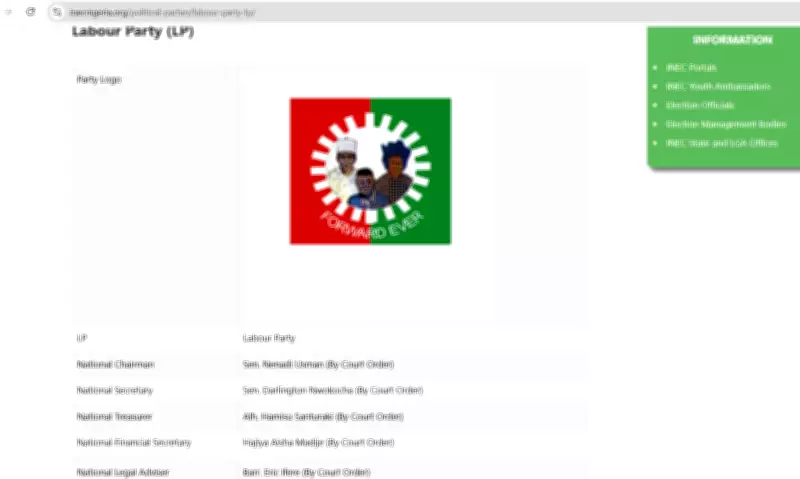
Verification conducted on the official INEC website on Friday, January 30, confirmed that the commission has updated its records to reflect Nenadi Usman as the chairperson of the Labour Party caretaker committee. The updated listings include other key members of the National Working Committee, such as Senator Darlington Nwokocha serving as National Secretary, Hamisu Santuraki as National Treasurer, Aisha Madije as National Financial Secretary, and Eric Ifere as National Legal Adviser.
This administrative action by INEC introduces a fresh dimension to the ongoing leadership turmoil that has plagued the Labour Party, one of Nigeria's prominent opposition political organizations. The recognition effectively creates parallel structures within the party, setting the stage for potential constitutional and operational conflicts.
Judicial Background and Court Ruling
The foundation for this development was laid on January 21 when Justice Peter Lifu of the Federal High Court in Abuja delivered a landmark ruling that recognized the Usman-led National Working Committee while simultaneously removing Julius Abure from the position of national chairman. Justice Lifu's judgment was grounded in an earlier Supreme Court decision that had declared Nenadi Usman as the authentic leader of the Labour Party.
In his comprehensive ruling, Justice Lifu issued a clear directive ordering INEC to recognize the Usman-led committee as the party's legally recognized authority until the conduct of the next national convention. The judge substantiated his decision by noting that evidence presented before the court demonstrated that Abure's tenure had officially expired, thereby invalidating his continued leadership claims.
Legal Reasoning and Constitutional Implications
While acknowledging that internal party affairs typically fall outside judicial purview, Justice Lifu emphasized that the establishment of a caretaker committee represented "a necessity" flowing directly from the Supreme Court's earlier judgment. This nuanced interpretation of party constitutional matters has sparked considerable debate within legal and political circles regarding the appropriate boundaries of judicial intervention in political party administration.
Factional Responses and Legal Challenges
Following the court's ruling, the Julius Abure-led faction of the Labour Party immediately announced its intention to pursue an appeal against the judgment. The group's spokesperson, Obiorah Ifoh, articulated their position by stating, "The judgment represents a clear contradiction of the Supreme Court's established position, which explicitly stated that no court possesses the authority to appoint leadership for any political party and that leadership matters constitute internal affairs of political parties."
Ifoh further elaborated on their legal stance by referencing previous judicial decisions, noting that the Court of Appeal had previously affirmed Abure's National Working Committee as the authentic leadership of the party. He insisted, "To our understanding, this ruling directly contradicts the Supreme Court's consistent position that all matters relating to political party leadership are internal affairs that should be resolved through party mechanisms rather than judicial intervention."
Historical Context and Political Ramifications
The internal crisis within the Labour Party traces its origins to the aftermath of the 2023 general elections, during which the party's presidential candidate, Peter Obi, garnered over six million votes nationwide. This electoral performance positioned the Labour Party as a significant opposition force, making its internal stability particularly crucial for Nigeria's democratic landscape.
In preparation for the upcoming 2027 elections, Peter Obi has since declared his affiliation with the African Democratic Congress, creating a leadership vacuum within the Labour Party. Subsequently, the party appointed Abia State Governor Alex Otti as its national leader, adding another layer to the complex leadership dynamics currently unfolding within the opposition political space.
The recognition of Nenadi Usman's leadership by INEC represents more than just an administrative update; it signifies a pivotal moment in Nigeria's political evolution, highlighting the intricate relationship between judicial authority, electoral administration, and party politics. As the Labour Party navigates these turbulent waters, the outcome of this leadership dispute will likely have far-reaching implications for opposition politics and electoral dynamics in Nigeria's evolving democratic system.