Reno Omokri Counters David Mark on Real-Time Election Results Transmission
Ambassador designate Reno Omokri has strongly criticized former Senate President David Mark for joining calls for real-time transmission of election results in Nigeria. This response comes after Mark, who chairs the African Democratic Congress (ADC), participated in a press conference with other opposition leaders on Thursday, February 26, in Abuja. At this event, they demanded the cancellation of the recently signed electoral law, which permits real-time transmission but also includes provisions for manual tabulation in areas with network failures.
Opposition Leaders Unite Against Electoral Law
The press conference saw prominent figures such as Atiku Abubakar, Peter Obi, and Rotimi Amaechi voicing their opposition to the new electoral regulations. They argued that the law's dual approach—combining electronic and manual methods—could compromise the integrity of election outcomes. However, Omokri, in a Facebook post shared this morning, questioned Mark's timing and motives, pointing out his long tenure in the Senate without advocating for such changes.
Omokri's Critique of Mark's Stance
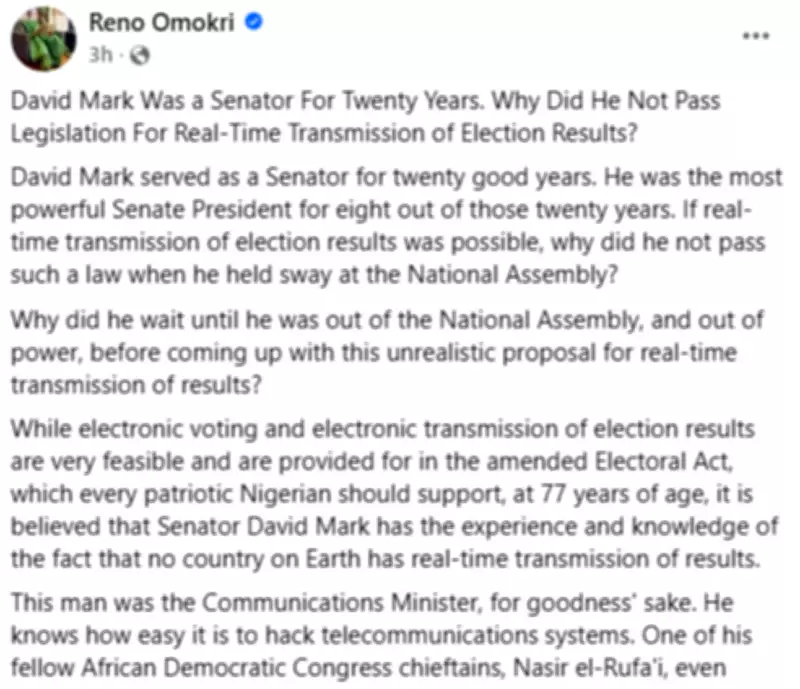
In his social media statement, Omokri highlighted that David Mark served as a Senator for twenty years, including eight as the powerful Senate President. He asked why Mark did not push for legislation on real-time transmission during his time in office, suggesting that his current advocacy is unrealistic and politically motivated. Omokri emphasized that while electronic voting and transmission are feasible and supported under the amended Electoral Act, no country globally implements real-time transmission as proposed.
Omokri wrote: "David Mark was a Senator for twenty good years. If real-time transmission was possible, why did he not pass such a law when he held sway at the National Assembly?"
Security Concerns and Global Comparisons
Omokri, referencing Mark's background as a former Communications Minister, raised serious security concerns. He noted that telecommunications systems are vulnerable to hacking, citing an example where an associate of ADC chieftain Nasir el-Rufa'i allegedly hacked the National Security Adviser's phone. Omokri warned that if such breaches can occur, foreign powers or terrorists could potentially hack the Independent National Electoral Commission's servers, risking the imposition of illegitimate candidates.
He debunked claims that countries like Brazil and Estonia use real-time transmission, clarifying that these nations only send results electronically after polls close, with manual backups in place. For instance, Brazil's Resolution Number 23.669 provides for manual voting and transmission as a contingency for internet or power outages. Omokri also mentioned that even advanced nations like the United States, United Kingdom, France, and Germany do not employ real-time transmission, and cybersecurity incidents, such as attacks on Amazon Web Services, highlight ongoing vulnerabilities.
Call for Practical Election Integrity Measures
Omokri concluded by arguing that rigging elections can be prevented through practical measures, such as ensuring all political parties have agents at every polling unit to sign Form EC8A. He suggested that some opposition parties lack organization and are seeking unrealistic legal amendments to cover their deficiencies. By advocating for a balanced approach that acknowledges technological limitations and security risks, Omokri urged support for the existing electoral framework, which includes electronic transmission with manual safeguards.