Divisions within Nigeria’s opposition bloc following the Ibadan summit have raised questions about the viability of a proposed single presidential candidate for the 2027 general elections, potentially strengthening the ruling All Progressives Congress (APC). While opposition leaders at the summit agreed to present a united front against President Bola Ahmed Tinubu, immediate dissent from key actors, including factions within the African Democratic Congress (ADC) and the African Action Congress (AAC), has exposed fault lines that could undermine efforts at electoral consolidation.
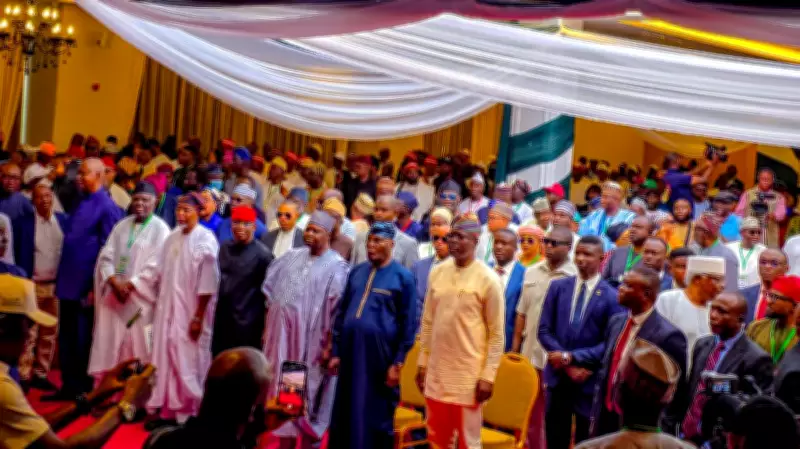
The summit, hosted by Oyo State Governor Seyi Makinde on Saturday, brought together key opposition figures, including former Vice President Atiku Abubakar, Labour Party’s 2023 presidential candidate Peter Obi, and former Kano State governor Rabiu Musa Kwankwaso. Beyond internal disagreements, the coalition faces legal and structural constraints. Nigeria’s electoral framework requires candidates to run under a single party, while rules on primaries, consensus and merger timelines limit coalition options, further complicated by intra-party disputes and competing ambitions.
Meanwhile, the APC has moved quickly to capitalise on the emerging divisions, dismissing the coalition as incoherent and lacking credibility, and arguing that the opposition’s internal disputes reinforce doubts about its capacity to mount a coordinated challenge in 2027. The All Progressives Congress rejected allegations of persecution by opposition figures at the summit and dismissed claims of a move towards a one-party state, describing comments attributed to Oyo State Governor Seyi Makinde as capable of undermining national stability.
Opposition parties, at a summit held in Ibadan on Saturday, had resolved to form a united front against what they described as attempts to impose a one-party system ahead of the 2027 general elections. In a statement signed by its National Publicity Secretary, Felix Morka, the APC said Makinde invoked the “bloody history” of “Operation Wetie” to incite Nigerians to violence over what it described as “baseless and senseless allegation of the country’s descent into a one-party state.”
The party described the governor’s remarks as “reckless and a clear and present threat to peace and national security,” adding that it was disturbing for a sitting governor to reference a violent episode in Nigeria’s history in a manner it said could threaten public order. “By his incitement to violence, Makinde has shown himself to be unworthy of the high office of Governor that he occupies,” the party stated. “Makinde’s violent rhetoric cannot be dismissed as mere opposition posturing. His statement risks fueling anarchy, murderous rage and widespread lawlessness capable of undermining national stability. We therefore call on all relevant security and intelligence agencies to take this unfortunate development seriously and act to safeguard lives, property, and defend Nigeria’s democratic order.”
The Peoples Democratic Party (PDP) has however, accused President Bola Tinubu, the All Progressives Congress (APC), and key national institutions of being responsible for rising political tension and any potential violence ahead of the 2027 general elections. In a counter-statement issued by its National Publicity Secretary, Comrade Ini Ememobong, the opposition party defended Oyo State Governor Seyi Makinde over his recent remarks at the National Summit of Opposition Political Parties held in Ibadan, insisting that his reference to the historic “wetie” violence was not a threat but a warning against political repression.
The PDP said the governor merely used history to caution the ruling party and national institutions about the consequences of suppressing opposition voices. “The use of history in the way and manner done by Governor Makinde in the said speech served as a caution and advisory to the Federal Government, the APC, and other national institutions, of the unmitigated crisis that their actions and inactions can result in,” the statement said. According to the PDP, Makinde’s remarks were a reminder that when political greed replaces patriotism and good governance, and public frustration continues to build, the outcome could be severe.
The APC also rejected what it described as attempts by “confused opposition leaders to frame their internal shambles in alarmist narratives about so-called one-party domination.” The party said opposition parties were grappling with internal challenges arising from what it described as “anti-democratic practices, miserably poor leadership, internal contradictions, utter disregard for due process and the rule of law, persistent factionalisation, and the desperate and dissonant presidential ambitions of their leaders.”
It further alleged that the Peoples Democratic Party was weakened by Atiku Abubakar’s “ruthless confiscation” of its 2023 presidential ticket, while claiming that the Labour Party had been undermined by the “restless nomadic disposition” of its 2023 presidential candidate, Peter Obi. The APC also described the African Democratic Congress coalition platform as “basically stillborn,” alleging that it had been weakened by internal disputes among opposition figures.
According to the party, opposition leaders had failed to build stable political structures, instead moving between parties in pursuit of presidential ambitions. The APC expressed confidence that Nigerians would assess the opposition’s internal challenges and governance record. “These opposition leaders and their coalition of confusion have not put anything forward by way of an alternative vision for Nigeria’s development. All they have in their arsenal is fear-mongering built on false narratives about the APC,” the statement said.
The party maintained that Nigeria’s democratic space remains open, noting that multiple political parties are registered and active in the electoral process. It reaffirmed its commitment to strengthening democratic institutions, upholding the rule of law, and implementing the Renewed Hope Agenda under the leadership of President Bola Ahmed Tinubu.
ADC disowns Ibadan opposition summit, affirms readiness for 2027 elections
The Nafiu Bala Gombe-led faction of the African Democratic Congress declared that the party was not involved in the recently convened National Summit of Opposition Political Parties held in Ibadan. The party also assured its members and supporters nationwide of its full participation in the 2027 general elections.
In a statement issued by its Director of Media and Public Affairs, Christopher Okechukwu, the ADC formally disassociated itself from the gathering, describing it as an event attended by individuals pursuing personal political ambitions. Okechukwu said the party plans to field credible candidates for all elective positions across the country in line with its constitutional mandate and democratic principles.
He stated: “The duly constituted and legitimate National Leadership of the African Democratic Congress under the tutelage of Nafiu Bala Gombe hereby categorically disassociates itself from, and declares its non-participation in, the so-called National Summit of Opposition Political Parties convened in Ibadan. As a principled and formidable opposition party in Nigeria, the ADC refuses to align itself with, or lend credibility to, a coalition of disgruntled elements whose political desperation knows no bounds.”
Sowore rejects Ibadan opposition summit, rules out coalition for 2027
Also, human rights activist and presidential candidate of the African Action Congress (AAC) in the 2023 election, Omoyele Sowore, rejected the resolutions of the opposition coalition summit held in Ibadan. Sowore said his party would not participate in what he described as an attempt to recycle Nigeria’s old political elite.
Sowore said he declined an invitation to attend the gathering, arguing that many of the participants have held power in different capacities over the years without delivering meaningful change. He maintained that the AAC would not be part of any coalition involving established political parties such as the APC, PDP, Labour Party and the African Democratic Congress, which were represented at the Ibadan meeting.
According to him, the party will instead present its own presidential candidate for the 2027 election, with a focus on building what he described as a genuine alternative rooted in accountability, transparency and people-driven governance. He said: “I was invited to attend the so-called ‘Opposition Summit’ in Ibadan, but I declined. There is no need to pretend that the same men (and a few women) who held Nigeria to ransom for years, presiding over stagnation, corruption, and systemic decay, can suddenly reinvent themselves as champions of progress or defenders of the people.”
Oyo APC dismisses Ibadan opposition summit as inconsequential
Similarly, the All Progressives Congress in Oyo State criticised participants at the opposition summit, describing them as lacking the capacity to advance democracy and good governance. In a statement issued in Ibadan by its Publicity Secretary, Olawale Sadare, the Oyo APC said neither President Bola Ahmed Tinubu nor members of the party were disturbed by the meeting, which it dismissed as inconsequential.
The party said the opposition lacked the seriousness and cohesion required to defeat the incumbent administration, describing the gathering as a futile exercise. “They are merely wasting their time. It is impossible for them to catch up with a man who is far ahead in the political race,” the statement said.
The APC also criticised Governor Makinde, accusing him of lacking the moral standing to lead opposition figures, whom it described as having poor governance records. It further alleged that threats linked to “Operation Wetie” should not be taken lightly, but expressed confidence that the 2027 general elections would be peaceful and credible. The party maintained that no act of unrest or violence would be allowed to undermine the electoral process, while insisting that those in power at the federal level remain focused on governance.
Utomi describes Ibadan opposition declaration as call for national liberation
However, Professor of Political Economy, Pat Utomi, has described the opposition declaration in Ibadan, Oyo State, to field a single presidential candidate in next year’s general elections as a call for national liberation. Utomi made the remark during an interview on Arise Television’s Morning Show, while reacting to the opposition summit.
The economist and chieftain of the African Democratic Congress said the choice of Ibadan as the venue was significant, noting that the gathering reflected a collective commitment among opposition figures to address challenges facing the country. He said: “Ibadan was an appropriate venue for the declaration by opposition politicians committing to rescue Nigerians in the face of creeping fascism, pressure toward a one-party state, and the shenanigans designed to disrupt multiparty democracy in this country.”
Utomi urged opposition parties to unite in addressing what he described as the “ponzi economics” of the APC-led administration. He also called on political actors to pursue a new policy direction focused on production, discipline and inclusive growth.
Single opposition candidate achievable, says ex-APC aspirant Ogbonnia
In the same vein, a former presidential aspirant of the All Progressives Congress, SKC Ogbonnia, said the resolution by opposition political parties to field a single presidential candidate for the 2027 election is achievable. Ogbonnia, who spoke to The Guardian in Enugu, described the outcome of the Ibadan national summit as a clarion call to save Nigeria, as well as an appeal for common sense and selflessness among citizens.
He said: “The very urgency of now is built around one individual that has emerged as the public enemy number one. The objective fact is that President Bola Ahmed Tinubu is an existential threat to the Nigerian project. This statement is not an emotional outburst nor a partisan outcry; it is a heartfelt scream for survival.”
Ogbonnia added that the opposition has no alternative but to unite behind a single candidate, stressing that such a candidate need not be perfect but must possess key attributes. “This candidate is not perfect, but simply a candidate who possesses these three non-negotiable attributes: popularity, massive financial backing, and high-level competence.”