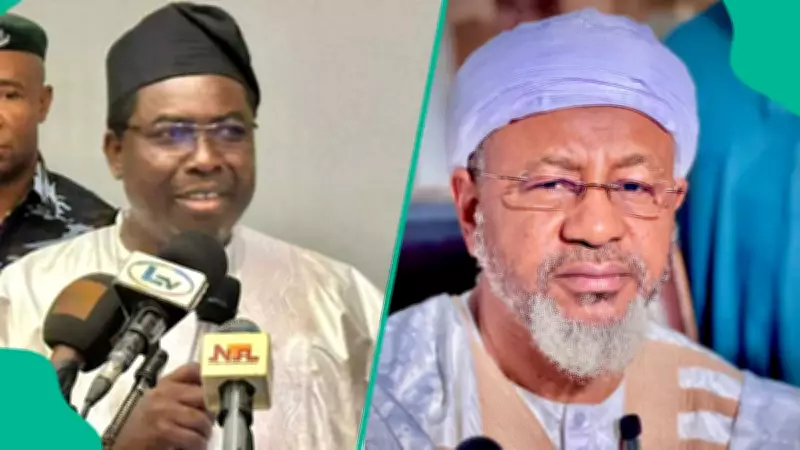
Shari'ah Council Demands INEC Chairman's Resignation Ahead of 2027 Elections
The Supreme Council for Sharia Law in Nigeria has issued a strong rejection of any future elections conducted under the leadership of Independent National Electoral Commission Chairman Professor Joash Amupitan. The council has formally called for his immediate resignation, warning that elections held under his supervision would lack legitimacy and further erode public trust in Nigeria's democratic institutions.
Religious Council Warns of Electoral Boycott
In a significant development that could impact Nigeria's electoral landscape, the Supreme Council for Sharia Law has declared that Nigerian Muslims will not recognize or accept any election results produced under Professor Amupitan's leadership. The council's speaker, Sheikh Bashir Aliyu Umar, made this position clear during an interview with the BBC, emphasizing that their stance stems from serious concerns about the INEC chairman's impartiality.
Sheikh Umar explained that the council's position was informed by what they described as Professor Amupitan's past actions, particularly referencing a legal brief he allegedly authored that appeared to accept claims of Christian massacres in Nigeria. "We are still at a loss because the chairman of the electoral commission has not come out to deny this claim," Sheikh Umar stated, adding that the alleged position taken by the INEC chairman amounted to divisive propaganda.
PFN Defends Constitutional Rights
Meanwhile, the Pentecostal Fellowship of Nigeria has strongly opposed the Shari'ah Council's demand for Professor Amupitan's removal. In an official statement signed by National Secretary Bishop David Bakare, the PFN described the call for resignation as unjustified and emphasized that every Nigerian, including public officials, maintains constitutional rights to express personal opinions.
The Christian organization argued that Professor Amupitan's right to express views on national issues should not jeopardize his position. "We must resist the temptation of profiling or judging people based on their religious beliefs," the PFN statement read, urging all stakeholders to exercise restraint and mutual respect on sensitive national matters.
Background of the Controversial Figure
Professor Joash Amupitan, born on April 25, 1967, in Ayetoro Gbede, Kogi State, brings extensive academic and legal credentials to his position. His educational journey includes:
- Primary and secondary education in Kwara State
- Studies at Polytechnic, Ilorin (1982-1984)
- Law degree from University of Jos (1984-1987)
- Master's degree in Law from University of Jos (1993)
- Doctorate from University of Jos (2007)
Currently serving as Vice-Chancellor of the University of Jos and Chairman of the Governing Council of Joseph Ayo Babalola University, Professor Amupitan was appointed Senior Advocate of Nigeria in 2014. His appointment as INEC chairman came with a charge from President Bola Ahmed Tinubu to work with integrity and protect electoral credibility.
Broader Religious Reactions
The controversy has drawn responses from various religious organizations across Nigeria. The Northern chapter of the Christian Association of Nigeria has criticized the Shari'ah Council's demand, emphasizing that competence and integrity rather than religious affiliation should guide leadership assessments. Christian groups have warned that using faith as a basis for political attacks risks deepening national divisions.
The ongoing debate highlights the delicate balance between religious sensitivities and institutional leadership in Nigeria's diverse democracy. As the 2027 general elections approach, this controversy raises important questions about electoral credibility, religious representation, and the boundaries of free expression for public officials.
Despite the mounting pressure and public statements from religious organizations, INEC has maintained official silence regarding the allegations against its chairman. The commission faces the significant challenge of preparing for the 2027 elections while navigating these complex religious and political dynamics that threaten to undermine public confidence in the electoral process.