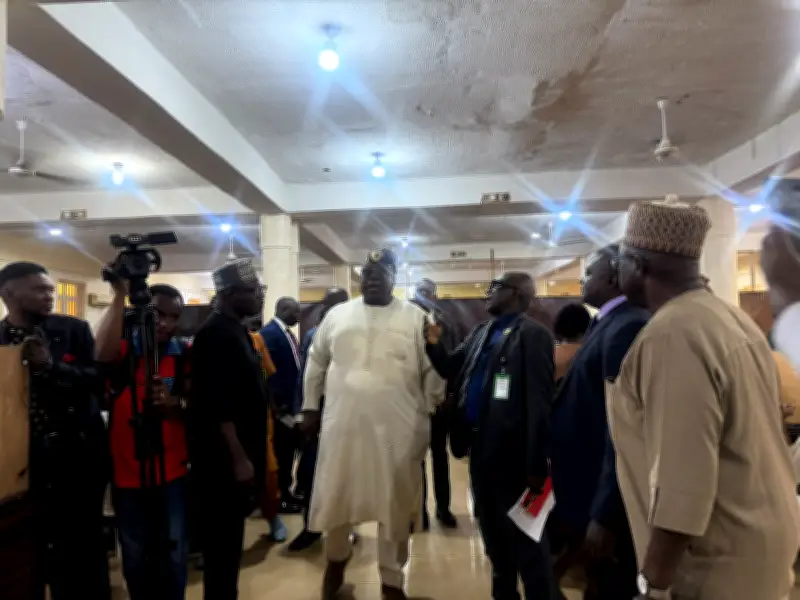
The Chairman of the Federal Civil Service Commission (FCSC), Prof. Tunji Olaopa, has expressed satisfaction with the orderly and largely seamless commencement of the 2026 Directorate Cadre Promotion Examination across designated centres nationwide. This followed his inspection of examination centres in Abuja on Monday, where he visited all eight centres within the Federal Capital Territory.
Prof. Olaopa disclosed that the Commission had planned for approximately 5,900 candidates, with 5,792 candidates successfully taking the examination so far. He explained that the exercise was decentralised across the six geopolitical zones to make participation more accessible to eligible officers and to improve the overall administration of the promotion process.
Decentralised Examination Across Geopolitical Zones
According to him, the candidates were distributed across centres in the Federal Capital Territory, South-West, South-East, South-South, North-West, North-East and North-Central zones. He noted that the FCT recorded the highest number of candidates partly because of its accessibility to officers from neighbouring States, including Kogi and Niger, thereby reducing the logistical burden associated with travelling to more distant examination locations.

Prof. Olaopa described the adoption of Computer-Based Testing (CBT) as a significant step forward in the Commission’s efforts to modernise and professionalise the administration of promotion examinations in the Federal Public Service. He observed that, based on the experience so far, CBT had proved considerably easier to administer than the previous manual system, while also providing greater opportunities for standardisation, transparency and efficient assessment.
High Punctuality and Minor Operational Challenges
The Chairman stated that approximately 97 per cent of candidates reported on time, while the few cases of late arrival were appropriately managed. He commended the candidates for their conduct and disclosed that the Commission had recorded only minor operational observations, which would serve as lessons for further improvement.
He also acknowledged some initial challenges associated with internet connectivity at a few centres, noting that the Commission had provided an alternative candidate identification code which enabled affected candidates to access the examination without prolonged delays. He further disclosed that provisions had been made for candidates with visual and physical challenges saying, “In instances where some candidates had not previously communicated their special requirements, the Commission, working with the Joint Admissions and Matriculation Board (JAMB), was able to make necessary adjustments to ensure that eligible candidates were accommodated.”
Addressing Computer Literacy and Ensuring Integrity
On concerns about computer literacy, he explained that the CBT platform was deliberately designed to be simple and user-friendly, requiring only basic navigation skills. He noted that the Commission had made demonstration materials available to candidates ahead of the examination and encouraged civil servants to continuously improve their digital competencies, particularly in view of the increasing digitalisation of government operations.
The Chairman reaffirmed the Commission’s commitment to protecting the integrity of the promotion process and preventing undue interference or manipulation. He stressed that the FCSC has a critical gatekeeping responsibility in ensuring that career progression in the Civil Service was based on merit, competence and demonstrable performance. He added that the Commission’s broader reform vision is to strengthen and reinvent competency-based human resource management in the Public Service.
Improved Performance and Future Improvements
He also acknowledged that the Commission’s work remains a continuous learning process. While rating the conduct of the 2025 exercise at about 68 per cent, he expressed confidence that the 2026 exercise had improved significantly, estimating the current performance at not less than 90 per cent. He identified logistics, network dependence, examination question-setting and other operational processes as areas where further improvements would continue to be pursued.

The Chairman expressed appreciation to the candidates, examination officials, JAMB and other stakeholders for their cooperation, while reaffirming the Commission’s determination to continuously improve the promotion examination system. He stated that the Commission would continue to explore measures that would make the process more accessible, efficient and credible, while ensuring that promotion remains a reflection of competence, merit and professional development within the Federal Civil Service.