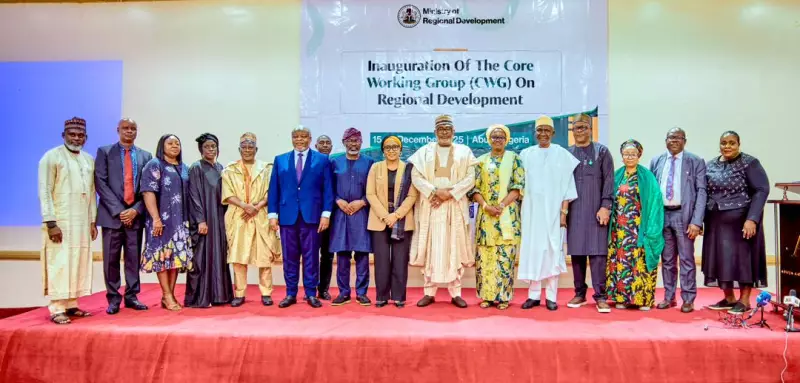
The Federal Government has taken a significant step towards addressing Nigeria's regional development disparities with the inauguration of a high-level technical team.
Inauguration of the Core Working Group
The Ministry of Regional Development officially launched its Core Working Group (CWG) on Regional Development in Abuja on December 15, 2025. The event, declared open by the Minister of State, Uba Maigari Ahmadu, marks a pivotal move in the government's strategy to strengthen policy coordination and institutional effectiveness for inclusive growth across all geopolitical zones.
Minister Ahmadu, acknowledging the leadership of President Bola Tinubu, stated that the creation of the Ministry and the various Regional Development Commissions is a deliberate national strategy. He described these commissions as strategic instruments designed to tackle persistent development gaps while also addressing evolving socio-economic and security challenges nationwide.
A Locally-Grounded and Secure Approach
The minister laid out clear expectations for the new initiative. He emphasised that the key to successful regional development is an approach that is locally grounded, secure, accountable, and sustainable. "A region-by-region approach must reflect local realities, priorities, and comparative advantages," Ahmadu stressed.
He further highlighted the critical need to integrate security considerations into development planning to reinforce peace-building, community resilience, and long-term stability. On governance, the minister insisted on strong accountability mechanisms featuring clear indicators, robust monitoring systems, and transparent processes. He also noted that all policy initiatives must align with national development plans and global best practices to ensure continuity beyond political cycles.
Technical Backbone and International Support
In her welcome address, the Permanent Secretary of the Ministry, Dr. Mary A. Ogbe, described the inauguration as a concrete step towards strengthening institutions and improving service delivery. She explained that the CWG will serve as the Ministry's technical backbone, providing evidence-based input and ensuring coherence across various departments.
Dr. Ogbe also revealed that the inauguration coincided with the start of a Rights and Results-Based Management (RRBM) training program. This training aims to transform how regional development policies are planned, implemented, and evaluated.
The event enjoyed strong international backing. In a keynote speech delivered on behalf of the United Nations Development Programme (UNDP), Mr. Hamidu Poufon, Chief Social Policy Officer, emphasised the Ministry's central role as the institutional anchor for achieving equitable and inclusive development. He stated that this role is crucial for the successful implementation of the government's Renewed Hope Agenda.
Poufon confirmed that the UNDP will serve as a technical partner to the Ministry. He outlined the main goal of the regional development efforts: to foster balanced national progress by driving inclusive growth in all regions. This ensures development interventions are equitably distributed to address disparities and unlock unique regional potentials.
The two-day high-level stakeholder engagement, held from December 15 to 16, 2025, was organized in collaboration with the Office of the National Security Adviser and the Federal Ministry of Budget and National Planning. It received support from international partners including the European Union (EU), UNDP, and UNICEF.