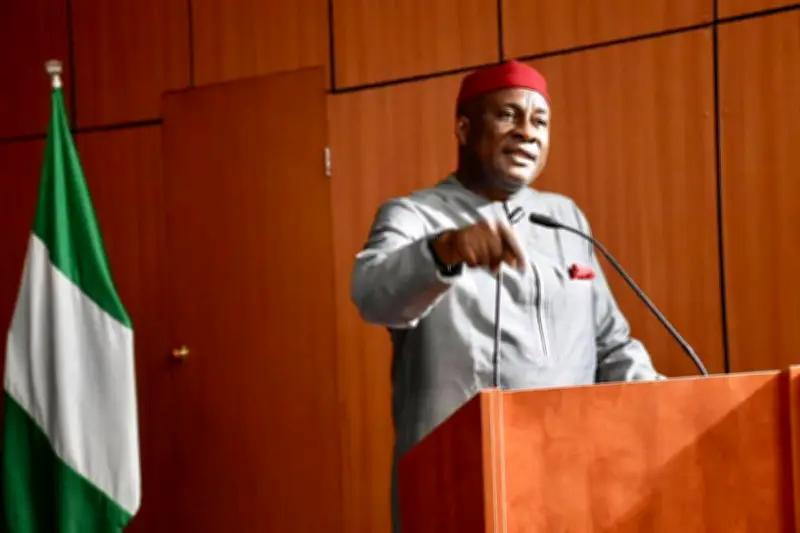
The Vice Chairman of the Airline Operators of Nigeria (AON) and Chairman of Air Peace, Allen Onyema, has issued a stark warning that several domestic airlines could cease operations within the next 30 days unless the Federal Government urgently intervenes in the challenges confronting the aviation industry. Speaking on Wednesday in Lagos, Onyema described the industry as facing an existential crisis driven by high operating costs and multiple financial obligations.
Onyema's Warning at Biography Launch
Onyema made these remarks at the launch of "Pathways, Pilgrimage & Destiny: The Biography of Alhaji Muneer Bankole," the founder of Med-View Airline. He emphasized the industry's harsh realities: "Going into aviation is not a piece of cake. It is an industry that is not very rewarding. It is capital-intensive, yet less rewarding. Today, we are facing a phase that poses existential threats. Except something drastic is done very quickly within the next 30 days, a lot of airlines might go extinct," he said.
The warning comes amid renewed concerns among Nigerian airline operators over the cost of aviation fuel, multiple regulatory charges, access to financing, and the financial obligations imposed on carriers. Onyema also criticized the planned picketing of airlines by aviation unions over the non-remittance of the five per cent Ticket Sales Charge (TSC), warning that such action could trigger a wider disruption in domestic air travel.
Threat of Picketing and Industry Solidarity
Onyema stated that airlines would support one another if any carrier were picketed. "If they picket any airline, others will go because there's no need for that. There is nowhere in the world that government agencies use unions to talk about issues of debt," he asserted. The five per cent TSC is a statutory charge collected by the Nigerian Civil Aviation Authority (NCAA) on tickets originating from Nigeria. The authority says the charge is collected under the Civil Aviation Act and shared with other aviation agencies, including the Nigerian Airspace Management Agency, the Nigerian Meteorological Agency, the Nigerian College of Aviation Technology, and the Nigerian Safety Investigation Bureau.
The NCAA has acknowledged challenges surrounding the timely remittance of the charge. In February, the authority met with AON regarding its requirement that airlines provide advance payment guarantees to ensure timely remittance. The NCAA said the measure was intended to safeguard funds collected from passengers and improve the predictability of funding for aviation agencies. It subsequently deferred implementation of the requirement for 90 days to allow operators to regularize outstanding remittances.
Financial Burden on Airlines
Onyema argued that the financial burden on airlines needed to be addressed through a broader review of government charges and the industry's operating environment. "The airlines are not against helping the government generate revenue. But no airline in the world is taxed directly for revenue. The airlines indirectly provide revenue for the government," he explained. He highlighted the capital-intensive nature of airline operations, high costs of aircraft maintenance, and daily operations as major challenges.
"Everybody pities Nigerian airlines, yet nobody wants to do anything about their situation," Onyema added. He noted that the industry's history showed how difficult it had been for domestic carriers to remain in business over the long term, with more than 50 airlines having exited the Nigerian market over the years. AON has previously cited the collapse of more than 50 Nigerian airlines over a three-decade period as evidence of the industry's long-standing financial difficulties.
Rising Cost Pressures and Calls for Intervention
The sector continues to face pressure from rising aviation fuel costs, foreign exchange challenges, aircraft maintenance expenses, and financing costs. In June, Onyema warned that airlines were borrowing from banks to purchase aviation fuel and reducing flight frequencies to limit losses. He also called for a review of aviation taxes and charges, particularly the five per cent TSC. More recently, he said many operators had been forced to scale back operations due to rising costs and warned that financial pressure could lead to further airline failures.
Onyema's latest warning adds to growing calls by airline operators for the government to review the financial and regulatory environment. The AON has previously sought direct engagement with President Bola Tinubu over aviation taxes and charges, arguing that the cumulative burden was undermining the viability of domestic airlines. Onyema called for an aviation taxes and charges review committee in June to examine the various levies imposed on airlines and recommend measures to improve sustainability.
Government's Position and Industry Outlook
The debate comes as the government continues to defend aviation-sector reforms and the need for airlines to meet their statutory obligations. The NCAA has said that the five per cent TSC is not an arbitrary levy but a statutory charge collected from passengers and remitted through airlines to fund key aviation agencies. For airlines, however, the issue is part of a wider concern about the cost of doing business in an industry where aircraft acquisition, maintenance, fuel, and financing are largely dollar-denominated.
Onyema said that unless urgent measures were taken to address the pressures facing operators, more airlines could be forced out of business. The industry's future hangs in the balance as stakeholders await government action.