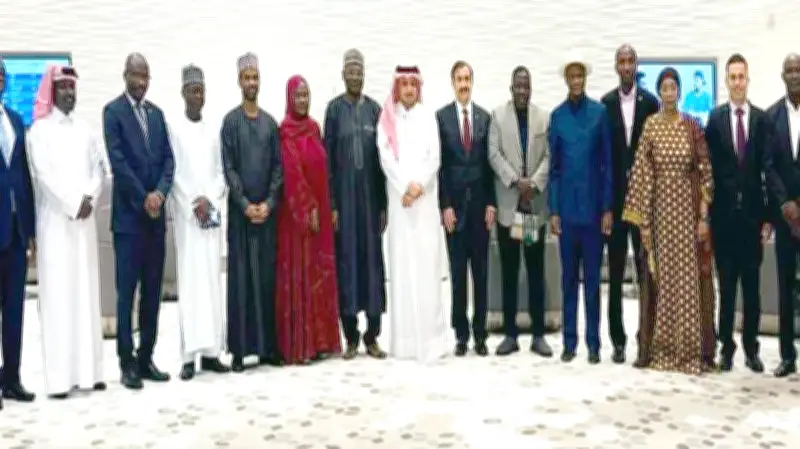
Former Chairman of the Independent National Electoral Commission (INEC), Professor Mahmood Yakubu, arrived in Doha on Wednesday to officially assume his duties as Nigeria’s ambassador to Qatar. This transition marks a significant shift from leading one of the country’s most contentious domestic offices to representing Nigeria on a strategically important diplomatic stage.
Arrival and Reception
Upon his arrival at the Qatari capital, the new envoy was received at the airport by Ambassador Ibrahim Yousif Abdullah Fakhro, Director of the Protocol Department at the Qatari Ministry of Foreign Affairs. This formal reception signalled Qatar’s official acknowledgement of his posting. Notably, 13 African ambassadors from Guinea, Algeria, Burundi, Morocco, Tanzania, Mali, Niger, Burkina Faso, Ghana, Senegal, Togo, Benin, and the Central African Republic also joined to welcome Yakubu. Additionally, Dr. Philip Mshelbila, Secretary General of the Gas Exporting Countries Forum, and Michael Ndukaihe Ihekwaba, President of the Nigerians in Diaspora Organisation in Qatar, were present at the reception.
Background and Appointment
Yakubu, who made history as the first INEC Chairman to serve two terms, concluded his tenure in October last year. He was among the 32 ambassadorial appointees whose names President Bola Tinubu forwarded to the Senate for confirmation in November. After Senate approval, the President approved the names of 65 ambassadors-designate on March 6, with Yakubu assigned to Qatar.

Strategic Significance
Analysts have described Yakubu’s posting to Qatar as strategic, citing the cordial relationship and strong economic ties between the two nations. Nigeria and Qatar formally established diplomatic relations in 2010, with both countries opening embassies in Abuja and Doha in 2013. The visit by former President Muhammadu Buhari to Qatar in 2016, followed by Qatar’s ruler Tamim bin Hamad Al Thani’s visit to Nigeria in 2019, laid the groundwork for extensive collaborations. President Tinubu’s visit to Qatar in 2024, during which several agreements and Memoranda of Understanding were signed, further deepened political and economic ties.
Energy Cooperation
Energy is a natural area of cooperation between Nigeria and Qatar. A key diplomatic goal will be to leverage Qatar’s expertise as a top LNG exporter alongside Nigeria’s vast natural gas reserves to advance mutual energy initiatives. The presence of Dr. Mshelbila at the airport underscores this priority. Yakubu now faces the task of aligning Nigeria’s Decade of Gas initiative with Qatari technical expertise and investment capital.
Economic Diplomacy
Beyond energy, Yakubu will need to translate President Tinubu’s economic reform programme—anchored on foreign exchange unification and subsidy removal—into concrete foreign direct investment flows from Qatar. The Qatar Investment Authority, the Gulf state’s sovereign wealth fund, manages assets exceeding $500 billion. Securing Qatari investment for viable Nigerian projects in agriculture, aviation, real estate, and digital infrastructure would be viewed as a significant diplomatic dividend.
Diaspora and Consular Services
Nigeria’s presence in the Gulf is expanding rapidly, shifting away from its traditional concentration in Western Europe and North America. Working alongside the Nigerians in Diaspora Organisation in Qatar, Yakubu will be expected to overhaul consular service delivery, protect the welfare of Nigerian professionals and labourers across the Gulf, and establish structured pathways for channelling diaspora remittances into productive investment at home.