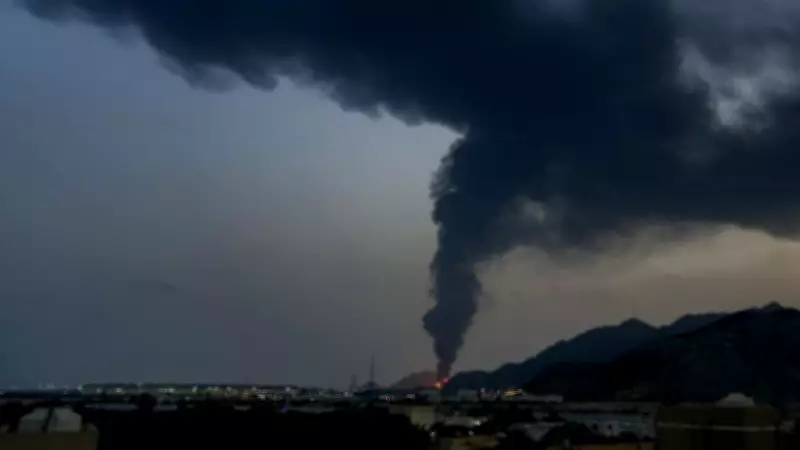
Iran Launches New Wave of Attacks on Gulf States, Targeting Vital Infrastructure
Iran initiated a fresh series of missile and drone assaults across Gulf nations on Sunday, March 8, striking critical infrastructure in Kuwait and Bahrain as the regional conflict entered its second consecutive week. Authorities confirmed that Iranian strikes directly hit fuel storage tanks at Kuwait International Airport and caused significant damage to a desalination plant in Bahrain, escalating tensions in the volatile region.
Casualties and Infrastructure Damage Reported
Kuwait's interior ministry officially announced that two border guards lost their lives "while performing their national duty" during the attacks, though specific details surrounding their deaths were not immediately disclosed. According to an AFP tally, at least sixteen individuals, including eight civilians, have been killed across the Gulf region since the conflict began following large-scale strikes by the United States and Israel against Iranian targets.
In Kuwait, the military stated that fuel tanks at the international airport were targeted by a drone strike. The Kuwait News Agency reported that a resulting fire was swiftly contained, with no major injuries recorded. However, the military characterized the assault as "a direct targeting of vital infrastructure." Debris from interception operations also damaged several civilian facilities, prompting Kuwait's national oil company to implement a precautionary reduction in crude oil production in response to multiple missile and drone threats.
Bahrain's Water Facility and Civilian Areas Hit
Bahrain's interior ministry reported that an Iranian drone strike damaged a water desalination facility, accusing Tehran of indiscriminately targeting civilian infrastructure. Earlier, the Islamic Revolutionary Guard Corps claimed it had struck the United States' Naval Support Activity Bahrain, alleging the base was used in attacks against an Iranian desalination facility. Bahrain's national communication office later clarified that the strike on the water plant did not disrupt water supplies or network capacity. Authorities also confirmed that falling missile debris injured three people and damaged a university building in the Muharraq area.
Regional Air Defenses Activated Amid Continued Threats
Saudi Arabia's defence ministry revealed that its air defence systems successfully intercepted thirty-three drones launched toward the country, including one targeting Riyadh's diplomatic quarter and another aimed at the Shaybah Oil Field. Officials reported no casualties or major damage from these attempted strikes. The United Arab Emirates stated its air defence systems were actively responding to incoming missile and drone threats, while Qatar confirmed that ten ballistic missiles and two cruise missiles fired from Iran the previous day were mostly intercepted.
Contradictory Messages from Iranian Leadership
Despite Iranian President Masoud Pezeshkian's apology to Gulf states hosting US military bases for Iranian strikes on their territory the previous day, Tehran's judiciary chief warned that attacks would continue on sites in Gulf states "at the disposal of the enemy." Pezeshkian reiterated that Tehran would persist in responding if neighbouring countries permitted their territories to be used for attacks against Iran. In a televised address, Mohammed bin Zayed Al Nahyan declared that the UAE was now in "a period of war" but would ultimately emerge stronger from the crisis.
Incident at Dubai International Airport
In Dubai, authorities confirmed that a Pakistani national was killed by debris from an aerial interception. The city briefly closed Dubai International Airport after an unidentified object was intercepted nearby. Witnesses described hearing a loud explosion followed by smoke rising near an airport concourse. Officials later characterized the incident as "a minor incident resulting from the fall of debris after an interception" and confirmed no further injuries were recorded.
The weekend attacks also impacted Saudi Arabia, the United Arab Emirates, Qatar, and Kuwait, with explosions reported earlier in Dubai and Manama. As the conflict persists, Gulf states remain on high alert, with vital infrastructure and civilian areas increasingly vulnerable to further escalation.