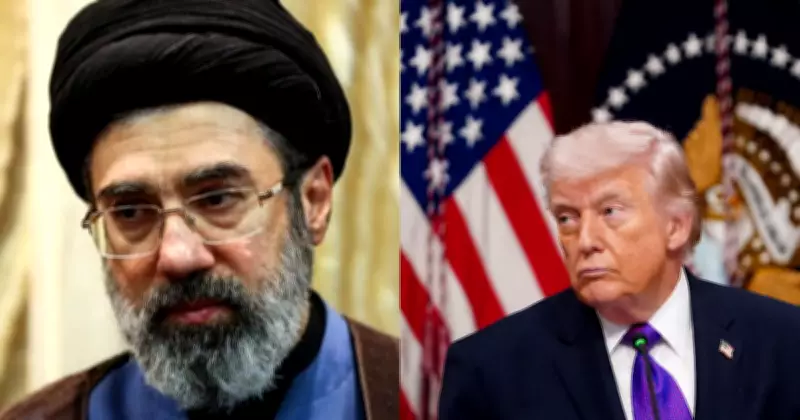
Iran's New Supreme Leader Mojtaba Khamenei Assumes Power Amidst Regional Missile Barrage
In a dramatic escalation of Middle Eastern tensions, Iran has launched a series of missile strikes targeting Israel and several Gulf nations, mere hours after appointing Mojtaba Khamenei as the country's new supreme leader. The 56-year-old son of the late Ayatollah Ali Khamenei was officially selected by Iran's 88-member Assembly of Experts, making him the third leader of the Islamic Republic since its establishment in 1979.
Immediate Military Action Follows Leadership Transition
The announcement of Mojtaba Khamenei's appointment was broadcast on Iranian state television, with a solemn presenter reading the official statement alongside a photograph of the new leader. "He is appointed and introduced as the third leader of the sacred system of the Islamic Republic of Iran," declared the statement, which further emphasized that the clerical body "did not hesitate for a minute" despite what it described as "the brutal aggression of the criminal America and the evil Zionist regime."
Shortly after this announcement, state media displayed footage of a projectile flying toward Israel, prominently featuring the slogan "At Your Command, Sayyid Mojtaba," clearly signaling Iran's immediate retaliatory posture under its new leadership.
Regional Impact and Escalating Violence
The situation across the Middle East has grown increasingly tense and volatile:
- Saudi Arabia successfully intercepted drones aimed at its crucial eastern oil fields
- The United Arab Emirates and Kuwait both reported missile attacks on their territories
- Bahrain activated emergency sirens as rockets approached populated areas
- Lebanon has become a significant battleground, with Iran-backed Hezbollah fighters engaging Israeli forces who entered via 15 helicopters from Syria
Fierce clashes erupted in Nabi Sheet, where Israel had previously killed 41 people, while a separate strike on a hotel in Beirut resulted in the deaths of five Revolutionary Guards commanders. Lebanon's health ministry reports at least 394 fatalities since the conflict began, including 83 children and 42 women.
International Reactions and Market Turmoil
Global leaders have responded to the rapidly developing situation with varying degrees of concern and confrontation. U.S. President Donald Trump, speaking before the official announcement of Iran's new leadership, dismissed Mojtaba Khamenei as a "lightweight" and insisted that the United States should have a say in his appointment. Israel's defense minister had previously warned that any new supreme leader would immediately become a "target."
The conflict has already sent shockwaves through global financial markets:
- The benchmark price for crude oil surged past $100 per barrel for the first time since Russia's invasion of Ukraine
- Stock markets across Asia experienced significant declines
- President Trump downplayed the price spike, calling it a "small price to pay" for removing what he perceives as Iran's nuclear threat
Humanitarian Toll and Continuing Escalation
Casualties continue to mount across the affected region:
- Bahrain reported 32 people wounded in a drone attack on Sitra, including a two-month-old baby and a 17-year-old girl with severe injuries
- Saudi Arabia confirmed two fatalities and twelve injuries in Al-Kharj province
- Iran's health ministry estimates at least 1,200 civilian deaths and approximately 10,000 injuries, though these numbers have not been independently verified by international agencies
- Israeli authorities report ten fatalities, while two Israeli soldiers were killed in Lebanon
The United States is not anticipating a quick resolution to the conflict. The State Department has ordered non-emergency staff to evacuate Saudi Arabia following a drone strike that hit the U.S. embassy. President Trump indicated that any decision to end hostilities would be made in coordination with Israeli Prime Minister Benjamin Netanyahu.
Internal Iranian Dynamics and Future Outlook
Mojtaba Khamenei assumes leadership during a period of intense internal and external pressure. His appointment comes just weeks after Iranian security forces violently suppressed nationwide protests, resulting in thousands of deaths. Considered a hardliner like his father, the new supreme leader is expected to continue cracking down on dissent within Iran.
The Islamic Revolutionary Guard Corps has pledged "complete obedience and self-sacrifice" in executing Mojtaba Khamenei's commands, while Foreign Minister Abbas Araghchi declared that the leadership change would "guarantee national sovereignty and territorial integrity." Iranian diplomats have publicly pledged their allegiance to the new leader.
As the region braces for further escalation, the Middle East faces an expanding conflict that has already created significant humanitarian crises, disrupted global energy markets, and raised fears of prolonged warfare under Iran's new leadership.