
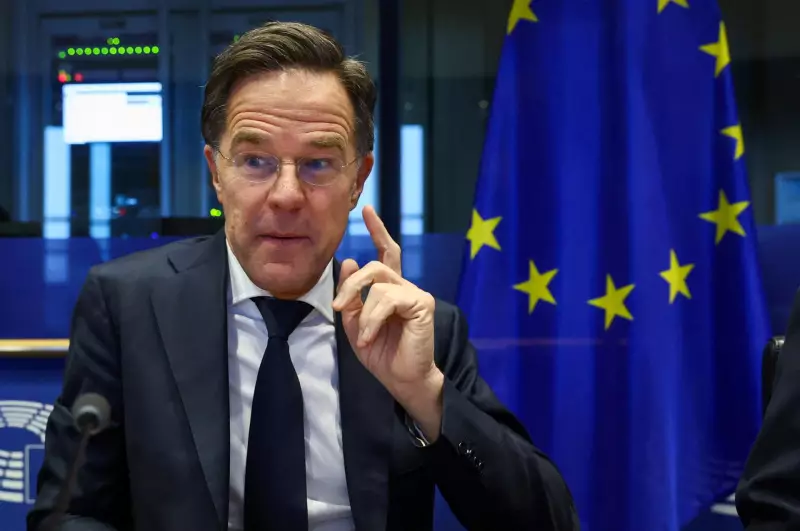
NATO Secretary General Mark Rutte has delivered a stark warning to European nations, stating bluntly that any belief in independent continental defense without United States support is merely a fantasy. In a direct address to committees of the European Parliament in Brussels, Rutte emphasized the indispensable nature of the transatlantic alliance for European security.
"Keep on Dreaming" If You Think Europe Can Go It Alone
"If anyone thinks here again that the European Union, or Europe as a whole, can defend itself without the US, keep on dreaming. You can't. We can't. We need each other," Rutte declared during his Monday appearance. His comments served as a sobering reality check for European lawmakers contemplating greater strategic autonomy.
The NATO chief outlined the staggering practical requirements for true European independence, suggesting defense spending would need to skyrocket to as much as 10 percent of GDP. Furthermore, he noted Europe would have to develop its own nuclear deterrent capability at a cost of billions of euros—a prospect he clearly viewed as unrealistic and undesirable.
The Critical US Nuclear Umbrella
Rutte specifically highlighted the irreplaceable role of American nuclear protection. "In that scenario, you will lose the ultimate guarantor of our freedom, which is the US nuclear umbrella. So hey, good luck," he remarked, underscoring the strategic vulnerability Europe would face without this cornerstone of NATO's deterrence posture.
His remarks followed a particularly turbulent period in transatlantic relations, sparked by renewed US interest in Greenland under President Donald Trump. Although Trump later ruled out using force to annex the Arctic island during his Davos speech, the episode highlighted ongoing geopolitical tensions.
Arctic Security Emerges as Critical Flashpoint
Despite potential irritation among European lawmakers, Rutte praised Trump for drawing necessary attention to Arctic security challenges. "I think he's right. There is an issue with the Arctic region. There is an issue of collective security, because these sea lanes are opening up, and because the Chinese and the Russians are more and more active," the NATO chief acknowledged.
Rutte outlined a dual-track approach to addressing Greenland and broader Arctic concerns:
- Enhanced NATO Responsibility: The alliance would assume greater collective responsibility for defending the Arctic region, specifically aiming to limit military and economic access by Russia and China.
- Continued Trilateral Dialogue: Separate talks would continue between the United States, Denmark, and Greenland's government, though Rutte clarified he would not participate in these negotiations, lacking any mandate to represent Danish interests.
Recent Diplomatic Developments
Earlier in January, Danish Foreign Minister Lars Løkke Rasmussen and Greenlandic Foreign Minister Vivian Motzfeldt held what were described as "constructive" discussions with US Vice President JD Vance and Secretary of State Marco Rubio in Washington. However, Rasmussen noted that "fundamental disagreements" persisted regarding Greenland's status.
The following week brought another twist when Trump and Rutte met at the World Economic Forum in Davos. The US president claimed to have reached a framework agreement on Greenland with the NATO chief, subsequently announcing he would no longer impose tariffs on European countries that had opposed his territorial ambitions. While details of this framework and Rutte's exact involvement remain unclear, the episode once again positioned the NATO secretary general at the center of delicate transatlantic diplomacy.
Rutte's Brussels appearance ultimately reinforced a central message: European security remains fundamentally intertwined with American commitment, despite periodic tensions and disagreements over specific issues like Arctic strategy. His blunt assessment suggests that dreams of European strategic independence will remain just that—dreams—for the foreseeable future.




