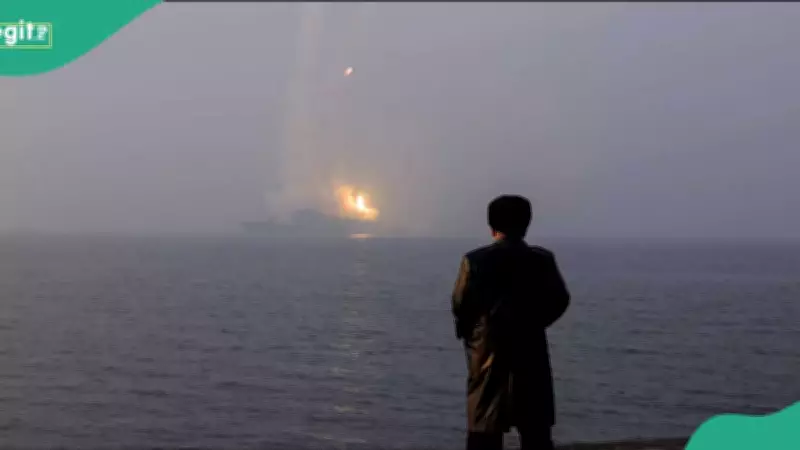
North Korea Launches 10 Ballistic Missiles Amid US-South Korea Military Drills
North Korea has fired approximately 10 ballistic missiles toward the eastern sea, according to South Korea's military, in a pointed display of force that coincided with joint military drills involving South Korea and the United States. The launches occurred on Saturday, marking a significant escalation in regional tensions during the allied exercises.
Missile Launch Details and Trajectory
South Korea's Joint Chiefs of Staff reported that the projectiles were launched from the Sunan area near Pyongyang's international airport. The missiles traveled an estimated distance of about 350 kilometers before landing in the sea. Japanese authorities confirmed that the weapons fell outside Japan's exclusive economic zone and reported no damage to aircraft or vessels in the area.
The missile activity unfolded as South Korean and United States forces pressed ahead with their annual spring exercises, which involve thousands of troops and are designed to enhance coordination and readiness. Seoul's military stated it has intensified surveillance and remains on heightened alert while sharing real-time intelligence with Washington and Tokyo.
Diplomatic Context and Regional Reactions
The launches came only hours after South Korean Prime Minister Kim Min-seok met with U.S. President Donald Trump in Washington, where he expressed hope for renewed diplomacy with Pyongyang. President Lee Jae Myung has sought to ease tensions with the North, and aides have suggested that Trump's upcoming visit to China could open diplomatic space.
However, Saturday's missile test appeared to counter that optimism. Pyongyang has hardened its stance toward Seoul in recent months and has urged Washington to abandon denuclearization demands before talks can resume. North Korea routinely condemns allied drills as invasion rehearsals and often answers them with weapons demonstrations.
In previous years, the North has staged salvo launches framed as simulations of nuclear strikes on South Korean targets, highlighting the persistent threat it poses to regional stability. Earlier this week, Kim Yo Jong, the influential sister of leader Kim Jong Un, criticized the drills and warned of "terrible consequences" if the country's security is challenged.
Broader Military and Strategic Implications
The ongoing Freedom Shield exercise, which runs through March 19, focuses on command post coordination and computer-simulated scenarios, alongside a related field training program. The drills have drawn renewed scrutiny as Washington is also engaged in a widening conflict in the Middle East.
Local media in Seoul have speculated that some U.S. missile defense assets stationed in South Korea could be repositioned to support operations elsewhere. Those reports have fueled public concern about possible gaps in the country's defenses. South Korea's presidential office declined to confirm details about U.S. military movements but emphasized that any redeployment would not weaken the allies' posture against a nuclear-armed North Korea.
Officials pointed to Seoul's conventional military capabilities as a deterrent, underscoring the importance of maintaining a strong defense posture in the face of North Korean provocations. Despite repeated calls from Seoul and Washington to revive talks stalled since 2019, Pyongyang has shown little interest, instead prioritizing closer ties with Russia through troop deployments and military support linked to the war in Ukraine.
Regional Alignments and International Context
North Korea's Foreign Ministry has also denounced recent U.S. and Israeli strikes on Iran while signaling support for Tehran's new leadership, indicating broader geopolitical alignments that complicate diplomatic efforts. The missile launches serve as a reminder of the volatile security environment in Northeast Asia and the challenges of managing relations with a reclusive and unpredictable regime.
As tensions rise during the allied drills, the international community watches closely, with Japan and other regional players monitoring North Korea's actions for any signs of further escalation. The lack of reported damage from the missile launches offers a temporary respite, but the underlying issues of denuclearization and regional security remain unresolved.