
North Korea Conducts Ballistic Missile Test Amid Heightened Regional Tensions
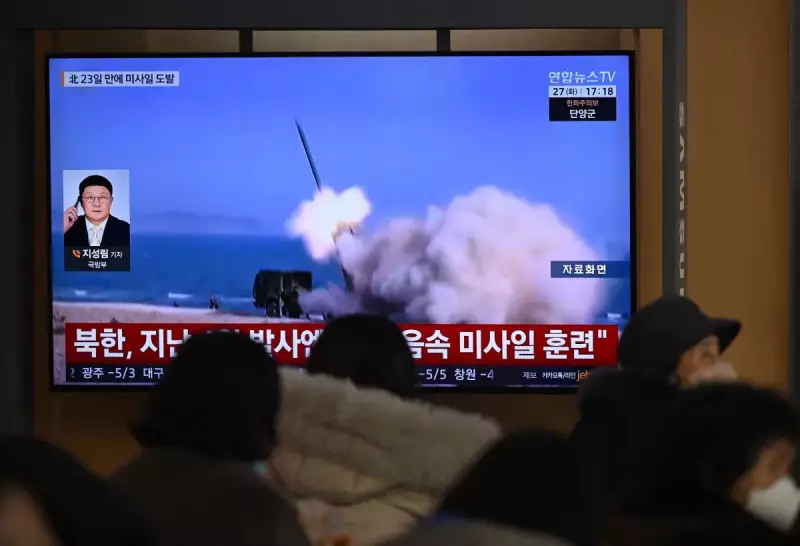
In a significant escalation of military posturing, North Korea fired at least two ballistic missiles toward the Sea of Japan on Tuesday, January 27. This provocative action was confirmed by defense officials from both Japan and South Korea, occurring against a backdrop of intensifying geopolitical friction on the Korean Peninsula.
Immediate Regional Responses and Confirmation
Japan's coast guard, acting on information from the country's defense ministry, swiftly reported the detection of two ballistic missiles flying in the direction of the Sea of Japan. According to reports from Japanese media outlet Jiji Press, the projectiles ultimately landed outside Japan's Exclusive Economic Zone, avoiding immediate territorial infringement but sending a clear strategic message.
Simultaneously, South Korea's Joint Chiefs of Staff announced that their surveillance systems had identified multiple ballistic missiles being launched toward what they refer to as the East Sea. This coordinated monitoring underscores the high alert status maintained by regional powers in response to Pyongyang's expanding missile capabilities.
Strategic Timing and Political Context
The missile launch represents North Korea's second such test this month, following closely on the heels of another demonstration conducted just hours before South Korea's president embarked on a diplomatic mission to China. This pattern suggests a deliberate strategy of timing military displays to coincide with significant regional diplomatic movements.
Notably, this latest provocation occurred merely one day after Elbridge Colby, the Pentagon's third-highest-ranking official, concluded a visit to Seoul where he publicly praised South Korea as Washington's "model ally." This characterization appears to have drawn a direct response from Pyongyang, which regularly condemns the enduring military alliance between the United States and South Korea.
Historical Alliances and Contemporary Tensions
The United States and South Korea maintain a formidable military partnership originally forged during the Korean War, with Washington currently stationing approximately 28,500 troops on South Korean soil as a deterrent against North Korean aggression. Pyongyang consistently portrays joint military exercises between these allies as rehearsal for invasion, further inflaming regional hostilities.
Last month, North Korean leader Kim Jong Un personally criticized South Korea's efforts to develop nuclear-powered submarines with American support, labeling the initiative a direct "threat" that required decisive countermeasures. This rhetoric aligns with Pyongyang's broader pattern of responding aggressively to perceived enhancements in allied military capabilities.
Failed Diplomacy and Shifting Alliances
Former US President Donald Trump engaged in three high-profile meetings with Kim Jong Un during his first term, attempting to negotiate a denuclearization agreement. However, these diplomatic efforts ultimately collapsed following an unsuccessful summit in Hanoi, where parties failed to reconcile disagreements about concessions Pyongyang would receive in exchange for abandoning its nuclear arsenal.
More recently, North Korea has reportedly deployed thousands of military personnel to support Russia's ongoing conflict in Ukraine, according to intelligence assessments from South Korean and Western agencies. This development suggests Pyongyang is cultivating strategic partnerships that extend beyond the Korean Peninsula.
Domestic Political Calculations
The timing of this missile launch holds particular significance as North Korea prepares for a major congress of its ruling Workers' Party, scheduled to occur in the coming weeks. This gathering marks the first such event in five years, and Kim Jong Un has reportedly ordered substantial expansion and modernization of the country's missile production capacity in anticipation.
Yang Moo-jin, a professor at the University of North Korean Studies in Seoul, offered analysis suggesting multiple motivations behind the launch. "With the party congress approaching, the latest launch appears intended to heighten tensions to reinforce internal discipline and consolidate regime unity," he observed. The professor further noted that the timing "may also be a response to Colby's visit" to the Korean Peninsula, indicating both domestic and international calculations behind the military demonstration.
Broader Implications for Regional Security
This latest missile test underscores North Korea's continued commitment to advancing its precision strike capabilities, which analysts believe serves multiple strategic objectives:
- Enhancing military deterrence against the United States and South Korea
- Testing weapons systems potentially intended for export to allied nations
- Demonstrating technological advancement ahead of important political events
- Responding to perceived provocations from regional adversaries
The persistent development of North Korea's ballistic missile program represents an ongoing challenge to regional stability, with each test providing valuable data for Pyongyang's weapons engineers while simultaneously testing the resolve and coordination of neighboring powers.




