
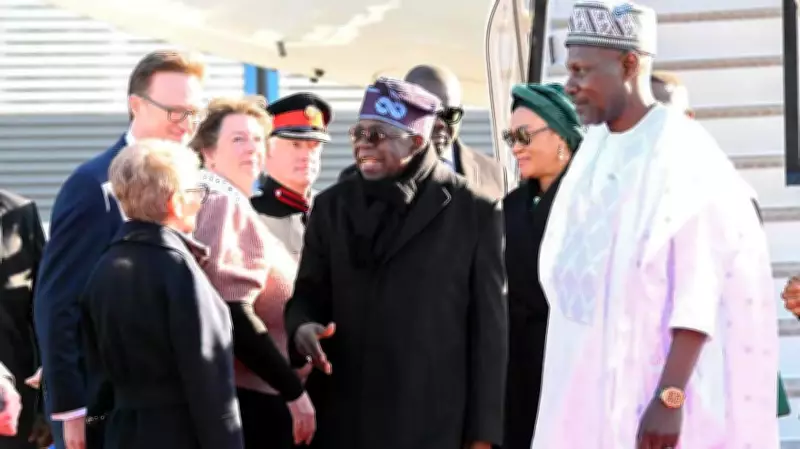
Tinubu at Windsor: Between Design and Destiny
When President Bola Ahmed Tinubu and his wife, Senator Oluremi Tinubu, entered the historic grounds of Windsor Castle on Wednesday, they were greeted by King Charles III and Queen Camilla. This moment carried a profound significance that went beyond mere ceremony, representing the first such high-level royal reception of a Nigerian leader in 37 years.
A Historic Diplomatic Gap
The 37-year gap since Nigeria's last similar reception raises critical questions. What transpired during these decades? Was there a diplomatic distance between the two historically connected nations that the public was not meant to scrutinize? Even excluding the military years, this lingering inquiry prompts reflection on Nigeria's national trajectory and the timing of this renewed engagement.
Diplomacy at its highest level is rarely about pleasantries; it is about signals. Windsor Castle, steeped in centuries of imperial memory, is not a venue for routine engagements. It is reserved for moments of strategic intent. Hosting Nigeria's president there suggests a recalibration—not only of bilateral relations but of how Nigeria is being repositioned within the global order.
The Political Durability of Bola Tinubu
Beyond the symbolism of Windsor lies a more complex inquiry: what explains the political durability and expanding influence of Bola Ahmed Tinubu? Truth be told, Tinubu's political career defies linear interpretation. He is not a product of chance; he is an architect of systems.
From Lagos to the national stage, his enduring strength has been his capacity to build networks that outlive moments. Where others accumulate followers, Tinubu cultivates structures—alliances that are flexible, absorptive, and resilient. His most striking political trait is neither dominance nor charisma, but assimilation.
Adversaries are rarely discarded; they are reconfigured and rehabilitated. Individuals who once opposed him now occupy strategic positions within his administration, including ministerial offices and diplomatic postings. This is not sentiment; it is doctrine.
Tinubu appears to operate from a philosophy that power is most effective when it neutralises opposition not through destruction, but through incorporation. In many political systems, memory is weaponised. Tinubu, however, seems to deploy memory differently.
His capacity to forgive—often described in almost mystical terms—may, in fact, be deeply strategic. For him, the hole of political hostility should not be dug too deep. By reabsorbing dissent, he reduces external threats while expanding his sphere of influence internally.
Geopolitical Significance and Economic Substance
The significance of the Windsor meeting extends into the realm of geopolitical signaling. For the United Kingdom, engagement with Nigeria is not optional. Nigeria remains Africa's largest economy and most populous nation, with strategic relevance across energy markets, regional security, and migration dynamics.
For Nigeria, however, Windsor was not only symbolic—it delivered substance. A £746 million export finance agreement was secured to support the rehabilitation of the Lagos Port Complex and Tin Can Island Port—two critical arteries of Nigeria's trade ecosystem long constrained by inefficiencies.
Engagements with Prime Minister Keir Starmer further deepened cooperation across trade, security, and migration, while also situating Nigeria within the United Kingdom's evolving post-Brexit economic diplomacy. There were also deliberate engagements with the Nigerian diaspora, reinforcing a bridge between policy and people, and signaling confidence in Nigeria's global human capital.
Even within the ceremonial setting, there were subtle layers of diplomatic sensitivity. The visit coincided with Ramadan, and adjustments were made to accommodate the President's observance, reflecting a level of cultural awareness that often escapes formal communiqués but matters deeply in international relations.
Domestic Reforms and Global Perception
Domestically, Tinubu's presidency has been defined by bold, and in many cases, disruptive economic reforms. The removal of fuel subsidies and the unification of foreign exchange windows marked a decisive break from long-standing policy inertia.
These measures have been widely acknowledged by institutions such as the International Monetary Fund and the World Bank as necessary corrections to structural distortions. However, necessity does not preclude consequence. Inflationary pressures, rising living costs, and currency volatility have imposed real burdens on ordinary Nigerians.
The reform process, while economically rational, is politically expensive. This tension—between long-term stability and short-term hardship—defines the current phase of Tinubu's administration.
Internationally, Tinubu is increasingly framed as a leader willing to undertake politically costly reforms where his predecessors lacked the courage. Financial markets have responded with cautious optimism, even as investors and rating agencies continue to weigh policy consistency against implementation risks.
The global narrative oscillates between two poles: Tinubu as a reformer resetting Nigeria's economic fundamentals, and Tinubu as a risk-taker navigating reforms within a fragile socio-economic environment. The truth, perhaps, lies in the convergence of both.
Leadership and Legacy
Who, then, is Bola Ahmed Tinubu? He is not easily reduced to archetype. He is neither purely ideological nor purely transactional. Instead, he embodies a hybrid model of leadership—part strategist, part institution-builder, part political philosopher.
At the core of his approach appears to be a belief in historical continuity: that power, once attained, must be used to construct systems that endure beyond individual tenure. This may explain both his inclusiveness and his persistence.
It may also explain the almost mythic language that surrounds his journey—the sense, among supporters and critics alike, that his trajectory operates beyond conventional political probability.
The image of Tinubu at Windsor Castle will endure not because of its rarity alone, but because of what it represents: a convergence of personal political mastery and national repositioning. Yet, it would be simplistic to attribute his rise solely to destiny.
What appears, at a distance, as mystique may, on closer inspection, be method—disciplined, deliberate, and deeply informed by an understanding of power as both instrument and inheritance.
Still, the question lingers: Is Tinubu a product of design, or a beneficiary of something less tangible—something that defies logic? Perhaps the answer lies in the uneasy space between both. For now, what is certain is this: at Windsor, Nigeria was not merely present. It was being reintroduced.
And, at the centre of that reintroduction stands a man who continues to challenge the boundaries between strategy and destiny.




