
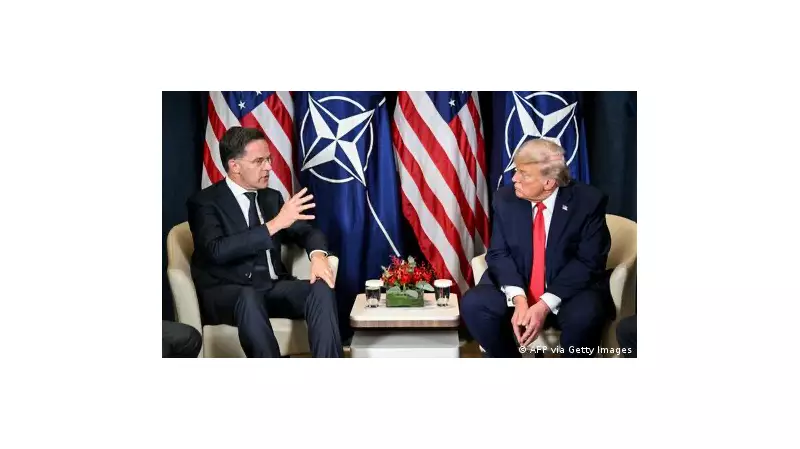
In a significant diplomatic development, former US President Donald Trump has announced the establishment of an agreed "framework" for a future deal concerning Greenland and the broader Arctic region. The announcement came following discussions with NATO Secretary-General Mark Rutte during the World Economic Forum in Davos, Switzerland.
Strategic Framework for Arctic Cooperation
Trump revealed the framework agreement late Wednesday through his Truth Social platform, describing it as a comprehensive arrangement that addresses multiple strategic interests. The framework reportedly encompasses security considerations, trade opportunities, and broader geopolitical cooperation in the increasingly important Arctic region.
"The United States and NATO have formed the framework of a future deal with respect to Greenland and, in fact, the entire Arctic Region," Trump stated during his announcement. This development represents a notable shift from previous discussions that had focused more narrowly on potential US acquisition of Greenland.
Clarifying Position on Greenland
When questioned by journalists about whether this framework aligned with his previously expressed interest in the United States owning Greenland, Trump characterized the situation as "a little bit complex." He notably refrained from making any claims of ownership or territorial acquisition, marking a departure from earlier rhetoric on the subject.
NATO Secretary-General Mark Rutte further clarified the discussions, emphasizing that Denmark's sovereignty over Greenland had not been a topic of conversation during their meetings. This clarification helped alleviate concerns about potential territorial disputes arising from the framework announcement.
Suspension of European Tariffs
In a related economic development, Trump confirmed that he would suspend previously announced tariffs targeting eight European countries. These tariffs had been scheduled to take effect on February 1, raising concerns about renewed transatlantic trade tensions.
The decision to suspend these tariffs was met with approval from several European governments, including Denmark, Italy, and the Netherlands. Officials from these nations described the move as a positive development for both transatlantic relations and economic stability across the region.
Diplomatic Approach Emphasized
Earlier during the Davos forum, Trump sought to address concerns about his previous statements regarding Greenland. He explicitly stated that the United States would not employ force to gain control of the territory, emphasizing a diplomatic approach over confrontation.
"While the United States has the power to act, it would not resort to excessive strength and force," Trump declared, reinforcing his commitment to diplomatic solutions in international relations. This statement helped contextualize the framework agreement within broader foreign policy objectives.
The announcement represents a notable development in Arctic diplomacy and transatlantic relations, potentially signaling a shift toward more collaborative approaches in addressing regional security and economic concerns.




