
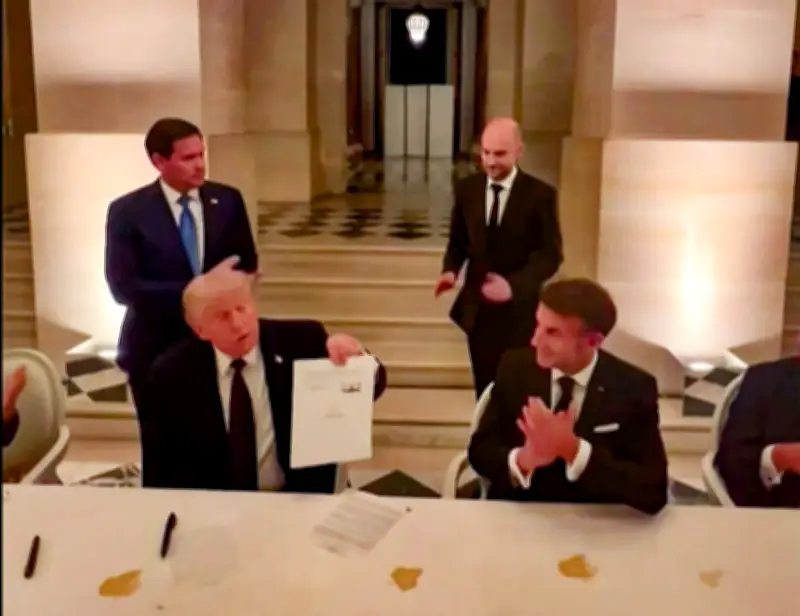
US President Donald Trump has hit back at critics of his agreement with Iran, describing those who claim he made too many concessions to end the war as “fools.”
Details of the Agreement
The deal, signed by Trump and Iranian President Masoud Pezeshkian, is aimed at ending the recent conflict, reopening the Strait of Hormuz and creating a pathway for further negotiations on Iran’s nuclear programme.
Speaking after the signing ceremony in France, Trump argued that the agreement was already producing positive economic results, pointing to record stock market gains and declining oil prices. He insisted that opponents of the deal were ignoring its benefits and accused them of being motivated by politics rather than facts.
Key Provisions
The agreement is expected to bring an end to the conflict between the United States, Israel and Iran, while restoring shipping through the Strait of Hormuz, one of the world’s most important energy routes. A 60-day negotiation period will now begin as both sides work toward a broader agreement covering Iran’s nuclear activities.
Under the deal, the United States will ease certain oil sanctions on Iran, while discussions continue on a potential reconstruction fund worth hundreds of billions of dollars. The International Atomic Energy Agency (IAEA) has also indicated its readiness to supervise measures relating to Iran’s enriched uranium stockpiles.
International Reactions
French President Emmanuel Macron praised the agreement, describing it as a major step toward peace and regional stability. Iranian officials also welcomed the deal, with President Pezeshkian calling it “historic” and saying the focus should now shift to implementation.
Criticism and Opposition
However, the agreement has faced criticism from some American politicians and analysts who argue that it does not go far enough in restricting Iran’s nuclear ambitions. Republican Senator Bill Cassidy described it as one of the worst foreign policy mistakes in decades, claiming Iran had gained significant benefits without making enough concessions.
Iranian officials, meanwhile, stressed that the country’s ballistic missile programme would not be part of any future negotiations, insisting that its defence capabilities remain non-negotiable.
Next Steps
The focus now moves to upcoming talks in Switzerland, where negotiators will attempt to reach a long-term agreement on Iran’s nuclear programme and broader regional security issues. Oil markets reacted positively to the announcement, with prices falling as concerns over disruptions to global energy supplies eased.




