
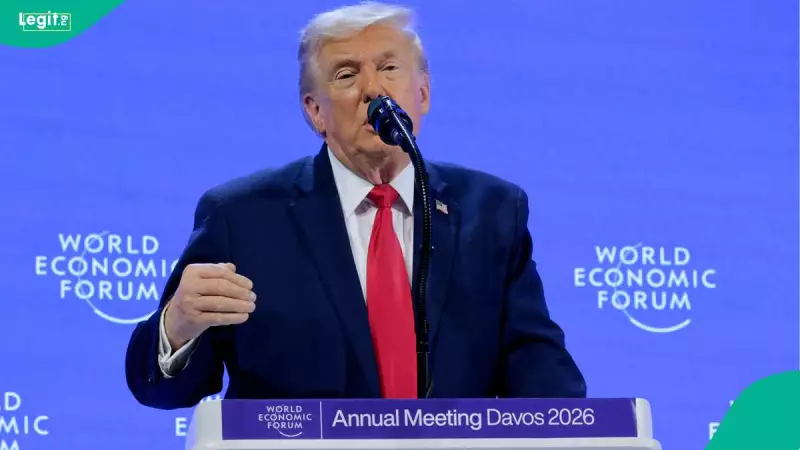
Trump Reignites Greenland Acquisition Push at Davos Forum
Former President Donald Trump has once again stirred international controversy by demanding immediate negotiations for the United States to acquire Greenland, the vast Arctic territory currently under Danish sovereignty. During a fiery speech at the World Economic Forum in Davos, Switzerland, Trump insisted on pursuing this acquisition despite clear rejections from both Danish and Greenlandic authorities who maintain the territory is not for sale.
Rejection of Military Annexation, Emphasis on Negotiation
In his address, Trump explicitly dismissed the possibility of using military force to annex Greenland, stating "I don't want to use force. I won't use force." Instead, he emphasized diplomatic channels, arguing that "immediate negotiations" should commence to discuss what he described as the United States' rightful acquisition of the strategic Arctic island. Trump claimed that only America possesses the capability to properly protect, develop, and improve Greenland for both European and American interests.
Historical Claims and Treaty Disregard
The former president revived historical arguments, suggesting the United States could have retained control of Greenland after deploying troops there during World War II to prevent German seizure. He criticized past American leaders for what he called their "stupid" decision to relinquish the territory. Remarkably, Trump's demands appear to disregard the 1917 treaty between the U.S. and Denmark, in which America formally renounced any claim to Greenland in exchange for purchasing what are now the U.S. Virgin Islands.
Strategic Defense Arguments and Existing Agreements
Trump argued that America needs "right title and ownership" of Greenland to properly defend it, despite the existence of a 1951 defense agreement that already grants the United States unlimited basing rights on the island. He dismissed the current arrangement as insufficient, stating "you can't defend it on a lease" and pointing to psychological reasons for requiring full ownership. This position comes despite Greenland's current status as an autonomous territory within the Kingdom of Denmark.
Veiled Threats to Denmark and Allies
The former president's remarks included what appeared to be veiled threats toward Denmark and other nations that might resist his acquisition demands. Addressing Davos attendees, Trump warned: "You can say yes, and we will be very appreciative. Or you can say no, and we will remember." These comments formed part of a broader speech that included sharp criticism of America's European allies and NATO partners.
Geographical Confusion and NATO Criticism
Even as he pressed for Greenland's acquisition, Trump demonstrated significant geographical confusion, mistakenly referring to Greenland as Iceland on multiple occasions during his speech. He also expressed doubt about NATO's reliability, suggesting he was "not sure they'd be there" if the United States faced another attack like September 11, despite historical evidence of NATO's collective defense response following those attacks.
Broader Criticism of Allies and Immigration Policies
Trump's Greenland remarks were embedded within a wider critique of international relations. He renewed attacks on European immigration policies, accusing leaders of allowing too many immigrants from non-white countries. He also targeted Canada specifically, calling the nation "ungrateful" in response to comments by Prime Minister Mark Carney about American reliability under Trump's previous administration.
Previous Statements and Security Justifications
This latest push continues Trump's longstanding interest in acquiring Greenland, which he has previously justified on national security grounds. In January 2026, he wrote on social media platform X that the United States needed Greenland for what he described as the "Golden Dome" project, warning that rival powers like Russia or China could otherwise gain influence in the strategically important Arctic region.
The renewed demand for Greenland acquisition negotiations represents another chapter in Trump's unconventional approach to foreign policy and territorial acquisition, raising questions about international law, sovereignty, and diplomatic norms in an increasingly contested Arctic region.




