
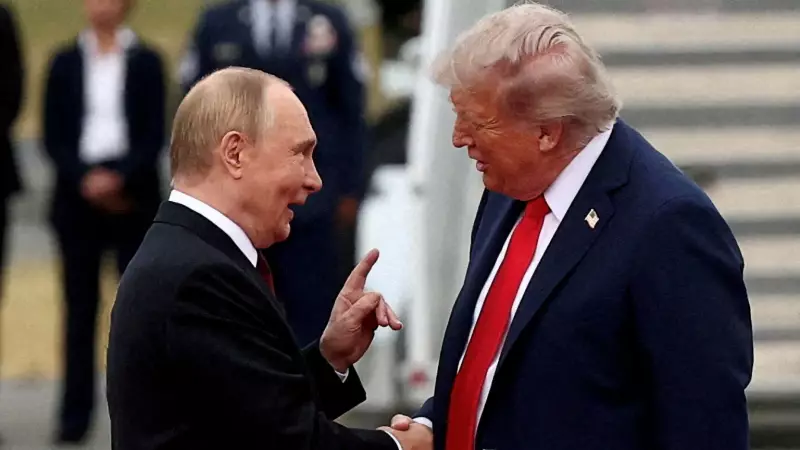
Trump Asserts Putin Accepts Invitation to Join Proposed Board of Peace for Gaza
U.S. President Donald Trump has made a significant announcement, claiming that Russian President Vladimir Putin has accepted an invitation to participate in his newly proposed Board of Peace for Gaza. This development emerged during Trump's remarks at the World Economic Forum in Davos, where he told reporters, "He was invited. He’s accepted," directly referencing Putin. The statement adds a new layer to international diplomatic efforts concerning the ongoing Israel–Hamas war.
Putin's Response and Russian Review Cast Doubt on Acceptance
However, the situation remains fluid as Putin did not publicly confirm this acceptance during a subsequent meeting of Russia's Security Council later the same day. Instead, the Russian leader indicated that Moscow would "consult with our strategic partners" while the Russian Foreign Ministry conducts a thorough review of the invitation details. This cautious approach introduces some uncertainty regarding Trump's claim, highlighting potential diplomatic complexities.
Board of Peace: Structure, Funding, and International Reactions
The Board of Peace represents a key component of Trump's broader 20-point plan aimed at resolving the Israel–Hamas conflict. Its proposed responsibilities include overseeing Gaza's political transition and reconstruction efforts. Reports suggest that dozens of countries from various regions, including Europe, the Americas, and the Middle East, have received invitations to join this initiative.
Internationally, the proposal has elicited mixed reactions. Critics argue that the Trump-chaired body, which reportedly requires a $1 billion payment to secure a permanent seat, could function as a parallel alternative to the United Nations—an institution Trump has frequently criticized. On January 21, Putin suggested a potential funding mechanism, stating that Russia might use frozen assets to cover the cost of a permanent seat. Specifically, he mentioned the possibility of directing $1 billion from Russian funds frozen by the United States under the previous administration, part of an estimated $5 billion blocked following Russia's full-scale invasion of Ukraine. Trump has not publicly commented on this apparent offer from Putin.
Broader Implications and Ukrainian Stance
According to U.S. officials, the board would temporarily assume responsibility for Gaza's administration and reconstruction. Discussions have also reportedly taken place about expanding the body's mandate to other conflict zones, including Ukraine. Ukrainian President Volodymyr Zelensky addressed this on January 20, noting that Kyiv is reviewing an invitation to join the Board of Peace but described it as "difficult to imagine" participating alongside Russia and Belarus. Zelensky emphasized, "Russia is our enemy, Belarus is their ally," underscoring the geopolitical tensions involved.
Although Trump had planned to meet Zelensky in Davos, the Ukrainian president ultimately cancelled his trip, choosing to remain in Ukraine amid ongoing Russian strikes on the country's energy infrastructure. This decision reflects the heightened security concerns and the complex dynamics at play in international diplomacy surrounding the proposed board.




