
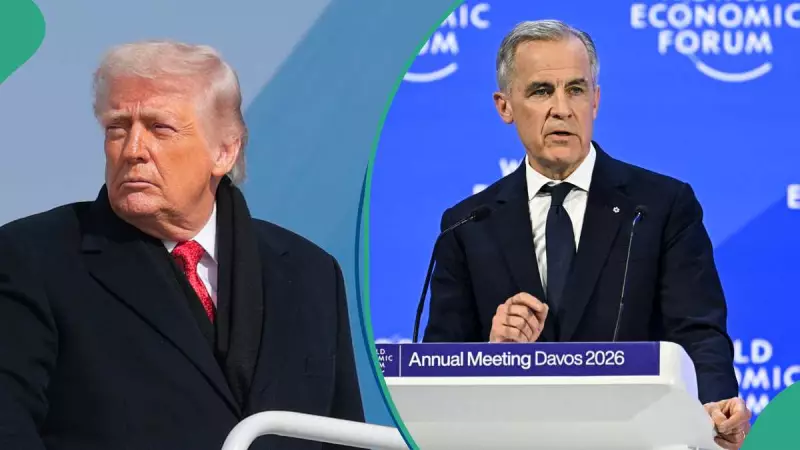
US President Trump Revokes Canada's Board of Peace Invitation Amid Diplomatic Tensions
In a significant diplomatic development, United States President Donald Trump has formally withdrawn Canada's invitation to participate in his newly established Board of Peace. This decision comes amid escalating tensions with Canadian Prime Minister Mark Carney, following a series of public exchanges and disagreements over the board's structure and financial requirements.
Trump's Social Media Announcement and Canada's Response
President Trump announced the withdrawal through a post on his Truth Social platform, directly addressing Prime Minister Carney. "Please let this Letter serve to represent that the Board of Peace is withdrawing its invitation to you regarding Canada's joining," he wrote. The announcement did not provide specific reasons for the reversal, but it followed Canada's indication that while it was willing in principle to join the board, it would not pay the proposed $1 billion membership fee for permanent members.
The Canadian Prime Minister's office has remained silent in response to Trump's announcement. Earlier, Carney had expressed openness to participation while highlighting Ottawa's reservations about the financial terms. The White House has clarified that permanent members are expected to contribute $1 billion to support the board's operational costs.
Background of the Board of Peace and International Concerns
The Board of Peace, promoted by the Trump administration as a fresh mechanism for resolving global conflicts, grants the US president extensive authority as chairman. Although initially associated with efforts to end the Israel-Hamas war in Gaza and oversee reconstruction, its draft charter does not specifically mention the Palestinian territory.
International concerns about the board's scope and governance have been mounting among US allies and European leaders. Approximately 60 countries have received invitations to participate, with around 35 agreeing to join, including nations such as:
- Argentina
- Egypt
- Turkey
- Qatar
- Saudi Arabia
- Pakistan
- Hungary
However, none of the other permanent members of the UN Security Council—China, France, Russia, and the United Kingdom—have committed to joining. France has stated that the charter is "incompatible" with its international obligations, particularly within the United Nations framework. The UK has expressed unease over the inclusion of Russian President Vladimir Putin, whose forces invaded Ukraine in 2022.
Davos Speeches and Escalating Diplomatic Rift
The diplomatic rift between Washington and Ottawa deepened following remarks by Prime Minister Carney at the World Economic Forum in Davos. Carney warned of a potential "rupture" in the US-led global order and urged middle powers to collaborate against economic coercion by larger states, without explicitly naming the United States.
A day later, President Trump responded sharply at the same forum, asserting that "Canada lives because of the United States." He added, "Remember that, Mark, the next time you make your statements." Carney countered this assertion while speaking in Quebec, stating, "Canada doesn't live because of the United States. Canada thrives because we are Canadians."
European Reservations and Future Prospects
European Council President Antonio Costa has voiced serious reservations about the Board of Peace, highlighting doubts regarding its scope, governance, and compatibility with the UN Charter. Following an EU summit in Brussels, Costa noted that while the bloc remains willing to cooperate with the United States on Gaza under a transitional framework, concerns persist about the board's structure.
Adding to the uncertainty, Spain has confirmed its decision to decline an invitation to join the Board of Peace. This move reflects broader skepticism among Western allies about the initiative's acceptance and future viability.
The withdrawal of Canada's invitation underscores the challenges facing President Trump's diplomatic efforts to establish the Board of Peace as a credible international organization. As tensions continue to simmer, the board's ability to attract widespread support from key global players remains in question.




