
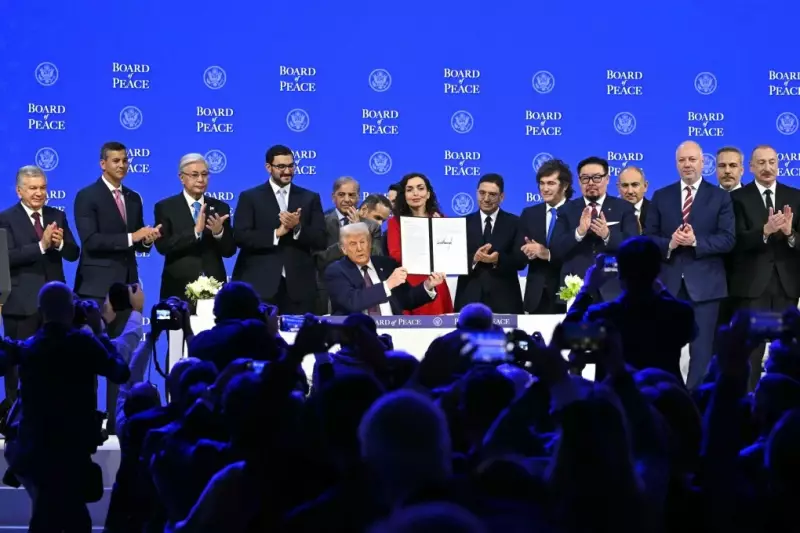
Trump Launches Board of Peace, Prompting Concerns Over UN Rivalry
U.S. President Donald Trump has officially inaugurated his Board of Peace, an initiative initially crafted to stabilize the fragile ceasefire in Gaza. However, Trump has indicated that the board could broaden its scope to address wider global challenges, a move that has sparked unease among some allies who fear it might undermine the established role of the United Nations.
Launch and Initial Mandate
Speaking at the launch event alongside the World Economic Forum in Davos, Trump emphasized that the board would operate in conjunction with the UN, asserting it was not intended to replace existing multilateral institutions. He praised the United Nations for its "great potential" that he believes has not been fully utilized, suggesting the new body could complement its efforts. Trump, who will chair the board, stated that once fully constituted, it would have a broad mandate to act on global issues beyond Gaza.
International Reactions and Participation
This ambitious expansion has unsettled several countries, particularly traditional U.S. allies, who worry the board's enhanced mandate could weaken the UN's position as the primary platform for global diplomacy and conflict resolution. So far, approximately 35 countries have committed to the initiative, including Israel, Saudi Arabia, Turkey, Argentina, and Indonesia. Russia has expressed interest in joining, while several Western powers have adopted a cautious stance. France has declined to participate, Britain has stated it is not joining for now, and China has yet to announce its position.
Funding and Governance Structure
Trump has stipulated that permanent members of the board must contribute $1 billion each. At the signing ceremony, no immediately visible representatives from major global powers were present. Russia's President Vladimir Putin mentioned that Moscow is studying the proposal and suggested that frozen Russian assets in the United States could be used to fund its contribution to support Palestinians.
Immediate Focus and Endorsements
U.S. Secretary of State Marco Rubio highlighted that the board's immediate focus would be ensuring the implementation of the Gaza peace plan, while also serving as a model for resolving conflicts elsewhere. The board's creation was endorsed by a UN Security Council resolution as part of Trump's Gaza plan, with the UN clarifying that its engagement would be limited to that framework.
Composition and Democratic Concerns
While some democracies have joined the initiative, many of the participating countries are not democratic. Supporters include leaders closely aligned with Trump's diplomatic approach. Board members also feature Rubio, U.S. Gaza negotiators Jared Kushner and Steve Witkoff, and former British Prime Minister Tony Blair.
Gaza Ceasefire and Future Challenges
Attention remains sharply focused on the fragile Gaza ceasefire. Kushner outlined that the next phase would center on funding reconstruction in the territory and addressing the disarmament of Hamas, which he described as a key obstacle to progress. He emphasized that the coming months would prioritize humanitarian aid while creating conditions for longer-term stability.
Progress and Ongoing Tensions
There have been signs of limited progress, with Palestinian officials indicating that the Rafah border crossing with Egypt is expected to reopen next week. However, the ceasefire agreed upon in October has been repeatedly strained, with Israel and Hamas accusing each other of violations, including disputes over hostages, aid access, and continued violence.
Regional Involvement and Long-term Issues
Israeli Prime Minister Benjamin Netanyahu has accepted an invitation to join the board, while Palestinian factions have endorsed the peace plan and backed a transitional Palestinian committee to administer Gaza under the board's oversight. Even if the current truce holds, future negotiations will need to tackle long-standing issues such as Hamas disarmament, security arrangements in Gaza, and an eventual Israeli withdrawal.




