
US Lawmakers Link Chinese Illegal Mining to Terrorism Funding in Nigeria
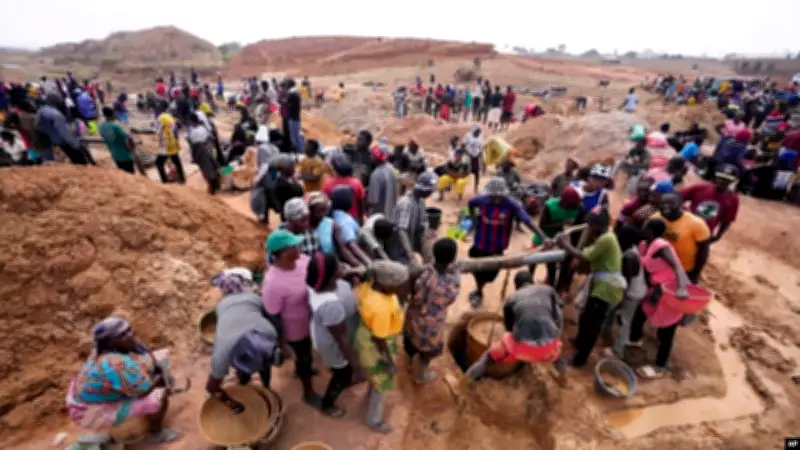
Five Republican lawmakers in the United States have made serious allegations that Chinese nationals engaged in illegal mining operations in Nigeria are providing financial support to terrorist organizations by paying protection money. These claims form a central part of the arguments presented in a newly proposed bill currently before the United States Congress.
The Nigeria Religious Freedom and Accountability Act of 2026
The lawmakers—Riley Moore of West Virginia, Chris Smith of New Jersey, Bill Huizenga of Michigan, Brian Mast of Florida, and Mario Diaz-Balart of Florida—included these allegations in the proposed Nigeria Religious Freedom and Accountability Act of 2026. According to a statement published on Representative Chris Smith's official website, the legislation is expected to advance rapidly through the House of Representatives and garner broad bipartisan support.
Chris Smith, who chairs the House Foreign Affairs Subcommittee on Africa, explained that the bill would mandate the US Secretary of State to compile and submit to Congress a comprehensive report detailing American efforts to address religious persecution and violence in Nigeria. A copy of the bill reviewed by journalists states that "systemic religious persecution," including mass killings, kidnappings, rape, village destruction, and forced displacement, has persisted in Nigeria since 2009.
Attribution to Extremist Groups
The lawmakers attribute these violent acts to several extremist organizations operating within Nigeria, including Boko Haram, the Islamic State West Africa Province (ISWAP), Fulani militant groups, and other terrorist factions. The legislation claims that between 50,000 and 125,000 Christians were killed between 2009 and 2025, with numerous churches attacked or destroyed during the same period.
The bill explicitly states: "The acts carried out by these militias are intended to intimidate, coerce, and displace civilian populations, disrupt local governance, and assert control over territory." It further asserts that such actions meet the legal criteria for designation as a Foreign Terrorist Organization under United States law.
Separate Legislation and Chinese Involvement
This proposed bill is distinct from another piece of legislation sponsored by Representatives Moore and Smith, which seeks to designate former Kano governor Rabiu Kwankwaso and two Nigerian herder groups as terrorist entities. In the new Nigeria Religious Freedom and Accountability Act, the five lawmakers argue that the US Secretary of State should collaborate with the Nigerian government to counter what they describe as "hostile foreign exploitation" linked to Chinese illegal mining operations.
The legislation specifically highlights the alleged practice of Chinese miners paying protection money to Fulani militias. Neither the Chinese government nor its embassy in Nigeria has issued any official response to these serious allegations at this time.
Previous Reports and Investigations
Previous investigative reports have made similar claims regarding Chinese mining activities in Nigeria. A study conducted by SBM Intelligence, a Lagos-based research and strategic intelligence firm, alleged that certain Chinese companies have bribed armed groups to gain access to mining sites. The findings, which were shared with a British newspaper, included videos in which militant leaders reportedly boasted that Chinese miners operating within their territories paid what they referred to as "rent."
Separately, an investigation by WikkiTimes, a Bauchi-based publication, reported that Chinese-affiliated miners allegedly engaged with members of a terror faction led by Dogo Gide to secure access to mining locations in Shiroro Local Government Area of Niger State. An audio clip cited in the report purportedly captured discussions about negotiations between the parties before mining operations commenced.
Heightened Diplomatic Tensions
The introduction of this bill occurs amid significantly heightened diplomatic tensions between the United States and Nigeria over allegations of religious persecution. Over the past year, several US lawmakers have accused Nigeria of tolerating what they describe as a campaign of Christian genocide—a claim the Nigerian government has repeatedly and vehemently denied. Abuja maintains that terrorist violence affects Nigerians of all religious backgrounds indiscriminately.
President Donald Trump recently redesignated Nigeria as a "Country of Particular Concern," a move that has raised concerns about potential sanctions or other punitive measures. Tensions escalated further following US airstrikes carried out on December 25, 2025, which President Trump stated targeted Islamic State camps in Nigeria's North-west region. Debris from these strikes was reportedly found in Sokoto, Kwara, and Niger states, with some observers questioning whether all missiles accurately hit their intended targets.
The Nigerian government confirmed that it consented to the airstrikes and described them as part of an ongoing bilateral security partnership conducted with full respect for Nigeria's sovereignty and territorial integrity.
US Military Presence in Nigeria
Reports have also indicated that the United States has deployed a small team of military personnel to Nigeria, with plans to send an additional 200 troops in the near future. Domestic concerns have been raised regarding the presence of foreign troops on Nigerian soil. However, Nigeria's Defence Headquarters has clarified that the US personnel will focus exclusively on training and tactical support missions rather than engaging in direct combat operations.




