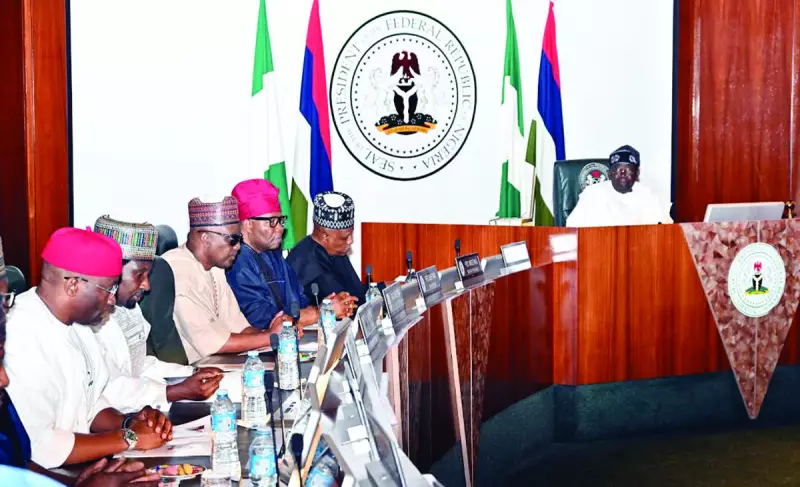
The Federal Executive Council (FEC) has given its official stamp of approval to Nigeria's proposed spending plan for the 2026 fiscal year. In a special session held on Thursday, December 19, 2025, at the Presidential Villa, the council cleared the N58.47 trillion draft appropriation bill for transmission to the National Assembly.
Key Fiscal Adjustments and Budget Highlights
Following the meeting, the Minister of Information and National Orientation, Mohammed Idris, alongside the Minister of Budget and Economic Planning, Senator Abubakar Atiku Bagudu, briefed State House correspondents. Senator Bagudu revealed that the council also endorsed crucial amendments to the Medium-Term Expenditure Framework (MTEF).
A significant change is the proposed adjustment of the official benchmark exchange rate from N1,512 to N1,400 per US dollar. This revision directly impacts the overall size of the budget. The Director-General of the Budget Office, Tanimu Yakubu, provided a detailed breakdown, noting that the N58.47 trillion total represents a 6% increase over the 2025 budget estimates.
The massive expenditure figure comprises several major components:
- N4.98 trillion for Government-Owned Enterprises (GOEs).
- N1.37 trillion allocated for grants and donor-funded projects.
- N4.1 trillion in statutory transfers.
- A substantial N15.52 trillion for debt service, which includes N318.85 billion for a sinking fund to manage maturing domestic bonds.
- Personnel costs and pensions, pegged at N10.75 trillion (about 7% higher than 2025).
- Overhead costs of N2.22 trillion.
Capital Expenditure and Revenue Strategy
Capital expenditure for the 2026 fiscal year is set at N25.68 trillion. This marks a deliberate 1.8% reduction from the previous year's allocation. According to Yakubu, this cautious approach prioritises the completion of ongoing projects and ensures value for money. Major capital allocations include N11.3 trillion for Ministries, Departments and Agencies (MDAs), N2.052 trillion for multilateral and bilateral project-tied loans, and N1.8 trillion from the development levy capital component.
The budget framework signals a notable structural shift in Nigeria's revenue base. The government now projects that non-oil revenue will account for roughly two-thirds of total receipts, moving the economy further away from its traditional dependence on crude oil. Corporate taxes, Value Added Tax (VAT), customs duties, and independent revenues are identified as the primary fiscal anchors.
Fiscal Discipline and Economic Priorities
Yakubu emphasised that the 2026 budget is crafted to maintain a balance between macroeconomic stabilisation and development needs under the government's Renewed Hope Agenda. He stated that conservative assumptions were applied to key variables like oil price, exchange rate, and dividends from GOEs.
The Director-General explained that the main pressures on expenditure are not from discretionary spending but from mandatory outlays like debt servicing, wages, and pensions. He described the wider fiscal deficit as a reflection of "legacy rigidities rather than policy loosening." To finance this deficit, the government plans to rely predominantly on domestic borrowing, supplemented by concessional loans from multilateral institutions.
With the FEC's approval secured, the stage is now set for President Bola Tinubu to formally present the N58.47 trillion 2026 budget proposal to the National Assembly for legislative scrutiny and passage.