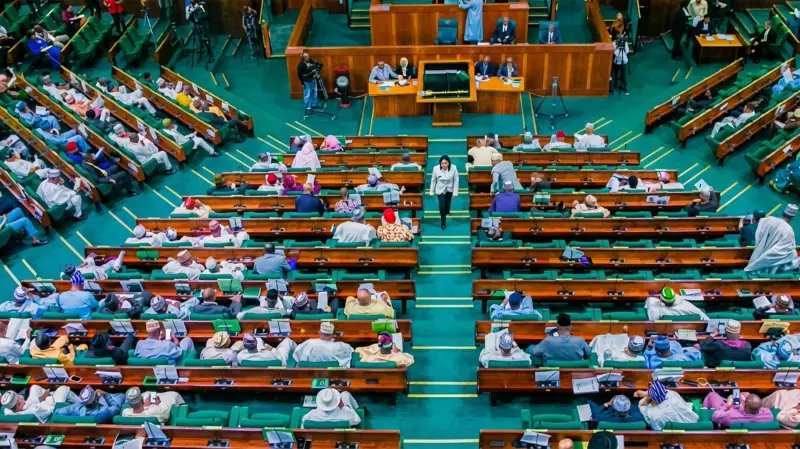
The Nigerian House of Representatives has set the stage for a potential legislative dialogue with the Senate after adopting a higher crude oil price benchmark for the 2026 fiscal year. The decision, taken on Thursday, December 18, 2025, sees the lower chamber endorsing the Federal Government's proposed benchmark of $64.85 per barrel, a figure that contrasts with the upper chamber's more conservative stance.
A Legislative Disagreement on Fiscal Assumptions
This divergence emerged during the consideration of the crucial 2026–2028 Medium Term Expenditure Framework and Fiscal Strategy Paper (MTEF/FSP). While the House backed the executive's proposal, the Senate had earlier, on Tuesday, reviewed the 2026 benchmark downward to $60 per barrel. Senator Sani Musa (APC, Niger East), Chairman of the Senate Committee on Finance, justified the Senate's cautious adjustment by citing global economic uncertainties, geopolitical tensions in Europe and the Middle East, and volatility in the oil market.
The House's position was solidified after its committees on Finance, National Planning and Economic Development presented and defended a report. This report endorsed the Federal Government's oil price assumptions of $64.85 for 2026, $64.30 for 2027, and $65.50 for 2028. The Senate's projections, however, are $60 for 2026, rising to $65 for 2027 and $70 for 2028.
Unified Production and Macroeconomic Projections
Despite the disagreement on price, both chambers found common ground on several other key parameters within the MTEF/FSP. They harmonised on crude oil production volumes, retaining identical projections:
- 1.84 million barrels per day (mbpd) for 2026
- 1.88 mbpd for 2027
- 1.92 mbpd for 2028
The lawmakers also approved a series of coordinated macroeconomic assumptions aimed at stabilising the economy. The exchange rate projections, aligned with Central Bank of Nigeria (CBN) policies, are set at N1,512 per US dollar in 2026, N1,432.15 in 2027, and N1,383.18 in 2028.
On inflation, the House endorsed targets of 16.5% for 2026, 13% for 2027, and 9% for 2028, reflecting confidence in the monetary authorities' ability to moderate pressures. Economic growth projections remain optimistic, with real GDP growth sustained at 4.68% in 2026, 5.96% in 2027, and 7.9% in 2028.
Budget Framework and Fiscal Recommendations
The House sustained the broad 2026 Federal Government budget framework, which includes a proposed total expenditure of N54.46 trillion. Key components of this fiscal plan include:
- Retained Revenue of N31.83 trillion
- New Borrowings (Domestic & Foreign) of N20.38 trillion
- Debt Servicing estimated at N15.52 trillion
- A Fiscal Deficit of N22.63 trillion
- Capital Expenditure (exclusive of transfers) of N20.131 trillion
Furthermore, the House strongly emphasised the role of tax reforms in driving future growth. It recommended the effective implementation of the newly enacted Tax Acts as fundamental instruments for economic transformation. To bolster revenue collection, the lawmakers urged the Federal Government to implement a National Scanning Policy within the Nigeria Revenue Service's National Single Window. This move is aimed at enhancing revenue assurance, improving trade facilitation, and curbing financial leakages.
This legislative activity sets a critical backdrop for the upcoming budget presentation by President Bola Tinubu, scheduled for Friday. The differing oil benchmarks between the two chambers will necessitate a harmonisation process to produce a unified MTEF/FSP document, a key step before the detailed appropriation bill is passed into law.